Mimura Ririko, Mori Kiwako, Torii Hidemasa, Nagai Norihiro, Suzuki Misa, Minami Sakiko, Ozawa Yoko, Kurihara Toshihide, Tsubota Kazuo
Department of Ophthalmology, Ichikawa General Hospital, Tokyo Dental College, 5-11-13, Sugano, Ichikawa, Chiba 272-8513, Japan.
Department of Ophthalmology, Keio University School of Medicine, 35 Shinanomachi, Shinjuku-ku, Tokyo 160-8582, Japan.
J Clin Med. 2019 Sep 20;8(10):1505. doi: 10.3390/jcm8101505.
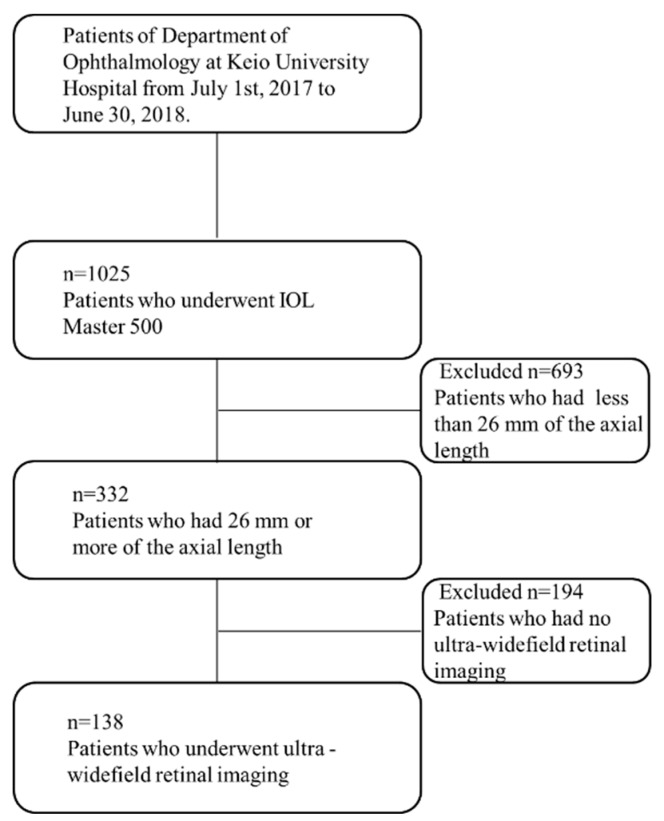
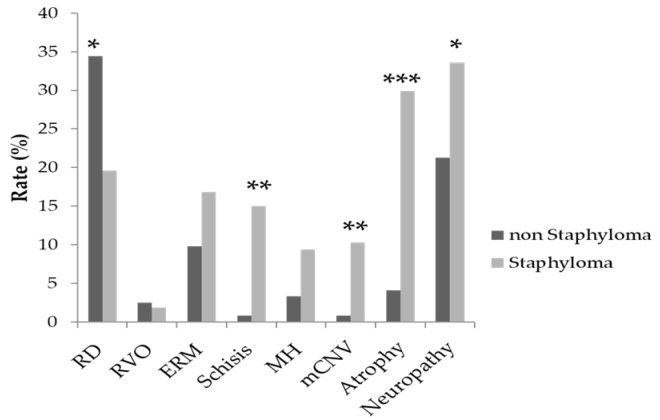
High myopia may develop to pathologic myopia, which brings severe visual impairment; however, the etiology is not fully understood. We, therefore, investigated the relationship between the presence of posterior staphyloma and posterior ocular disorders by assessing the patients with high myopia. A retrospective study was performed for the patients, who have more than 26 mm of the axial length and of whom fundus photography was taken with an ultra-widefield retinal imaging system. The objectives were 138 cases encompassing 229 eyes. In 138 cases, 91 were bilateral and 47 were unilateral. The averages ± SD of axial length of bilateral and unilateral were 28.8 ± 2.2 mm, 27.3 ± 1.2 mm, respectively, showing statistically significant difference. The number of eyes with and without posterior staphyloma were 107 (46.7%) and 122 (53.3%), respectively. Retinal detachment and retinal breaks are more observed in cases without posterior staphyloma ( = 0.017). Myopic choroidal neovascularization (mCNV) ( = 0.002), chorioretinal atrophy ( < 0.001), retinoschisis ( < 0.001), and optic neuropathy ( = 0.038) are more often seen in cases with posterior staphyloma. In conclusion, the prevalence rates of myopic choroidal neovascularization, retinal choroidal atrophy, and optic neuropathy were significantly higher with posterior staphyloma. The rate of periocular disorders such as retinal detachment was significantly higher without posterior staphyloma. These results indicate associations between types of pathological myopia and presence or absence of posterior staphyloma analyzed by ultra-widefield retinal imaging.
高度近视可能发展为病理性近视,从而导致严重的视力损害;然而,其病因尚未完全明确。因此,我们通过评估高度近视患者来研究后巩膜葡萄肿与后部眼部疾病之间的关系。对眼轴长度超过26mm且使用超广角视网膜成像系统进行眼底摄影的患者进行了一项回顾性研究。研究对象为138例患者,共229只眼。在138例患者中,91例为双眼,47例为单眼。双眼和单眼的眼轴长度平均值±标准差分别为28.8±2.2mm、27.3±1.2mm,差异具有统计学意义。有后巩膜葡萄肿和无后巩膜葡萄肿的眼数分别为107只(46.7%)和122只(53.3%)。视网膜脱离和视网膜裂孔在无后巩膜葡萄肿的病例中更为常见(P = 0.017)。近视性脉络膜新生血管(mCNV)(P = 0.002)、脉络膜视网膜萎缩(P < 0.001)、视网膜劈裂(P < 0.001)和视神经病变(P = 0.038)在有后巩膜葡萄肿的病例中更常出现。总之,后巩膜葡萄肿患者近视性脉络膜新生血管、视网膜脉络膜萎缩和视神经病变的患病率显著更高。无后巩膜葡萄肿时,视网膜脱离等眼周疾病的发生率显著更高。这些结果表明,通过超广角视网膜成像分析,病理性近视的类型与后巩膜葡萄肿的有无之间存在关联。