Agga Getahun E, Raboisson Didier, Walch Ludovic, Alemayehu Fitsum, Semu Dawit T, Bahiru Getahun, Woube Yilkal A, Belihu Kelay, Tekola Berhe G, Bekana Merga, Roger François L, Waret-Szkuta Agnès
Food Animal Environmental Systems Research Unit, Agricultural Research Service, United States Department of Agriculture, Bowling Green, KY, United States.
IHAP, INRA, ENVT, Université de Toulouse, Toulouse, France.
Front Vet Sci. 2019 Sep 12;6:302. doi: 10.3389/fvets.2019.00302. eCollection 2019.
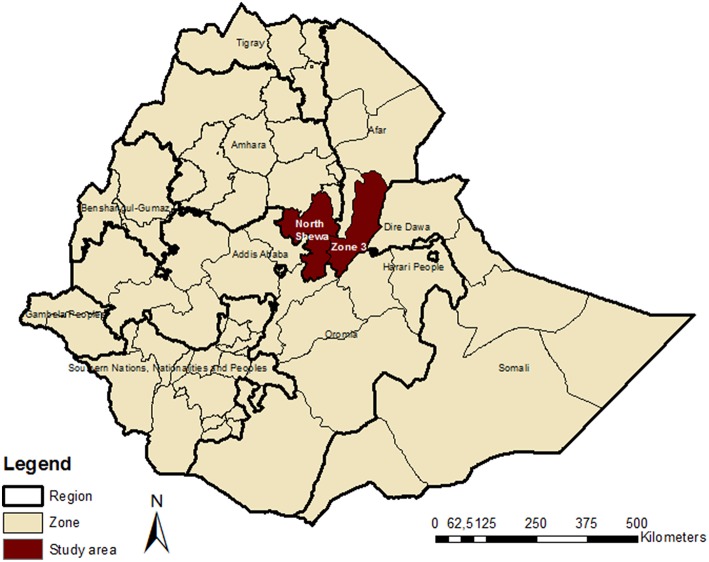
Peste des petits ruminants (PPR) is a highly contagious viral disease of small ruminants; it emerged in countries previously free of the disease following the eradication of rinderpest. PPR is classified by international organizations as the next priority animal disease for global eradication campaign. Assessment of the local situations is the first step in the eradication efforts. The objective of this study was to investigate and compare the seroprevalence of PPR in cattle, sheep, and goats under two livestock production systems in Ethiopia: North Shewa zone of Amhara region represents a highland sedentary life style characterized by mixed livestock-crop production system; Zone Three of Afar region represents a lowland nomadic life style characterized by pastoral livestock production system. N-competitive ELISA PPR test was performed on sera from 2,993 animals ≥6 months old sampled at watering and grazing points. Multivariable logistic regression models comparing the seropositivity between the two production systems were built by classifying doubtful results as positive, negative, or excluding them from the data. The odds ratio (OR) comparing overall PPR seroprevalence in the sedentary North Shewa Zone compared to the nomadic Zone Three ranged from 19 to 27 ( < 0.001), depending on how doubtful results were classified, which contrasts with what has been reported in the literature. This is not likely to be related solely to vaccination, since seroprevalences in cattle and small ruminants were similarly high or low in the respective zones (0-4% for Zone Three and 20-40% for North Shewa Zone), and cattle were not likely to be vaccinated. The OR of seropositivity for goats compared to cattle ranged from 1.9 [95% confidence interval (CI): 1.3-2.7; < 0.001] to 2.2 (95% CI: 1.5-3.1; < 0.001) when doubtful results were excluded or classified as negative, respectively. When doubtful results were classified as positive, association between seropositivity and animal species was not significant ( > 0.05). Our results suggest to further investigate cattle as sentinel animals for PPR surveillance.
小反刍兽疫(PPR)是小反刍动物的一种高度传染性病毒性疾病;在牛瘟根除后,该病在以前无此病的国家出现。国际组织将PPR列为全球根除运动的下一个优先动物疾病。评估当地情况是根除工作的第一步。本研究的目的是调查和比较埃塞俄比亚两种畜牧生产系统下牛、绵羊和山羊的PPR血清阳性率:阿姆哈拉地区的北谢瓦区代表以农牧混合生产系统为特征的高原定居生活方式;阿法尔地区的三区代表以游牧畜牧生产系统为特征的低原定居生活方式。对在饮水点和放牧点采集的2993只6个月及以上龄动物的血清进行了N竞争ELISA PPR检测。通过将可疑结果分类为阳性、阴性或从数据中排除,建立了比较两种生产系统之间血清阳性率的多变量逻辑回归模型。与游牧的三区相比,定居的北谢瓦区总体PPR血清阳性率的优势比(OR)在19至27之间(<0.001),这取决于可疑结果的分类方式,这与文献报道的情况形成对比。这不太可能仅与疫苗接种有关,因为在各自区域,牛和小反刍动物的血清阳性率同样高或低(三区为0-4%,北谢瓦区为20-40%),而且牛不太可能接种疫苗。当排除或分别将可疑结果分类为阴性时,山羊血清阳性的OR值在1.9 [95%置信区间(CI):1.3-2.7;<0.001]至2.2(95%CI:1.5-3.1;<0.001)之间。当将可疑结果分类为阳性时,血清阳性与动物种类之间的关联不显著(>0.05)。我们的结果表明,需进一步研究将牛作为PPR监测的哨兵动物。