Department of Neuroscience, Yale University, New Haven CT 06520, United States; Kavli Institute for Neuroscience, Yale University, New Haven, CT 06520, United States.
Curr Opin Neurobiol. 2019 Oct;58:175-180. doi: 10.1016/j.conb.2019.09.008. Epub 2019 Oct 1.
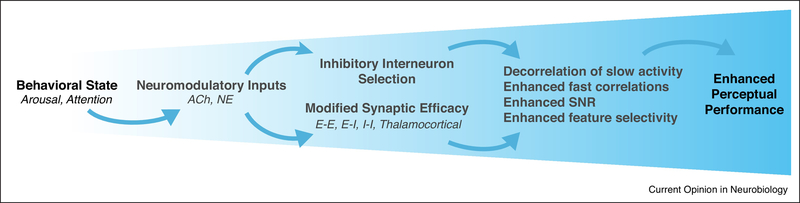
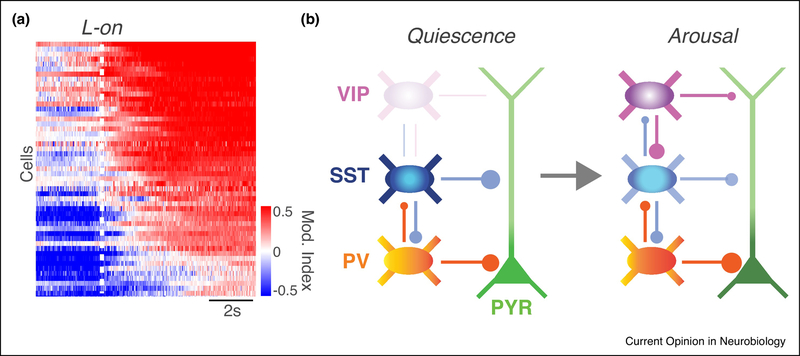
Cortical networks receive a highly variable stream of inputs from internal and external influences, and must flexibly adapt their operations on a short timescale. Recent work has highlighted this state-dependent functional flexibility of cortical circuits and provided initial insights into underlying circuit-level mechanisms. Transitions from quiescent to aroused or task-engaged behavioral states are associated with common motifs of network activity, including changes in correlations and enhanced sensory encoding. Evidence points to a key role for selective activation of specific GABAergic interneuron populations in mediating mode-switching in cortical networks. Finally, inhibitory interneurons may function as a critical target for convergent state-dependent neuromodulatory sculpting of cortical circuits.
皮质网络从内部和外部影响接收高度可变的输入流,并且必须在短时间尺度上灵活地适应其操作。最近的工作强调了皮质电路的这种状态相关的功能灵活性,并为潜在的电路级机制提供了初步的见解。从静止到唤醒或任务参与的行为状态的转变与网络活动的共同模式相关联,包括相关性的变化和增强的感官编码。有证据表明,选择性激活特定的 GABA 能中间神经元群体在介导皮质网络的模式转换中起着关键作用。最后,抑制性中间神经元可能作为会聚状态依赖的神经调质对皮质回路进行塑形的关键目标。