School of Psychology, University of Wollongong, Building 41, Northfields Ave, Wollongong, NSW, 2522, Australia.
Wollongong Antimicrobial Resistance Research Alliance (WARRA), Wollongong, New South Wales, Australia.
BMC Public Health. 2019 Oct 30;19(1):1425. doi: 10.1186/s12889-019-7796-8.
Antimicrobial resistance is a global public health concern, with extensive associated health and economic implications. Actions to slow and contain the development of resistance are imperative. Despite the fact that overuse and misuse of antibiotics are highlighted as major contributing factors to this resistance, no sufficiently validated measures aiming to investigate the drivers behind consumer behaviour amongst the general population are available. The objective of this study was to develop and investigate the psychometric properties of an original, novel and multiple-item questionnaire, informed by the Theory of Planned Behaviour, to measure factors contributing to self-reported antibiotic use within the community.
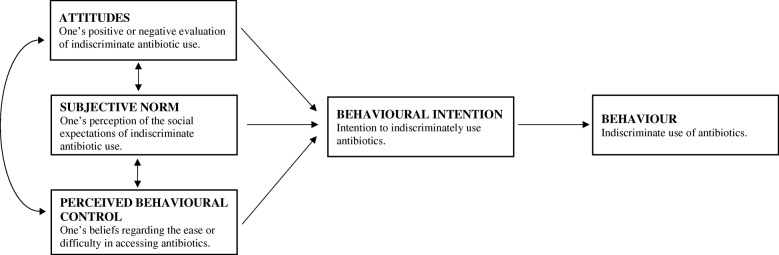
A three-phase process was employed, including literature review and item generation; expert panel review; and pre-test. Investigation of the questionnaire was subsequently conducted through a cross-sectional, anonymous survey. Orthogonal principal analysis with varimax rotation, cronbach alpha and linear mixed-effects modelling analyses were conducted. A 60 item questionnaire was produced encompassing demographics, social desirability, three constructs of the Theory of Planned Behaviour including: attitudes and beliefs; subjective norm; perceived behavioural control; behaviour; and a covariate - knowledge.
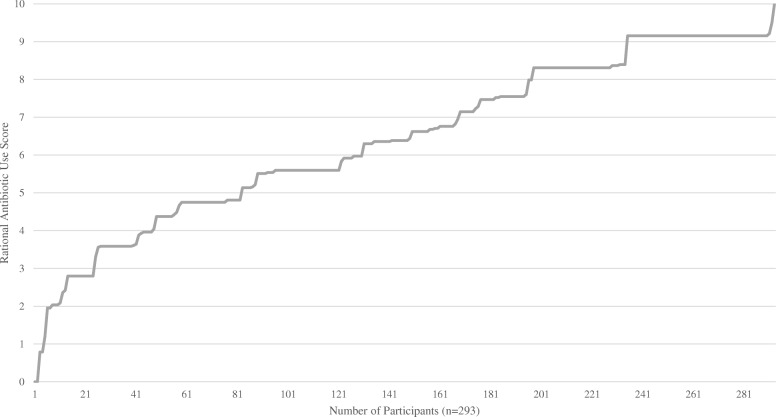
Three hundred seventy-three participants completed the survey. Eighty participants (21%) were excluded due to social desirability concerns, with data from the remaining 293 participants analysed. Results showed modest but acceptable levels of internal reliability, with high inter-item correlations within each construct. All four variables and the outcome variable of antibiotic use behaviour comprised four items with the exception of social norms, for which there were two items, producing a final 18 item questionnaire. Perceived behavioural control, social norms, the interaction between attitudes and beliefs and knowledge, and the presence of a healthcare worker in the family were all significant predictors of antibiotic use behaviour. All other predictors tested produced a nonsignificant relationship with the outcome variable of self-reported antibiotic use.
This study successfully developed and validated a novel tool which assesses factors influencing community antibiotic use and misuse. The questionnaire can be used to guide appropriate intervention strategies to reduce antibiotic misuse in the general population. Future research is required to assess the extent to which this tool can guide community-based intervention strategies.
抗菌药物耐药性是一个全球性的公共卫生问题,对健康和经济都有广泛影响。采取行动减缓并遏制耐药性的发展是当务之急。尽管过度使用和滥用抗生素是导致这种耐药性的主要因素之一,但目前尚无足够有效的措施来调查普通人群中消费者行为的驱动因素。本研究的目的是开发并研究一种基于计划行为理论的原创、新颖的多项目问卷的心理测量特性,以衡量社区内自我报告抗生素使用的因素。
采用三阶段过程,包括文献回顾和项目生成;专家小组审查;和预测试。随后通过横断面、匿名调查对问卷进行了调查。采用正交主成分分析、方差极大旋转、克朗巴赫阿尔法和线性混合效应模型分析。制作了一个包含人口统计学、社会期望、计划行为理论的三个构念(包括态度和信念;主观规范;感知行为控制)、行为和协变量(知识)的 60 个项目的问卷。
373 名参与者完成了调查。由于社会期望问题,有 80 名参与者(21%)被排除在外,对其余 293 名参与者的数据进行了分析。结果表明,内部可靠性虽然适度但可以接受,每个构念的内部项目之间具有高度相关性。除了社会规范,每个构念和抗生素使用行为的结果变量都由四个项目组成,社会规范有两个项目,最终产生了一个包含 18 个项目的问卷。感知行为控制、社会规范、态度和信念之间的相互作用以及知识的存在、以及家庭中是否有医疗保健工作者,都是抗生素使用行为的重要预测因素。所有其他测试的预测因素与自我报告的抗生素使用结果变量之间都没有显著关系。
本研究成功开发并验证了一种新的工具,用于评估影响社区抗生素使用和滥用的因素。该问卷可用于指导适当的干预策略,以减少普通人群中的抗生素滥用。需要进一步的研究来评估该工具在多大程度上可以指导基于社区的干预策略。