Department of Education and Psychology, Freie Universität Berlin, Berlin, Germany.
Center for Cognitive Neuroscience Berlin, Freie Universität Berlin, Berlin, Germany.
Soc Cogn Affect Neurosci. 2019 Oct 1;14(10):1109-1118. doi: 10.1093/scan/nsz078.
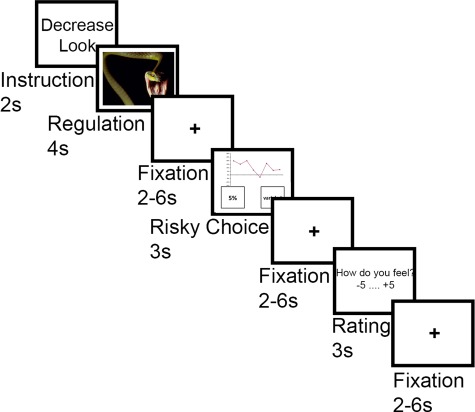
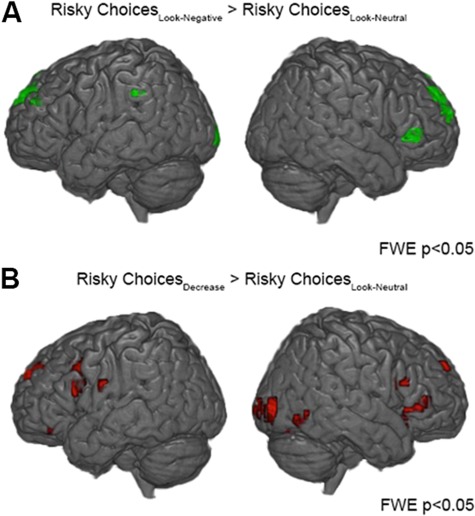
Emotion regulation impacts the expected emotional responses to the outcomes of risky decisions via activation of cognitive control strategies. However, whether the regulation of emotional responses to preceding, incidental stimuli also impacts risk-taking in subsequent decisions is still poorly understood. In this study, we investigated the interplay between the regulation of incidentally induced emotional responses and subsequent choice behavior using a risky decision-making task in two independent samples (behavioral and functional magnetic resonance imaging experiment). We found that overall, emotion regulation was followed by less risky decisions, which was further reflected in an increase in activation in brain regions in dorsolateral and ventrolateral prefrontal cortex and cingulate cortex. These findings suggest that altering incidental emotions using reappraisal strategies impacts on subsequent risk-taking in decision-making.
情绪调节通过激活认知控制策略,影响对风险决策结果的预期情绪反应。然而,对于先前偶然出现的刺激的情绪反应的调节是否也会影响后续决策中的冒险行为,目前仍知之甚少。在这项研究中,我们使用风险决策任务在两个独立的样本(行为和功能性磁共振成像实验)中研究了偶然诱导的情绪反应的调节与后续选择行为之间的相互作用。我们发现,总的来说,情绪调节后做出的风险决策较少,这进一步反映在背外侧和腹外侧前额叶皮层和扣带皮层的脑区激活增加。这些发现表明,使用重评策略改变偶然情绪会影响后续决策中的冒险行为。