Santos Marcos Ferreira, Alexandre-Pires Graça, Pereira Maria A, Marques Cátia S, Gomes Joana, Correia Jorge, Duarte Ana, Gomes Lídia, Rodrigues Armanda V, Basso Alexandra, Reisinho Ana, Meireles José, Santos-Mateus David, Brito Maria Teresa Villa, Tavares Luís, Santos-Gomes Gabriela M, da Fonseca Isabel Pereira
Faculdade de Medicina Veterinária, CIISA-Centro de Investigação Interdisciplinar em Sanidade Animal, Universidade de Lisboa, Lisboa, Portugal.
GHTM-Global Health and Tropical Medicine, Instituto de Higiene e Medicina Tropical (IHMT), Universidade Nova de Lisbon (UNL), Lisbon, Portugal.
Front Vet Sci. 2019 Oct 18;6:362. doi: 10.3389/fvets.2019.00362. eCollection 2019.
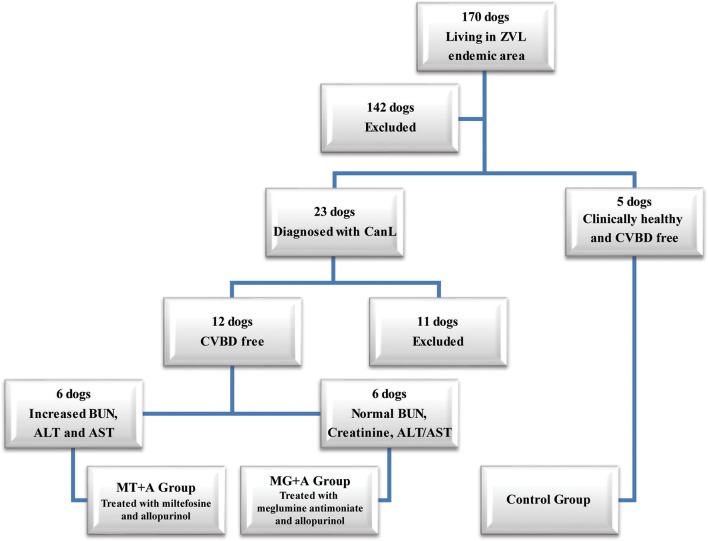
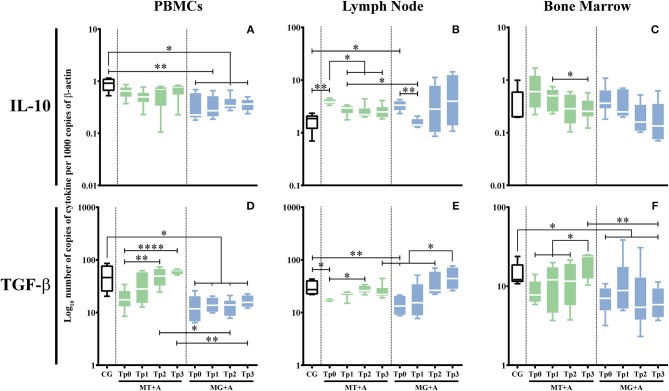
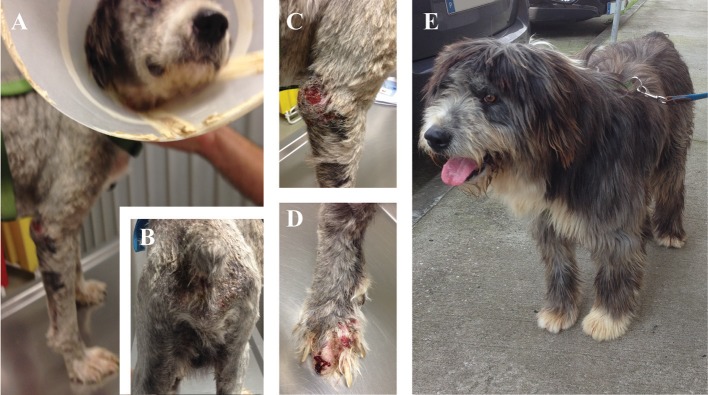
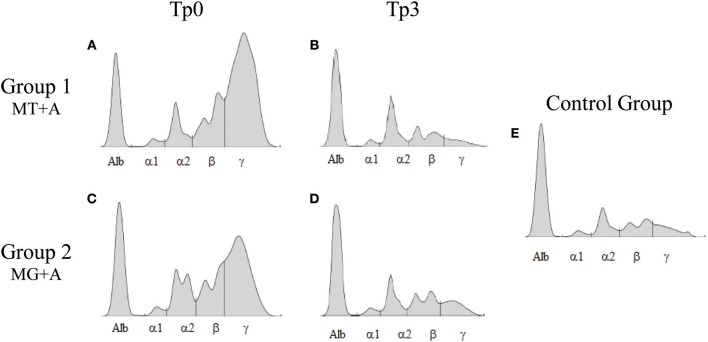
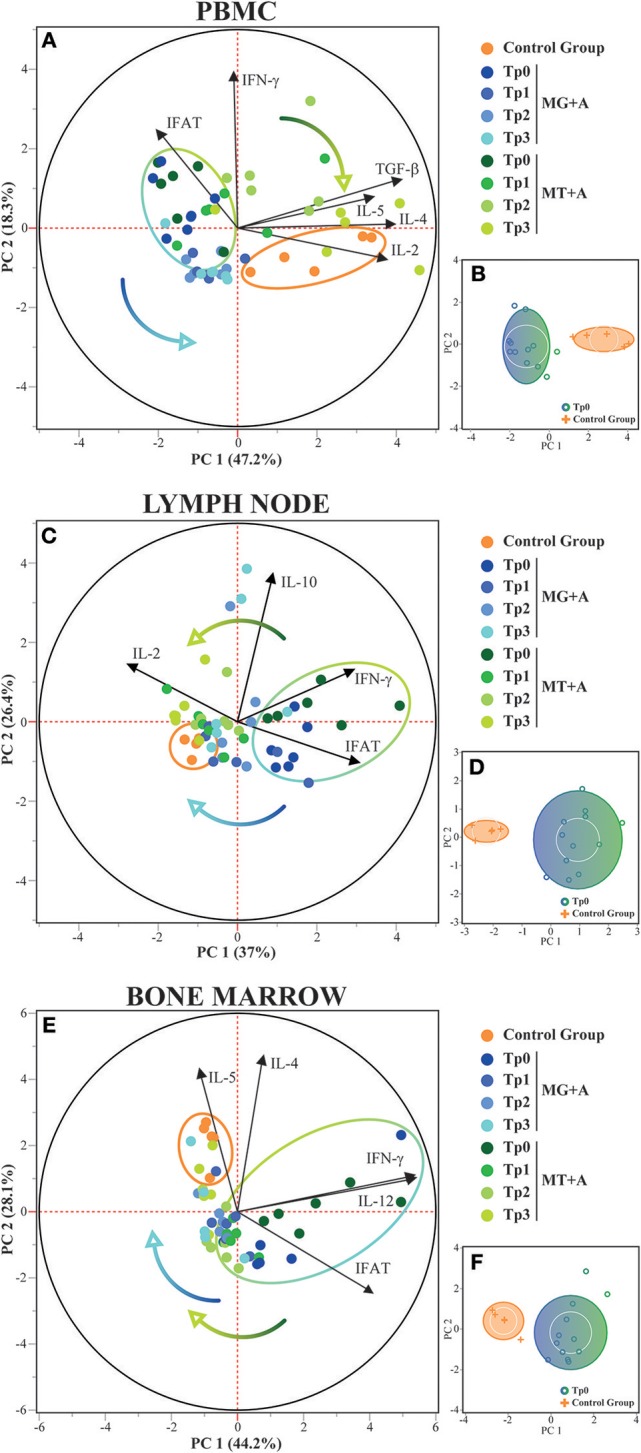
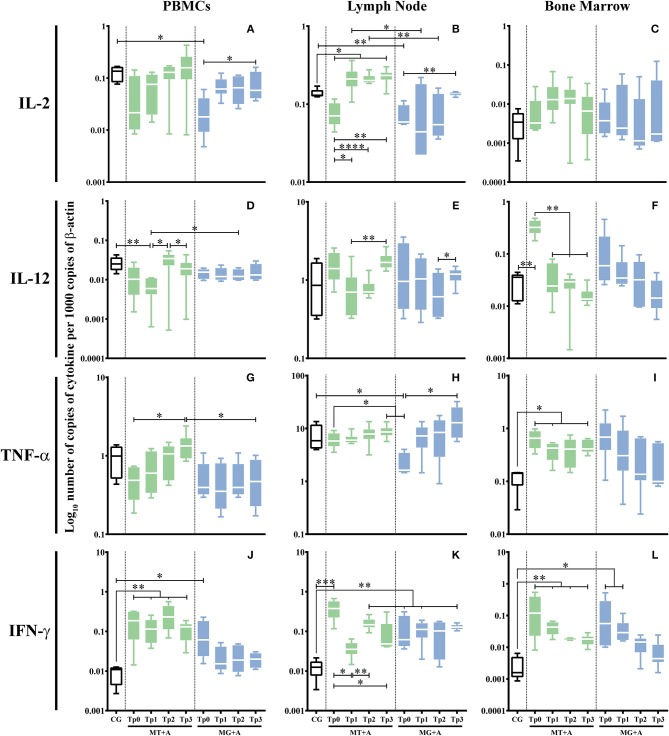
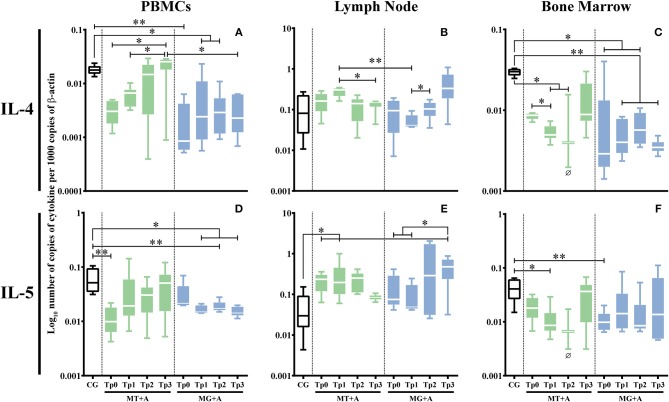
Canine leishmaniosis (CanL) caused by is a zoonotic disease of global concern. Antileishmanial drug therapies commonly used to treat sick dogs improve their clinical condition, although when discontinued relapses can occur. Thus, the current study aims to evaluate the effect of CanL treatments in peripheral blood, lymph node, and bone marrow cytokine profile associated with clinical recovery. Two groups of six dogs diagnosed with CanL were treated with miltefosine combined with allopurinol and meglumine antimoniate combined with allopurinol (MT+A and MG+A), respectively. At diagnosis and after treatment, during a 3-month follow-up, clinical signs, hematological and biochemical parameters, urinalysis results and antileishmanial antibody titers were registered. Furthermore, peripheral blood, popliteal lymph node, and bone marrow samples were collected to assess the gene expression of IL-2, IL-4, IL-5, IL-10, IL-12, TNF-α, TGF-β, and IFN-γ by qPCR. In parallel, were also evaluated samples obtained from five healthy dogs. Both treatment protocols promoted the remission of clinical signs as well as normalization of hematological and biochemical parameters and urinalysis values. Antileishmanial antibodies returned to non-significant titers in all dogs. Sick dogs showed a generalized upregulation of IFN-γ and downregulation of IL-2, IL-4, and TGF-β, while gene expression of IL-12, TNF-α, IL-5, and IL-10 varied between groups and according to evaluated tissue. A trend to the normalization of cytokine gene expression was induced by both miltefosine and meglumine antimoniate combined therapies. However, IFN-γ gene expression was still up-regulated in the three evaluated tissues. Furthermore, the effect of treatment in the gene expression of cytokines that were not significantly changed by infection, indicates that miltefosine and meglumine antimoniate combined therapy directly affects cytokine generation. Both combined therapies are effective in CanL treatment, leading to sustained pro-inflammatory immune environments that can compromise parasite survival and favor dogs' clinical cure. In the current study, anti-inflammatory and regulatory cytokines do not seem to play a prominent role in CanL or during clinical recovery.
由[病原体名称未给出]引起的犬利什曼病(CanL)是一种全球关注的人畜共患病。常用的抗利什曼原虫药物疗法可改善患病犬的临床状况,不过停药后可能会复发。因此,本研究旨在评估CanL治疗对外周血、淋巴结和骨髓中与临床康复相关的细胞因子谱的影响。两组各6只被诊断为CanL的犬分别接受米替福新联合别嘌呤醇以及葡甲胺锑酸盐联合别嘌呤醇治疗(MT + A和MG + A)。在诊断时和治疗后,在3个月的随访期间,记录临床症状、血液学和生化参数、尿液分析结果以及抗利什曼原虫抗体滴度。此外,采集外周血、腘淋巴结和骨髓样本,通过qPCR评估IL - 2、IL - 4、IL - 5、IL - 10、IL - 12、TNF -α、TGF -β和IFN -γ的基因表达。同时,也对从5只健康犬获取的样本进行了评估。两种治疗方案均促使临床症状缓解以及血液学和生化参数及尿液分析值恢复正常。所有犬的抗利什曼原虫抗体滴度均恢复到无显著意义的水平。患病犬表现出IFN -γ普遍上调,IL - 2、IL - 4和TGF -β下调,而IL - 12、TNF -α、IL - 5和IL - 10的基因表达在不同组之间以及根据评估的组织而有所不同。米替福新和葡甲胺锑酸盐联合疗法均诱导了细胞因子基因表达趋于正常化的趋势。然而,在三个评估组织中IFN -γ基因表达仍上调。此外,治疗对未因感染而发生显著变化的细胞因子基因表达的影响表明米替福新和葡甲胺锑酸盐联合疗法直接影响细胞因子的产生。两种联合疗法在CanL治疗中均有效,导致持续的促炎免疫环境,这可能会损害寄生虫的生存并有利于犬的临床治愈。在本研究中,抗炎和调节性细胞因子在CanL或临床康复过程中似乎并未发挥突出作用。