Nemati Sorour, Kim Se-Jeong, Shin Young Min, Shin Heungsoo
Department of Bioengineering, Hanyang University, 222 Wangsimni-ro, Seongdong-gu, Seoul, 04763, Republic of Korea.
BK21 Plus Future Biopharmaceutical Human Resources Training and Research Team, 222 Wangsimni-ro, Seongdong-gu, Seoul, 04763, Republic of Korea.
Nano Converg. 2019 Nov 8;6(1):36. doi: 10.1186/s40580-019-0209-y.
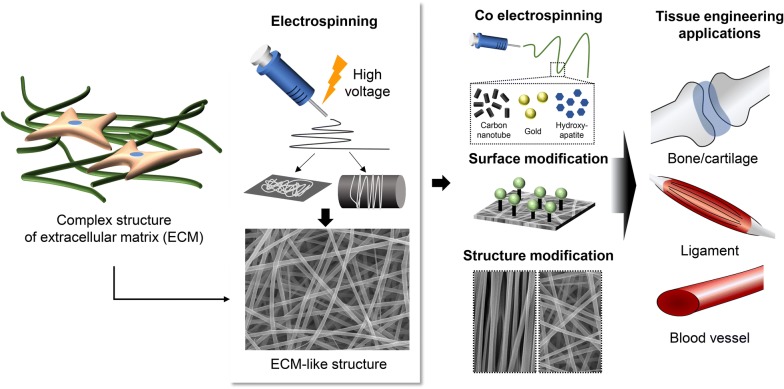
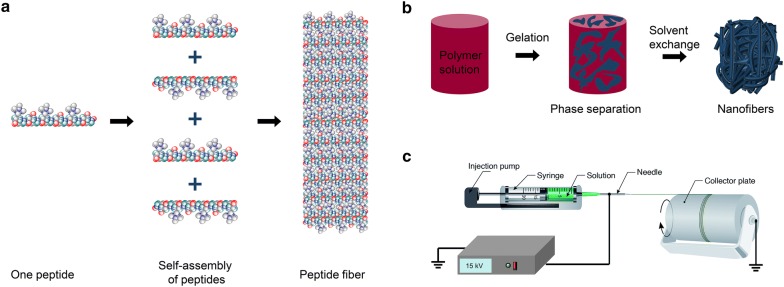
Tissue engineering uses a combination of cell biology, chemistry, and biomaterials to fabricate three dimensional (3D) tissues that mimic the architecture of extracellular matrix (ECM) comprising diverse interwoven nanofibrous structure. Among several methods for producing nanofibrous scaffolds, electrospinning has gained intense interest because it can make nanofibers with a porous structure and high specific surface area. The processing and solution parameters of electrospinning can considerably affect the assembly and structural morphology of the fabricated nanofibers. Electrospun nanofibers can be made from natural or synthetic polymers and blending them is a straightforward way to tune the functionality of the nanofibers. Furthermore, the electrospun nanofibers can be functionalized with various surface modification strategies. In this review, we highlight the latest achievements in fabricating electrospun nanofibers and describe various ways to modify the surface and structure of scaffolds to promote their functionality. We also summarize the application of advanced polymeric nanofibrous scaffolds in the regeneration of human bone, cartilage, vascular tissues, and tendons/ligaments.
组织工程学结合细胞生物学、化学和生物材料来制造三维(3D)组织,这些组织模仿细胞外基质(ECM)的结构,具有多样的交织纳米纤维结构。在几种制备纳米纤维支架的方法中,静电纺丝备受关注,因为它能制造出具有多孔结构和高比表面积的纳米纤维。静电纺丝的工艺和溶液参数会极大地影响所制备纳米纤维的组装和结构形态。静电纺纳米纤维可由天然或合成聚合物制成,将它们混合是调节纳米纤维功能的直接方法。此外,静电纺纳米纤维可以通过各种表面改性策略进行功能化。在本综述中,我们重点介绍了制造静电纺纳米纤维的最新成果,并描述了修饰支架表面和结构以促进其功能的各种方法。我们还总结了先进聚合物纳米纤维支架在人类骨骼、软骨、血管组织和肌腱/韧带再生中的应用。