• 文献检索
  • 文档翻译
  • 深度研究
  • 学术资讯
  • Suppr Zotero 插件Zotero 插件
  • 邀请有礼
  • 套餐&价格
  • 历史记录
应用&插件
Suppr Zotero 插件Zotero 插件浏览器插件Mac 客户端Windows 客户端微信小程序
定价
高级版会员购买积分包购买API积分包
服务
文献检索文档翻译深度研究API 文档MCP 服务
关于我们
关于 Suppr公司介绍联系我们用户协议隐私条款
关注我们

Suppr 超能文献

核心技术专利:CN118964589B侵权必究
粤ICP备2023148730 号-1Suppr @ 2026

文献检索

告别复杂PubMed语法,用中文像聊天一样搜索,搜遍4000万医学文献。AI智能推荐,让科研检索更轻松。

立即免费搜索

文件翻译

保留排版,准确专业,支持PDF/Word/PPT等文件格式,支持 12+语言互译。

免费翻译文档

深度研究

AI帮你快速写综述,25分钟生成高质量综述,智能提取关键信息,辅助科研写作。

立即免费体验

基于DNA的商业草药产品鉴定揭示了其在全球范围内普遍存在的掺假现象。

The DNA-Based Authentication of Commercial Herbal Products Reveals Their Globally Widespread Adulteration.

作者信息

Ichim Mihael Cristin

机构信息

"Stejarul" Research Centre for Biological Sciences, National Institute of Research and Development for Biological Sciences, Piatra Neamt, Romania.

出版信息

Front Pharmacol. 2019 Oct 24;10:1227. doi: 10.3389/fphar.2019.01227. eCollection 2019.

DOI:10.3389/fphar.2019.01227
PMID:31708772
原文链接:https://pmc.ncbi.nlm.nih.gov/articles/PMC6822544/
Abstract

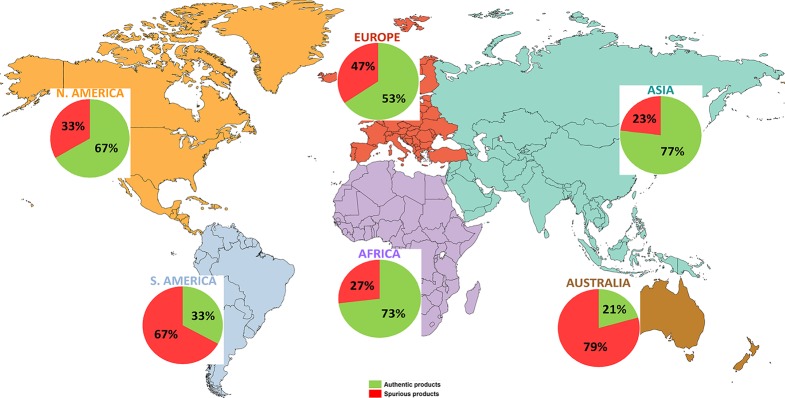
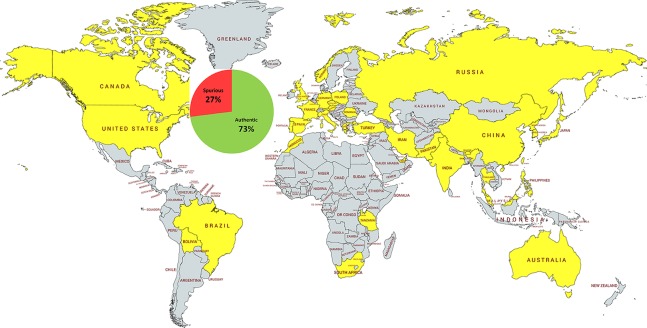
The herbal products, sold worldwide as medicines or foods, are perceived as low risk because they are considered natural and thus safe. The quality of these products is ineffectively regulated and controlled. The growing evidence for their lack of authenticity is causing deep concern, but the scale of this phenomenon at the global, continental or national scale remains unknown. We analyzed data reporting the authenticity, as detected with DNA-based methods, of 5,957 commercial herbal products sold in 37 countries, distributed in all six inhabited continents. Our global survey shows that a substantial proportion (27%) of the herbal products commercialized in the global marketplace is adulterated when their content was tested against their labeled, claimed ingredient species. The adulterated herbal products are distributed across all continents and regions. The proportion of adulterated products varies significantly among continents, being highest in Australia (79%), South America (67%), lower in Europe (47%), North America (33%), Africa (27%) and the lowest in Asia (23%). The commercial HPs' authenticity among the 37 countries included in our global analysis ranges between 0 and 100% from the total number of product reported for each specific national marketplace. For 9 countries, more than 100 products were successfully DNA-based authenticated and reported. From these countries, the highest percentage of adulterated commercial HPs was reported for Brazil (68%), followed distantly by Taiwan (32%), India (31%), USA (29%), followed closely by Malaysia (24%), Japan (23%), South Korea (23%), Thailand (20%), and China (19%). Our results confirm the large-scale presence of adulterated herbal products throughout the global market. The adulterated herbal products contain undeclared contaminant, substitute, and filler species, or none of the labeled species, which all may be accidental or intentional, economically-motivated and fraudulent. Due to the ever-increasing analytical sensitivity of the high throughput DNA sequencing, increasingly used for the untargeted, simultaneous multi-taxa identification, the proportion of adulterated HPs detected on the global market is expected to increase. In the context of the increasing demand for HPs, the limited supply of raw materials derived from many plant species, some of which being already nationally or internationally protected and having various degrees of trade restrictions, adds up to the differences and discrepancies between national HPs' regulatory frameworks and further increases the risks of adulteration of many types of herbal products. The globally widespread adulteration is a serious threat to consumers' well-being and safety, in spite of herbal products' claimed or expected health benefits.

摘要

这些草药产品作为药品或食品在全球范围内销售,由于被认为是天然的因而安全,所以被视为低风险产品。这些产品的质量监管不力。越来越多证据表明其缺乏真实性,这引发了人们的深切关注,但在全球、各大洲或国家层面,这一现象的规模仍不明确。我们分析了用基于DNA的方法检测的37个国家销售的5957种商业草药产品的真实性数据,这些国家分布在所有六大有人居住的大陆。我们的全球调查显示,当按照标签上声称的成分物种对全球市场上商业化的草药产品进行含量检测时,相当大比例(27%)的产品存在掺假情况。掺假的草药产品分布在各大洲和地区。掺假产品的比例在各大洲之间差异显著,在澳大利亚最高(79%),南美洲(67%),欧洲较低(47%),北美洲(33%),非洲(27%),亚洲最低(23%)。在我们全球分析所涵盖的37个国家中,商业草药产品的真实性从每个特定国家市场报告的产品总数来看,介于0到100%之间。对于9个国家,有超过100种产品通过基于DNA的方法成功鉴定并报告。在这些国家中,掺假商业草药产品报告比例最高的是巴西(68%),其次是台湾(32%)、印度(31%)、美国(29%),紧随其后的是马来西亚(24%)、日本(23%)、韩国(23%)、泰国(20%)和中国(19%)。我们的结果证实了掺假草药产品在全球市场广泛存在。掺假的草药产品含有未申报的污染物、替代物和填充物种,或者根本没有标签上标注的物种,这些情况可能是偶然的,也可能是故意的、出于经济动机的欺诈行为。由于越来越多地用于非靶向、同时进行多分类群鉴定的高通量DNA测序的分析灵敏度不断提高,预计全球市场上检测到的掺假草药产品比例将会增加。在对草药产品需求不断增加的背景下,许多植物物种原材料供应有限,其中一些已经受到国家或国际保护并存在不同程度的贸易限制,这加剧了各国草药产品监管框架之间的差异和不一致,进一步增加了多种草药产品掺假的风险。尽管草药产品声称或预期有健康益处,但全球范围内普遍存在的掺假现象对消费者的健康和安全构成了严重威胁。
https://cdn.ncbi.nlm.nih.gov/pmc/blobs/78d0/6822544/f2196bffba83/fphar-10-01227-g002.jpg
https://cdn.ncbi.nlm.nih.gov/pmc/blobs/78d0/6822544/b897f1b58ae1/fphar-10-01227-g001.jpg
https://cdn.ncbi.nlm.nih.gov/pmc/blobs/78d0/6822544/f2196bffba83/fphar-10-01227-g002.jpg
https://cdn.ncbi.nlm.nih.gov/pmc/blobs/78d0/6822544/b897f1b58ae1/fphar-10-01227-g001.jpg
https://cdn.ncbi.nlm.nih.gov/pmc/blobs/78d0/6822544/f2196bffba83/fphar-10-01227-g002.jpg

相似文献

1
The DNA-Based Authentication of Commercial Herbal Products Reveals Their Globally Widespread Adulteration.基于DNA的商业草药产品鉴定揭示了其在全球范围内普遍存在的掺假现象。
Front Pharmacol. 2019 Oct 24;10:1227. doi: 10.3389/fphar.2019.01227. eCollection 2019.
2
A Review of Authenticity and Authentication of Commercial Ginseng Herbal Medicines and Food Supplements.商业人参草药药品和食品补充剂的真实性与鉴定综述
Front Pharmacol. 2021 Jan 11;11:612071. doi: 10.3389/fphar.2020.612071. eCollection 2020.
3
Microscopic Authentication of Commercial Herbal Products in the Globalized Market: Potential and Limitations.全球化市场中商业草药产品的微观鉴定:潜力与局限
Front Pharmacol. 2020 Jun 9;11:876. doi: 10.3389/fphar.2020.00876. eCollection 2020.
4
Chemical Authentication of Botanical Ingredients: A Review of Commercial Herbal Products.植物成分的化学鉴定:市售草药产品综述
Front Pharmacol. 2021 Apr 15;12:666850. doi: 10.3389/fphar.2021.666850. eCollection 2021.
5
Estimating Herbal Product Authentication and Adulteration in India Using a Vouchered, DNA-Based Biological Reference Material Library.利用基于DNA的凭证生物参考材料库评估印度草药产品的真伪和掺假情况。
Drug Saf. 2016 Dec;39(12):1211-1227. doi: 10.1007/s40264-016-0459-0.
6
DNA Metabarcoding Authentication of Ayurvedic Herbal Products on the European Market Raises Concerns of Quality and Fidelity.欧洲市场上阿育吠陀草药产品的DNA条形码鉴定引发了对质量和保真度的担忧。
Front Plant Sci. 2019 Feb 5;10:68. doi: 10.3389/fpls.2019.00068. eCollection 2019.
7
DNA barcoding and NMR spectroscopy-based assessment of species adulteration in the raw herbal trade of Saraca asoca (Roxb.) Willd, an important medicinal plant.基于DNA条形码和核磁共振光谱法对重要药用植物无忧花(Saraca asoca (Roxb.) Willd)原草药贸易中物种掺假的评估
Int J Legal Med. 2016 Nov;130(6):1457-1470. doi: 10.1007/s00414-016-1436-y. Epub 2016 Sep 14.
8
Assessing product adulteration in natural health products for laxative yielding plants, Cassia, Senna, and Chamaecrista, in Southern India using DNA barcoding.利用DNA条形码技术评估印度南部用于生产泻药的天然健康产品中番泻叶、决明属植物和金合欢属植物的产品掺假情况。
Int J Legal Med. 2015 Jul;129(4):693-700. doi: 10.1007/s00414-014-1120-z. Epub 2014 Nov 26.
9
What's in the box? Authentication of Echinacea herbal products using DNA metabarcoding and HPTLC.盒子里有什么?使用 DNA 条形码和 HPTLC 对紫锥菊草药产品进行鉴定。
Phytomedicine. 2018 May 15;44:32-38. doi: 10.1016/j.phymed.2018.03.058. Epub 2018 Mar 21.
10
Mitigating the Impact of Admixtures in Thai Herbal Products.减轻泰国草药产品中混合物的影响。
Front Pharmacol. 2019 Oct 15;10:1205. doi: 10.3389/fphar.2019.01205. eCollection 2019.

引用本文的文献

1
Unveiling Adulteration in Herbal Markets: MassARRAY iPLEX Assay for Accurate Identification of L.揭示草药市场中的掺假现象:用于准确鉴定L.的MassARRAY iPLEX检测法
Int J Mol Sci. 2025 Jul 24;26(15):7168. doi: 10.3390/ijms26157168.
2
Quality assessment of medicinal material Daqingye and Banlangen from Isatis tinctoria Fort. reveals widespread substitution with Strobilanthes species.对菘蓝药材大青叶和板蓝根的质量评估显示,其普遍被马蓝属物种替代。
PLoS One. 2025 May 7;20(5):e0323084. doi: 10.1371/journal.pone.0323084. eCollection 2025.
3
Metabolomic, antibacterial, and ethnobotanical investigation of a Caribbean chew stick (bejuco de Indio), Gouania lupuloides (L.) Urb.

本文引用的文献

1
Defining the Public Health Threat of Dietary Supplement Fraud.界定膳食补充剂欺诈行为对公众健康构成的威胁。
Compr Rev Food Sci Food Saf. 2013 Nov;12(6):599-613. doi: 10.1111/1541-4337.12033.
2
Species identification approach for both raw materials and end products of herbal supplements from Tinospora species.来自天仙藤属植物的草药补充剂原料和终产品的物种鉴定方法。
BMC Complement Altern Med. 2018 Mar 27;18(1):111. doi: 10.1186/s12906-018-2174-0.
3
Critical evaluation of causality assessment of herb-drug interactions in patients.
对加勒比咀嚼棒(印度藤条)——羽叶瓜藤(Gouania lupuloides (L.) Urb.)的代谢组学、抗菌及民族植物学研究
Fitoterapia. 2025 Apr;182:106403. doi: 10.1016/j.fitote.2025.106403. Epub 2025 Feb 3.
4
The Role of Antioxidant Plant Extracts' Composition and Encapsulation in Dietary Supplements and Gemmo-Derivatives, as Safe Adjuvants in Metabolic and Age-Related Conditions: A Review.抗氧化植物提取物的成分与包封在膳食补充剂和植物衍生物中的作用,作为代谢及与年龄相关病症中的安全佐剂:综述
Pharmaceuticals (Basel). 2024 Dec 23;17(12):1738. doi: 10.3390/ph17121738.
5
Flavonoids and Other Polyphenols: Bioactive Molecules from Traditional Medicine Recipes/Medicinal Plants and Their Potential for Phytopharmaceutical and Medical Application.黄酮类化合物及其他多酚类物质:来自传统医学配方/药用植物的生物活性分子及其在植物制药和医学应用中的潜力。
Molecules. 2024 Dec 5;29(23):5760. doi: 10.3390/molecules29235760.
6
Pharmacognostic Evaluation, Chemical Characterization, and Antibacterial Activity of (Wight) A.J. Scott.(怀特)A.J. 斯科特的生药学评价、化学特征分析及抗菌活性
Plants (Basel). 2024 Jun 25;13(13):1753. doi: 10.3390/plants13131753.
7
Monitoring Indian "Superfood" Moringa oleifera Lam. - species-specific PCR-fingerprint-based authentication for more consumer safety.监测印度“超级食物”辣木——基于物种特异性PCR指纹图谱的鉴定以提高消费者安全性。
NPJ Sci Food. 2024 Apr 13;8(1):21. doi: 10.1038/s41538-024-00264-z.
8
Advancing botanical safety: A strategy for selecting, sourcing, and characterizing botanicals for developing toxicological tools.推进植物安全性:为开发毒理学工具选择、采购和鉴定植物原料的策略。
Food Chem Toxicol. 2024 Apr;186:114537. doi: 10.1016/j.fct.2024.114537. Epub 2024 Feb 27.
9
The contemporary nexus of medicines security and bioprospecting: a future perspective for prioritizing the patient.药品安全与生物勘探的当代关联:以患者为优先的未来展望。
Nat Prod Bioprospect. 2024 Jan 25;14(1):11. doi: 10.1007/s13659-024-00431-5.
10
In Search of Authenticity Biomarkers in Food Supplements Containing Sea Buckthorn: A Metabolomics Approach.寻找含沙棘的食品补充剂中的真实性生物标志物:一种代谢组学方法。
Foods. 2023 Dec 15;12(24):4493. doi: 10.3390/foods12244493.
对患者中药-药物相互作用因果关系评估的批判性评价。
Br J Clin Pharmacol. 2018 Apr;84(4):679-693. doi: 10.1111/bcp.13490. Epub 2018 Jan 29.
4
Integrated analytical assets aid botanical authenticity and adulteration management.综合分析资产有助于植物药的真实性和掺伪管理。
Fitoterapia. 2018 Sep;129:401-414. doi: 10.1016/j.fitote.2017.11.017. Epub 2017 Nov 22.
5
DNA metabarcoding of orchid-derived products reveals widespread illegal orchid trade.对兰花衍生产品的DNA条形码分析揭示了广泛存在的非法兰花贸易。
Proc Biol Sci. 2017 Sep 27;284(1863). doi: 10.1098/rspb.2017.1182.
6
Benefits and Limitations of DNA Barcoding and Metabarcoding in Herbal Product Authentication.DNA 条形码和代谢条形码在草药产品鉴定中的优势和局限性。
Phytochem Anal. 2018 Mar;29(2):123-128. doi: 10.1002/pca.2732. Epub 2017 Sep 14.
7
Derivative Technology of DNA Barcoding (Nucleotide Signature and SNP Double Peak Methods) Detects Adulterants and Substitution in Chinese Patent Medicines.DNA 条形码衍生技术(核苷酸特征和 SNP 双峰方法)检测中药中的掺假和替代物。
Sci Rep. 2017 Jul 19;7(1):5858. doi: 10.1038/s41598-017-05892-y.
8
Comparative authentication of Hypericum perforatum herbal products using DNA metabarcoding, TLC and HPLC-MS.采用 DNA 条形码、TLC 和 HPLC-MS 对贯叶金丝桃草药产品进行比较鉴定。
Sci Rep. 2017 May 2;7(1):1291. doi: 10.1038/s41598-017-01389-w.
9
Assessment of the Authenticity of Herbal Dietary Supplements: Comparison of Chemical and DNA Barcoding Methods.草药膳食补充剂的真实性评估:化学方法与DNA条形码方法的比较
Planta Med. 2017 Jul;83(11):921-936. doi: 10.1055/s-0043-107881. Epub 2017 Apr 28.
10
Poisonous or non-poisonous plants? DNA-based tools and applications for accurate identification.有毒植物还是无毒植物?基于DNA的准确鉴定工具及应用
Int J Legal Med. 2017 Jan;131(1):1-19. doi: 10.1007/s00414-016-1460-y. Epub 2016 Oct 30.