Ichim Mihael Cristin, Häser Annette, Nick Peter
"Stejarul" Research Centre for Biological Sciences, National Institute of Research and Development for Biological Sciences, Piatra Neamt, Romania.
Molecular Cell Biology, Karlsruhe Institute of Technology, Karlsruhe, Germany.
Front Pharmacol. 2020 Jun 9;11:876. doi: 10.3389/fphar.2020.00876. eCollection 2020.
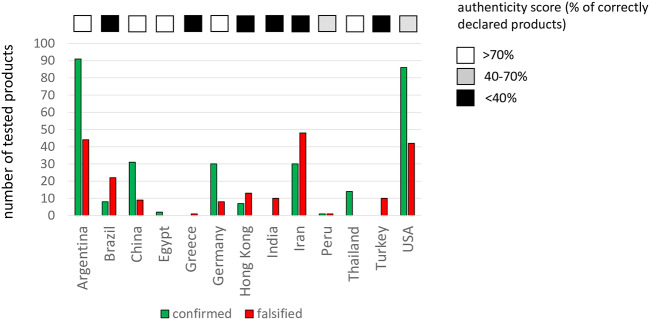
Herbal products are marketed and used around the globe for their claimed or expected health benefits, but their increasing demand has resulted in a proportionally increase of their accidental contamination or intentional adulteration, as already confirmed with DNA-based methods. Microscopy is a traditional pharmacopoeial method used for plant identification and we systematically searched for peer-reviewed publications to document its potential and limitations to authenticate herbal medicines and food supplements commercially available on the global market. The overall authenticity of 508 microscopically authenticated herbal products, sold in 13 countries, was 59%, while the rest of 41% were found to be adulterated. This problem was extending over all continents. At the national level, there were conspicuous differences, even between neighboring countries. These microscopically authenticated commercial herbal products confirm that different magnifying instruments can be used to authenticate crude or processed herbal products traded in the global marketplace. The reviewed publications report the successful use of different magnifying instruments, single or in combinations with a second one, with or without a chemical or DNA-based technique. Microscopy is therefore a rapid and cost-efficient method, and can cope with mixtures and impurities. However, it has limited applicability for highly processed samples. Microscopic authentication of commercial herbal products will therefore contribute to raise public awareness for the extent of adulteration and the need to safeguard consumer safety against the challenges of globalization.
草药产品因其宣称的或预期的健康益处而在全球范围内销售和使用,但其需求的不断增加已导致其意外污染或故意掺假的比例相应增加,基于DNA的方法已证实了这一点。显微镜检查是一种用于植物鉴定的传统药典方法,我们系统地检索了同行评审的出版物,以记录其在鉴定全球市场上商业可得的草药和食品补充剂方面的潜力和局限性。在13个国家销售的508种经显微镜鉴定的草药产品,总体真品率为59%,其余41%被发现掺假。这个问题在各大洲都存在。在国家层面,甚至相邻国家之间也存在显著差异。这些经显微镜鉴定的商业草药产品证实,不同的放大仪器可用于鉴定在全球市场上交易的生药或加工草药产品。综述的出版物报道了不同放大仪器单独使用或与另一种仪器联合使用、结合或不结合化学或基于DNA的技术的成功应用。因此,显微镜检查是一种快速且经济高效的方法,并且可以处理混合物和杂质。然而,它对高度加工的样品适用性有限。因此,商业草药产品的显微镜鉴定将有助于提高公众对掺假程度的认识,以及应对全球化挑战保障消费者安全的必要性的认识。