Institute of Systems Neuroscience, Medical Faculty, Heinrich Heine University Düsseldorf, Düsseldorf, Germany.
Institute of Neuroscience and Medicine, Brain and Behaviour (INM-7), Research Centre Jülich, Jülich, Germany.
PLoS Biol. 2019 Nov 14;17(11):e3000497. doi: 10.1371/journal.pbio.3000497. eCollection 2019 Nov.
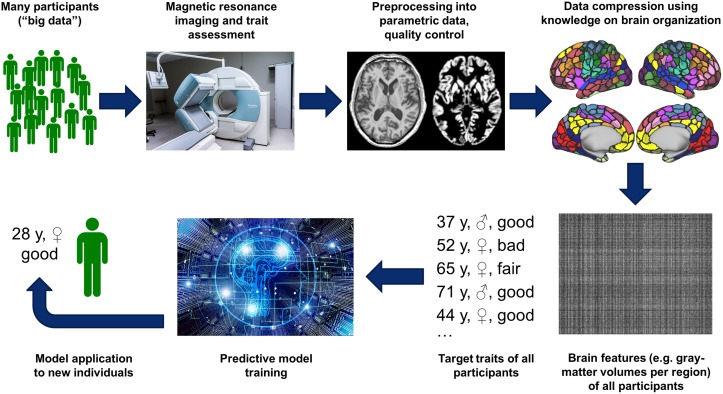
Predicting individual mental traits and behavioral dispositions from brain imaging data through machine-learning approaches is becoming a rapidly evolving field in neuroscience. Beyond scientific and clinical applications, such approaches also hold the potential to gain substantial influence in fields such as human resource management, education, or criminal law. Although several challenges render real-life applications of such tools difficult, future conflicts of individual, economic, and public interests are preprogrammed, given the prospect of improved personalized predictions across many domains. In this Perspective paper, we thus argue for the need to engage in a discussion on the ethical, legal, and societal implications of the emergent possibilities for brain-based predictions and outline some of the aspects for this discourse.
通过机器学习方法从脑成像数据中预测个体心理特征和行为倾向,正在成为神经科学中一个迅速发展的领域。除了科学和临床应用,这些方法还有可能在人力资源管理、教育或刑法等领域产生重大影响。尽管存在一些挑战使得这些工具的实际应用变得困难,但考虑到在许多领域提高个性化预测的前景,此类工具的应用将会引发个体利益、经济利益和公共利益之间的未来冲突,这些冲突在事先就已经设定好了。因此,在这篇观点文章中,我们认为有必要就基于大脑的预测的新兴可能性所带来的伦理、法律和社会影响展开讨论,并概述了这一讨论的一些方面。