Departments of Anesthesiology, Medicine, and Physiology, David Geffen School of Medicine, University of California at Los Angeles, Los Angeles, California.
Physiol Rev. 2020 Apr 1;100(2):673-694. doi: 10.1152/physrev.00007.2019. Epub 2019 Nov 21.
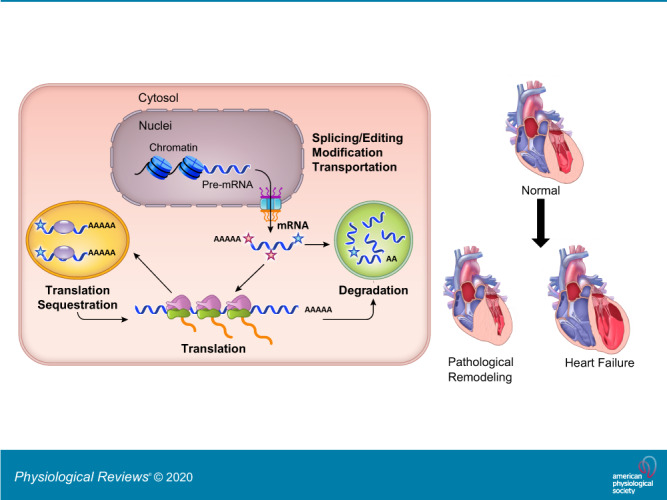
The central dogma of molecular biology illustrates the importance of mRNAs as critical mediators between genetic information encoded at the DNA level and proteomes/metabolomes that determine the diverse functional outcome at the cellular and organ levels. Although the total number of protein-producing (coding) genes in the mammalian genome is ~20,000, it is evident that the intricate processes of cardiac development and the highly regulated physiological regulation in the normal heart, as well as the complex manifestation of pathological remodeling in a diseased heart, would require a much higher degree of complexity at the transcriptome level and beyond. Indeed, in addition to an extensive regulatory scheme implemented at the level of transcription, the complexity of transcript processing following transcription is dramatically increased. RNA processing includes post-transcriptional modification, alternative splicing, editing and transportation, ribosomal loading, and degradation. While transcriptional control of cardiac genes has been a major focus of investigation in recent decades, a great deal of progress has recently been made in our understanding of how post-transcriptional regulation of mRNA contributes to transcriptome complexity. In this review, we highlight some of the key molecular processes and major players in RNA maturation and post-transcriptional regulation. In addition, we provide an update to the recent progress made in the discovery of RNA processing regulators implicated in cardiac development and disease. While post-transcriptional modulation is a complex and challenging problem to study, recent technological advancements are paving the way for a new era of exciting discoveries and potential clinical translation in the context of cardiac biology and heart disease.
分子生物学的中心法则表明,mRNA 作为 DNA 水平编码的遗传信息与决定细胞和器官水平各种功能结果的蛋白质组/代谢组之间的关键介质至关重要。尽管哺乳动物基因组中产生蛋白质(编码)的基因总数约为 20,000,但显然,心脏的复杂发育过程以及正常心脏的高度调节的生理调节,以及患病心脏中病理性重构的复杂表现,将需要转录组水平及以上的更高程度的复杂性。事实上,除了在转录水平上实施广泛的调控方案外,转录后转录处理的复杂性大大增加。RNA 处理包括转录后修饰、选择性剪接、编辑和运输、核糖体加载和降解。虽然心脏基因的转录控制是近几十年来的主要研究重点,但最近我们对 mRNA 的转录后调控如何有助于转录组复杂性的理解取得了很大进展。在这篇综述中,我们强调了 RNA 成熟和转录后调控中的一些关键分子过程和主要参与者。此外,我们还提供了关于在心脏发育和疾病中发现涉及 RNA 加工的调节因子的最新进展的最新信息。虽然转录后调节是一个复杂且具有挑战性的研究问题,但最近的技术进步为心脏生物学和心脏病学领域的激动人心的发现和潜在的临床转化开辟了新的时代。