Tasmanian Institute of Agriculture, University of Tasmania, Prospect, TAS, Australia.
Department of Horticulture, Faculty of Agriculture, Sher-e-Bangla Agricultural University, Sher-e-Bangla Nagar, Dhaka, Bangladesh.
BMC Genomics. 2019 Nov 21;20(1):891. doi: 10.1186/s12864-019-6249-1.
Barley yellow dwarf (BYD) is an important virus disease that causes significant reductions in wheat yield. For effective control of Barley yellow dwarf virus through breeding, the identification of genetic sources of resistance is key to success. In this study, 335 geographically diverse wheat accessions genotyped using an Illumina iSelect 90 K single nucleotide polymorphisms (SNPs) bead chip array were used to identify new sources of resistance to BYD in different environments.
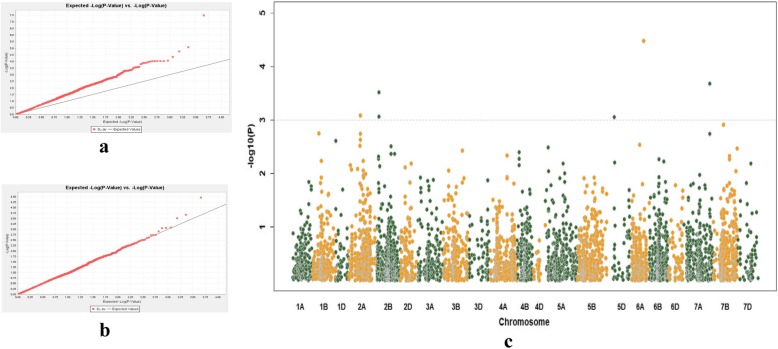
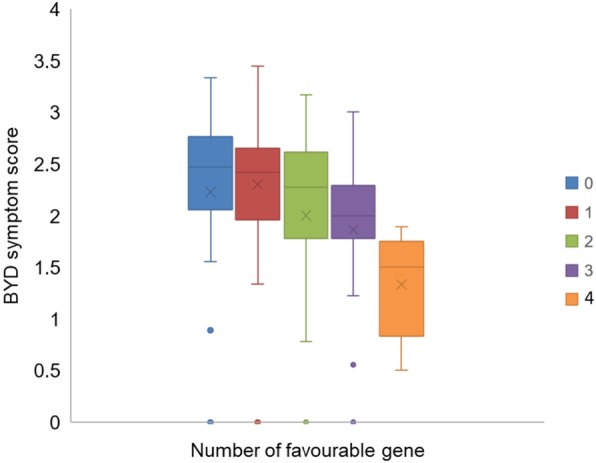
A genome-wide association study (GWAS) performed using all the generalised and mixed linkage models (GLM and MLM, respectively) identified a total of 36 significant marker-trait associations, four of which were consistently detected in the K model. These four novel quantitative trait loci (QTL) were identified on chromosomes 2A, 2B, 6A and 7A and associated with markers IWA3520, IWB24938, WB69770 and IWB57703, respectively. These four QTL showed an additive effect with the average visual symptom score of the lines containing resistance alleles of all four QTL being much lower than those with less favorable alleles. Several Chinese landraces, such as H-205 (Baimazha) and H-014 (Dahongmai) which have all four favorable alleles, showed consistently higher resistance in different field trials. None of them contained the previously described Bdv2, Bdv3 or Bdv4 genes for BYD resistance.
This study identified multiple novel QTL for BYD resistance and some resistant wheat genotypes. These will be useful for breeders to generate combinations with and/or without Bdv2 to achieve higher levels and more stable BYD resistance.
大麦黄花叶病(BYD)是一种重要的病毒病,可导致小麦产量大幅下降。为了通过育种有效控制大麦黄花叶病毒,鉴定抗性的遗传资源是成功的关键。在这项研究中,使用 Illumina iSelect 90K 单核苷酸多态性(SNP)珠芯片阵列对 335 个地理上多样化的小麦品系进行了基因型分析,以鉴定不同环境下对 BYD 的新抗性来源。
使用所有广义和混合连锁模型(GLM 和 MLM)进行的全基因组关联研究(GWAS)总共鉴定出 36 个与标记性状显著关联的位点,其中 4 个在 K 模型中一致检测到。这四个新的数量性状位点(QTL)分别位于 2A、2B、6A 和 7A 染色体上,与标记 IWA3520、IWB24938、WB69770 和 IWB57703 分别相关。这四个 QTL 表现出累加效应,含有四个 QTL 抗性等位基因的系的平均视觉症状评分明显低于含有不利等位基因的系。一些中国地方品种,如 H-205(白芒子)和 H-014(大红麦),都含有这四个有利等位基因,在不同的田间试验中表现出一致的高抗性。它们都不含有先前描述的用于 BYD 抗性的 Bdv2、Bdv3 或 Bdv4 基因。
本研究鉴定了多个用于 BYD 抗性的新 QTL 和一些抗性小麦基因型。这些将有助于育种者产生具有和/或不具有 Bdv2 的组合,以实现更高水平和更稳定的 BYD 抗性。