School of Rehabilitation Therapy, Faculty of Health Sciences, Queen's University, 31 George Street, Louise D. Acton Building, Kingston, Ontario, Canada.
Ottawa Hospital Research Institute, 501 Smyth Road, Ottawa, Ontario, Canada.
BMC Med Res Methodol. 2019 Nov 21;19(1):211. doi: 10.1186/s12874-019-0838-1.
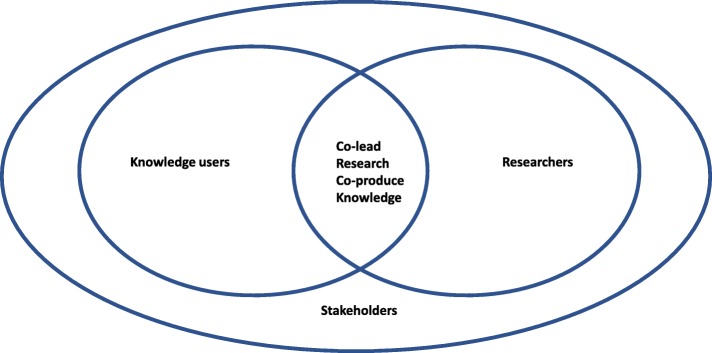
Engaging those who influence, administer and/or who are active users ("knowledge users") of health care systems, as co-producers of health research, can help to ensure that research products will better address real world needs. Our aim was to identify and review frameworks of knowledge user engagement in health research in a systematic manner, and to describe the concepts comprising these frameworks.
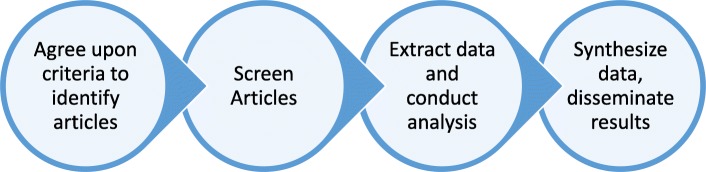
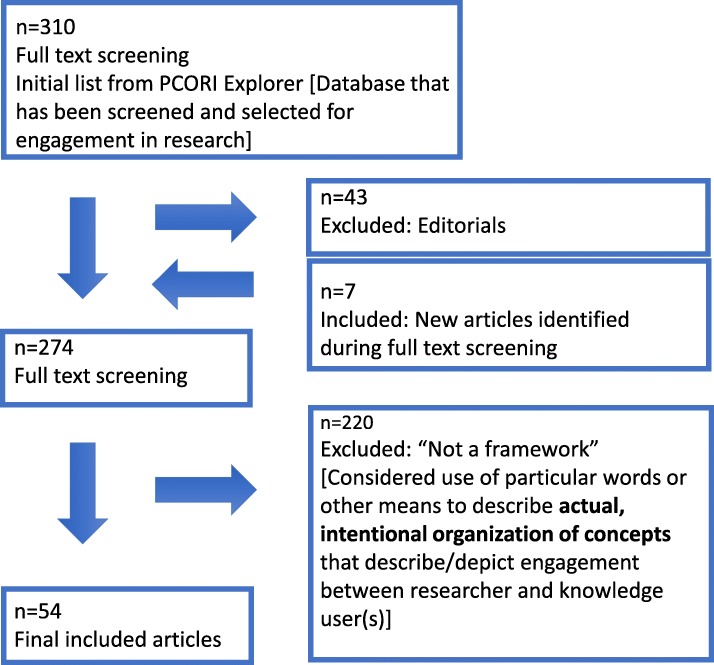
An international team sharing a common interest in knowledge user engagement in health research used a consensus-building process to: 1) agree upon criteria to identify articles, 2) screen articles to identify existing frameworks, 3) extract, analyze data, and 4) synthesize and report the concepts of knowledge user engagement described in health research frameworks. We utilized the Patient Centered Outcomes Research Institute Engagement in Health Research Literature Explorer (PCORI Explorer) as a source of articles related to engagement in health research. The search includes articles from May 1995 to December 2017.
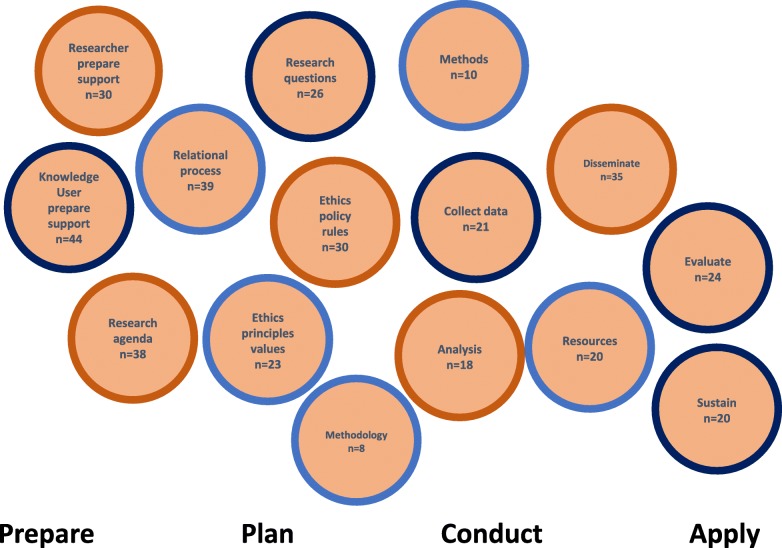
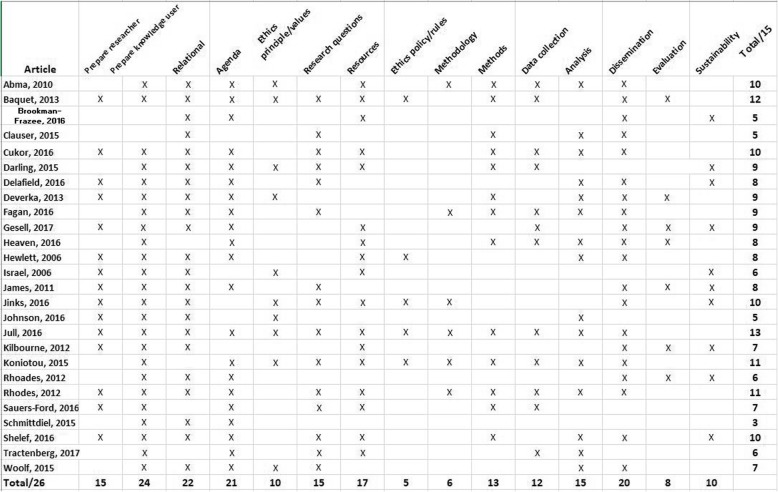
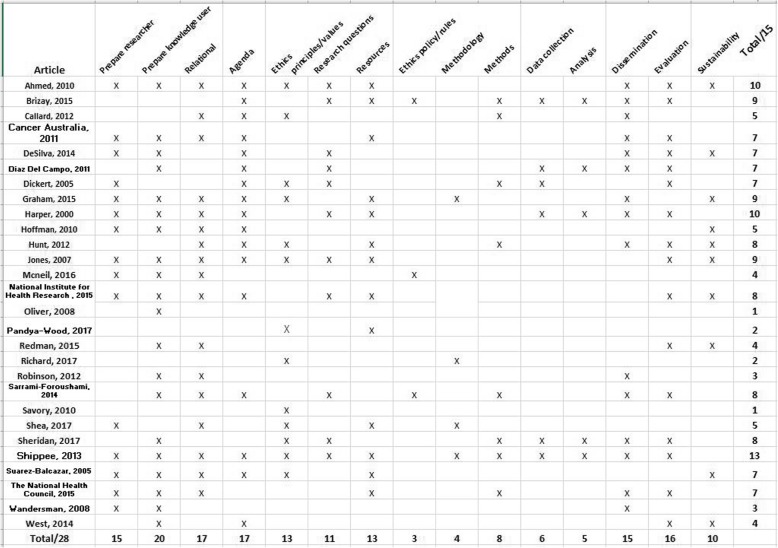
We identified 54 articles about frameworks for knowledge user engagement in health research and report on 15 concepts. The average number of concepts reported in the 54 articles is n = 7, and ranges from n = 1 to n = 13 concepts. The most commonly reported concepts are: knowledge user - prepare, support (n = 44), relational process (n = 39), research agenda (n = 38). The least commonly reported concepts are: methodology (n = 8), methods (n = 10) and analysis (n = 18). In a comparison of articles that report how research was done (n = 26) versus how research should be done (n = 28), articles about how research was done report concepts more often and have a higher average number of concepts (n = 8 of 15) in comparison to articles about how research should be done (n = 6 of 15). The exception is the concept "evaluate" and that is more often reported in articles that describe how research should be done.
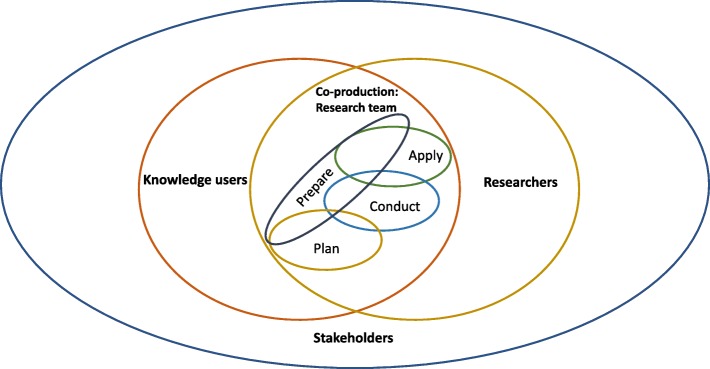
We propose that research teams 1) consider engagement with the 15 concepts as fluid, and 2) consider a form of partnered negotiation that takes place through all phases of research to identify and use concepts appropriate to their team needs. There is a need for further work to understand concepts for knowledge user engagement.
让那些影响、管理和/或积极使用医疗保健系统的人(“知识使用者”)作为健康研究的共同生产者,可以帮助确保研究成果能更好地满足实际需求。我们的目的是系统地识别和审查健康研究中知识使用者参与的框架,并描述这些框架所包含的概念。
一个对健康研究中知识使用者参与有共同兴趣的国际团队,通过共识建立过程:1)就识别文章的标准达成一致,2)筛选文章以确定现有的框架,3)提取、分析数据,4)综合和报告健康研究框架中描述的知识使用者参与的概念。我们利用患者中心的结果研究所参与健康研究文献资源(PCORI 资源)作为与健康研究相关的文章来源。该搜索包括 1995 年 5 月至 2017 年 12 月期间的文章。
我们确定了 54 篇关于健康研究中知识使用者参与框架的文章,并报告了 15 个概念。54 篇文章中报告的平均概念数量为 n=7,范围从 n=1 到 n=13 个概念。报告最多的概念是:知识使用者 - 准备、支持(n=44),关系过程(n=39),研究议程(n=38)。报告最少的概念是:方法学(n=8),方法(n=10)和分析(n=18)。在报告研究如何进行(n=26)与报告研究应如何进行(n=28)的文章比较中,报告研究如何进行的文章更频繁地报告概念,并且概念的平均数量更高(n=15),与报告研究应如何进行的文章相比(n=15)。唯一的例外是“评估”这一概念,在描述研究应如何进行的文章中更常被提及。
我们建议研究团队 1)考虑将 15 个概念的参与视为灵活的,2)考虑一种伙伴式谈判形式,这种形式贯穿研究的所有阶段,以确定和使用适合团队需求的概念。需要进一步的工作来理解知识使用者参与的概念。