Research Institute Brainclinics, Nijmegen, The Netherlands; Synaeda Psycho Medisch Centrum, Leeuwarden, The Netherlands; Department of Clinical Neurophysiology, Technical Medical Centre, University of Twente, Enschede, The Netherlands.
Research Institute Brainclinics, Nijmegen, The Netherlands; Department of Cognitive Neuroscience, Donders Institute for Brain, Cognition and Behaviour, Radboud University Medical Centre, Nijmegen, The Netherlands.
Neuroimage Clin. 2019;24:102056. doi: 10.1016/j.nicl.2019.102056. Epub 2019 Oct 31.
Frontal alpha asymmetry (FAA) is a proposed prognostic biomarker in major depressive disorder (MDD), conventionally acquired with electroencephalography (EEG). Although small studies attributed trait-like properties to FAA, a larger sample is needed to reliably asses this characteristic. Furthermore, to use FAA to predict treatment response, determining its stability, including the potential dependency on depressive state or medication, is essential.
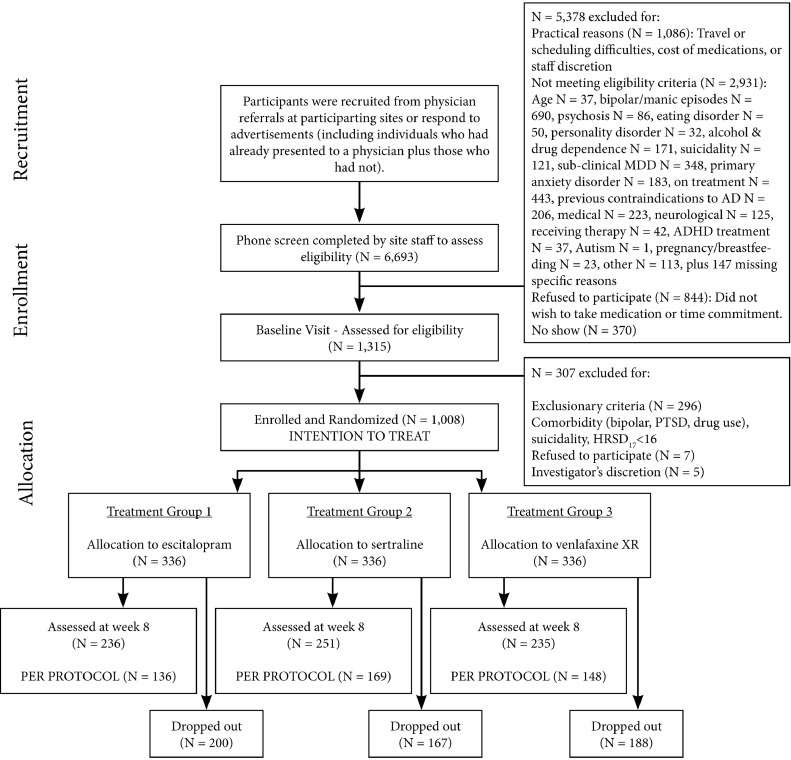
In the international Study to Predict Optimized Treatment in Depression (iSPOT-D), a multi-center, randomized, prospective open-label trial, 1008 MDD participants were randomized to treatment with escitalopram, sertraline or venlafaxine-extended release. Treatment response was established eight weeks after treatment initiation and resting state EEG was measured both at baseline and after eight weeks (n = 453).
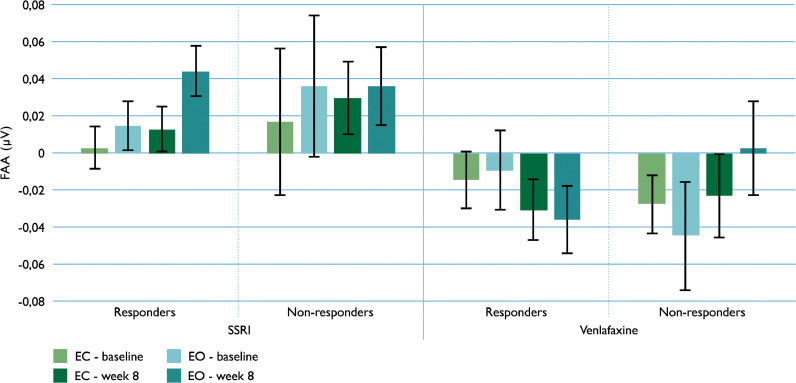
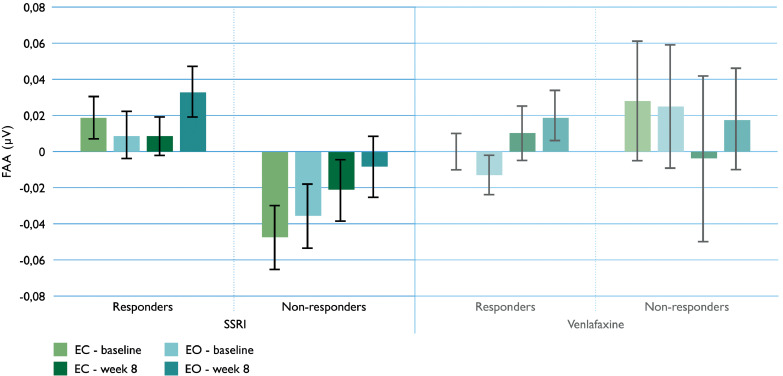
FAA did not change significantly after eight weeks of treatment (n = 453, p = .234), nor did we find associations with age, sex, depression severity, or change in depression severity. After randomizing females to escitalopram or sertraline, for whom treatment response could be predicted in an earlier study, FAA after eight weeks resulted in equivalent response prediction as baseline FAA (one tailed p = .028).
We demonstrate that FAA is a stable trait, robust to time, state and pharmacological status. This confirms FAA stability. Furthermore, as prediction of treatment response is irrespective of moment of measurement and use of medication, FAA can be used as a state-invariant prognostic biomarker with promise to optimize MDD treatments.
额区阿尔法不对称(FAA)是一种在重度抑郁症(MDD)中提出的预后生物标志物,通常通过脑电图(EEG)获得。尽管一些小型研究认为 FAA 具有特质性,但需要更大的样本量才能可靠地评估这一特征。此外,为了使用 FAA 预测治疗反应,确定其稳定性,包括对抑郁状态或药物的潜在依赖性,是至关重要的。
在国际预测抑郁优化治疗研究(iSPOT-D)中,一项多中心、随机、前瞻性、开放标签试验中,1008 名 MDD 参与者被随机分为接受依他普仑、舍曲林或文拉法辛缓释片治疗。治疗反应在治疗开始后八周确定,在基线和八周后测量静息状态脑电图(n=453)。
在八周的治疗后,FAA 没有显著变化(n=453,p=0.234),我们也没有发现 FAA 与年龄、性别、抑郁严重程度或抑郁严重程度的变化有关。在将女性随机分为依他普仑或舍曲林组后,对于在早期研究中可以预测治疗反应的女性,八周后的 FAA 与基线 FAA 一样可以预测治疗反应(单侧 p=0.028)。
我们证明 FAA 是一种稳定的特质,不受时间、状态和药物状态的影响。这证实了 FAA 的稳定性。此外,由于治疗反应的预测与测量的时刻和药物的使用无关,因此 FAA 可以作为一种状态不变的预后生物标志物,有望优化 MDD 的治疗。