Department of General Medicine, Kaohsiung Medical University Hospital, Kaohsiung Medical University, Kaohsiung, Taiwan.
Institute of Behavioral Medicine, College of Medicine, National Cheng Kung University, Tainan, Taiwan.
Sci Rep. 2019 Dec 12;9(1):18950. doi: 10.1038/s41598-019-55427-w.
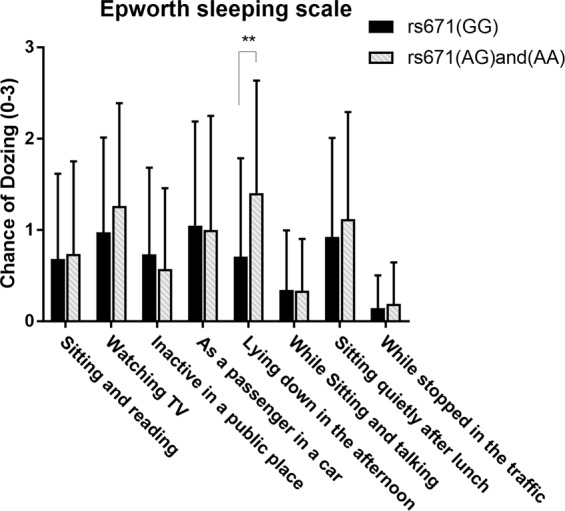
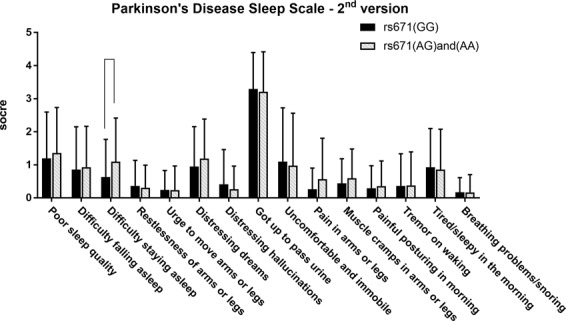
Monoamine neurotransmitters play essential roles in the regulation of arousal and sleep. Impaired metabolism of monoamine neurotransmitters could result in the accumulation of neurotoxic aldehyde metabolites and, hence, neuronal degeneration. Aldehyde dehydrogenases play an important role in the metabolism of the neurotoxic aldehyde metabolites, including the aldehyde metabolites of dopamine, serotonin, and noradrenaline. Deficient aldehyde dehydrogenase 2 (ALDH2) has been suggested to result in the accumulation of these biogenic aldehydes. An ALDH2 single nucleotide polymorphism (SNP), rs671 (A), results in significantly reduced ALDH2 enzyme activity. A total of 83 Parkinson's disease (PD) patients were recruited in this study. In addition to the genotypes of rs671, the patients were assessed with the PD sleep scale-2nd version (PDSS-2) and the Epworth sleepiness scale (ESS) for symptoms of daytime and nocturnal sleep disturbances. The patients carrying rs671 (A) had more frequent dozing while lying down to rest in the afternoon (ESS item5) (F = 7.308, p = 0.008) than the rs671 (GG) patients. The patients with rs671 (A) reported a trend toward more frequent difficulty staying asleep than the patients with rs671 (GG). (F = 3.278, p = 0.074). The results indicate that patients carrying allele rs671 (A) are more likely to experience impairment in the regulation of arousal and sleep. The results also support the hypothesis that the accumulation of neurotoxic monoamine neurotransmitter aldehyde metabolites secondary to reduced ALDH2 enzyme activity may cause more severe monoaminergic neuronal loss and, hence, more severe symptoms in the regulation of wakefulness and sleep.
单胺神经递质在调节觉醒和睡眠中起着至关重要的作用。单胺神经递质代谢受损可能导致神经毒性醛类代谢物的积累,从而导致神经元退化。醛脱氢酶在神经毒性醛类代谢物的代谢中起着重要作用,包括多巴胺、血清素和去甲肾上腺素的醛类代谢物。醛脱氢酶 2(ALDH2)缺乏被认为会导致这些生物源性醛类的积累。ALDH2 的一个单核苷酸多态性(SNP),rs671(A),导致 ALDH2 酶活性显著降低。本研究共招募了 83 名帕金森病(PD)患者。除了 rs671 的基因型外,患者还使用 PD 睡眠量表-第 2 版(PDSS-2)和 Epworth 嗜睡量表(ESS)评估白天和夜间睡眠障碍的症状。携带 rs671(A)的患者在下午休息时更容易打盹(ESS 项目 5)(F=7.308,p=0.008)比 rs671(GG)患者更频繁。与 rs671(GG)患者相比,携带 rs671(A)的患者报告入睡困难的趋势更为明显(F=3.278,p=0.074)。结果表明,携带等位基因 rs671(A)的患者更有可能出现觉醒和睡眠调节受损。这些结果还支持了这样一种假设,即由于 ALDH2 酶活性降低导致的神经毒性单胺神经递质醛类代谢物的积累可能导致更严重的单胺能神经元丢失,从而导致觉醒和睡眠调节的症状更严重。