Christie Grant I, Shepherd Matthew, Merry Sally N, Hopkins Sarah, Knightly Stephen, Stasiak Karolina
Department of Psychological Medicine, Faculty of Medical & Health Science, University of Auckland, New Zealand.
InGame Limited, PO Box 106-804, Auckland, New Zealand.
Internet Interv. 2019 Oct 18;18:100286. doi: 10.1016/j.invent.2019.100286. eCollection 2019 Dec.
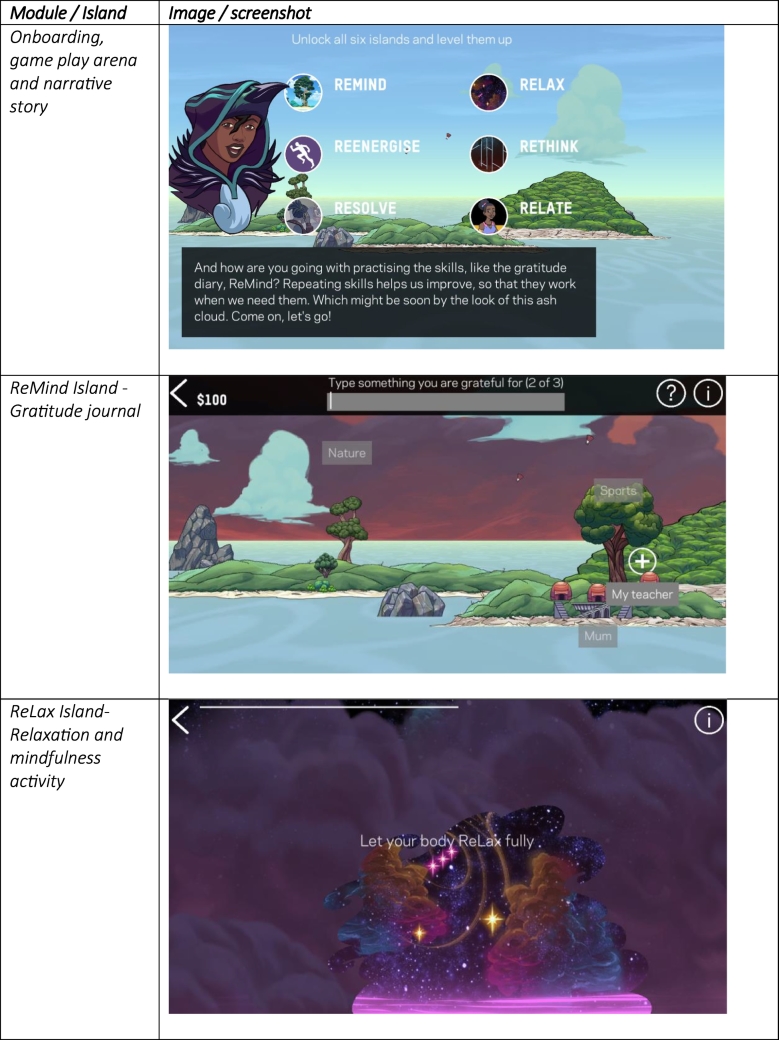
mHealth interventions promise the economic delivery of evidence-based mental health treatments like cognitive behavioural therapy (CBT) to populations that struggle to access health services, such as adolescents and in New Zealand, Māori and Pasifika youth. Unfortunately engagement with digital therapies is poor; modularisation and gamification have potential to increase their appeal. Gamifying CBT involves selecting suitable interventions, adapting them to a digital format while applying gamification principles. We describe the design and development of Quest - Te Whitianga, an app that encourages the user to learn CBT skills via a series of activities and games. A variety of approaches including consultation with clinicians, reference to best-practice literature, focus groups and interactive workshops with youth were used to inform the co-design process. Clinicians worked iteratively with experienced game designers to co-create a youth CBT digital intervention. The Quest modular app is set on an ocean and the user travels between islands to learn six evidence-based skills. These include a relaxation/mindfulness activity, activity planning, a gratitude journal plus problem solving and communication skills training. We describe the theoretical and design aspects of each module detailing the gamified features that aim to increase user engagement. In the near future we will be testing the app and the principles discussed in this paper via a randomised-controlled trial.
移动健康干预措施有望以经济高效的方式,为难以获得医疗服务的人群,如青少年,以及在新西兰的毛利族和太平洋岛裔青年,提供诸如认知行为疗法(CBT)等循证心理健康治疗。不幸的是,人们对数字疗法的参与度很低;模块化和游戏化有潜力提高其吸引力。将CBT游戏化涉及选择合适的干预措施,将其改编为数字形式,同时应用游戏化原则。我们描述了一款名为Quest - Te Whitianga的应用程序的设计与开发,该应用鼓励用户通过一系列活动和游戏来学习CBT技能。我们采用了多种方法,包括与临床医生协商、参考最佳实践文献、开展焦点小组讨论以及与青少年进行互动工作坊,为协同设计过程提供信息。临床医生与经验丰富的游戏设计师反复合作,共同创建了一种针对青少年的CBT数字干预措施。Quest模块化应用程序以海洋为背景,用户在各个岛屿之间穿梭,学习六种循证技能。这些技能包括一项放松/正念活动、活动规划、一本感恩日记,以及问题解决和沟通技巧训练。我们描述了每个模块的理论和设计方面,详细说明了旨在提高用户参与度的游戏化功能。在不久的将来,我们将通过随机对照试验对该应用程序以及本文讨论的原则进行测试。