Kuršvietienė Lolita, Mongirdienė Aušra, Bernatonienė Jurga, Šulinskienė Jurgita, Stanevičienė Inga
Department of Biochemistry, Lithuanian University of Health Sciences, LT-50161 Kaunas, Lithuania.
Department of Drug Technology and Social Pharmacy, Lithuanian University of Health Sciences, LT-50162 Kaunas, Lithuania.
Antioxidants (Basel). 2020 Jan 17;9(1):80. doi: 10.3390/antiox9010080.
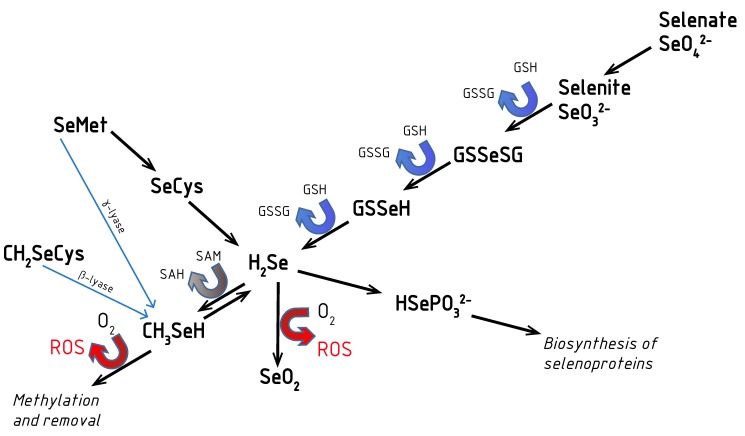
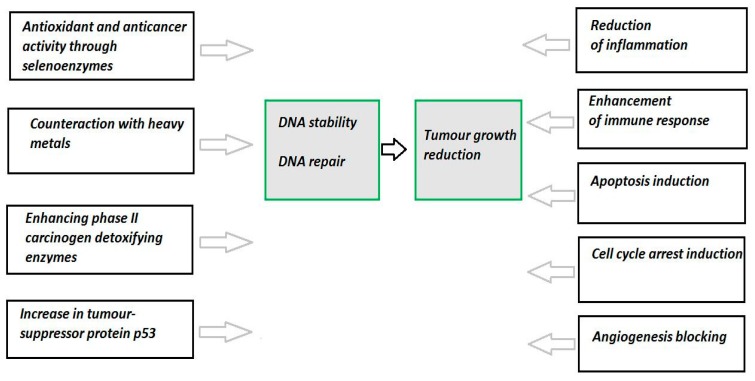
(1) Background: In this review, we provide information published in recent years on the chemical forms, main biological functions and especially on antioxidant and prooxidant activities of selenium. The main focus is put on the impact of selenoproteins on maintaining cellular redox balance and anticancerogenic function. Moreover, we summarize data on chemotherapeutic application of redox active selenium compounds. (2) Methods: In the first section, main aspects of metabolism and redox activity of selenium compounds is reviewed. The second outlines multiple biological functions, asserted when selenium is incorporated into the structure of selenoproteins. The final section focuses on anticancer activity of selenium and chemotherapeutic application of redox active selenium compounds as well. (3) Results: optimal dietary level of selenium ensures its proper antioxidant and anticancer activity. We pay special attention to antioxidant activities of selenium compounds, especially selenoproteins, and their importance in antioxidant defence. It is worth noting, that data on selenium anticancer properties is still contraversive. Moreover, selenium compounds as chemotherapeutic agents usually are used at supranutritional doses. (4) Conclusions: Selenium play a vital role for many organism systems due to its incorporation into selenoproteins structure. Selenium possesses antioxidant activity at optimal doses, while at supranutritional doses, it displays prooxidant activity. Redox active selenium compounds can be used for cancer treatment; recently special attention is put to selenium containing nanoparticles.
(1) 背景:在本综述中,我们提供近年来发表的有关硒的化学形态、主要生物学功能,特别是抗氧化和促氧化活性的信息。主要重点在于硒蛋白对维持细胞氧化还原平衡和抗癌功能的影响。此外,我们总结了氧化还原活性硒化合物的化疗应用数据。(2) 方法:在第一部分,综述了硒化合物代谢和氧化还原活性的主要方面。第二部分概述了硒掺入硒蛋白结构时所具有的多种生物学功能。最后一部分重点关注硒的抗癌活性以及氧化还原活性硒化合物的化疗应用。(3) 结果:最佳饮食硒水平可确保其适当的抗氧化和抗癌活性。我们特别关注硒化合物,尤其是硒蛋白的抗氧化活性及其在抗氧化防御中的重要性。值得注意的是,关于硒抗癌特性的数据仍然存在争议。此外,硒化合物作为化疗药物通常以超营养剂量使用。(4) 结论:由于硒掺入硒蛋白结构中,它对许多生物体系统起着至关重要的作用。硒在最佳剂量时具有抗氧化活性,而在超营养剂量时则表现出促氧化活性。氧化还原活性硒化合物可用于癌症治疗;最近特别关注含硒纳米颗粒。