Division of Molecular Microbiology, School of Life Sciences, University of Dundee, Dundee, United Kingdom.
Data Analysis Group, Division of Computational Biology, School of Life Sciences, University of Dundee, Dundee, United Kingdom.
J Bacteriol. 2020 Mar 11;202(7). doi: 10.1128/JB.00692-19.
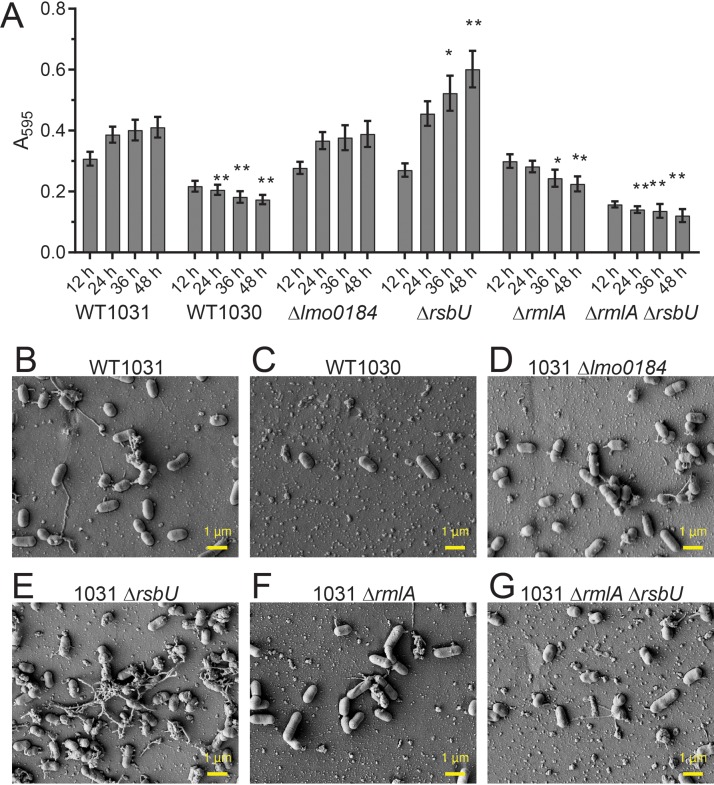
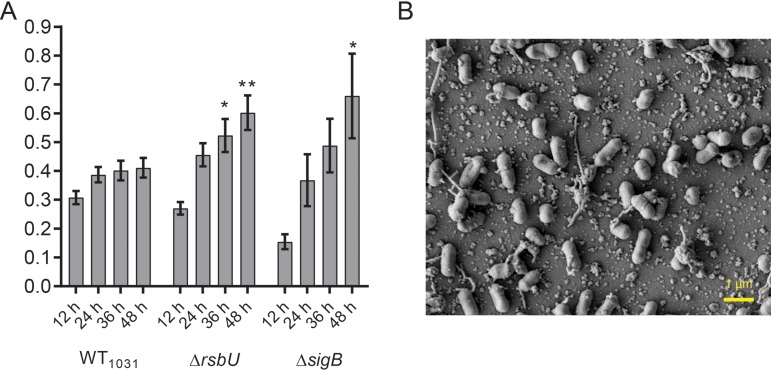
is a Gram-positive firmicute that causes foodborne infections, in part due to its ability to use multiple strategies, including biofilm formation, to survive adverse growth conditions. As a potential way to screen for genes required for biofilm formation, we harnessed the ability of bacteria to accumulate mutations in the genome over time, diverging the properties of seemingly identical strains. By sequencing the genomes of four laboratory reference strains of the commonly used EGDe, we showed that each isolate contains single nucleotide polymorphisms (SNPs) compared with the reference genome. We discovered that two SNPs, contained in two independent genes within one of the isolates, impacted biofilm formation. Using bacterial genetics and phenotypic assays, we confirmed that and influence biofilm formation. RsbU is the upstream regulator of the alternative sigma factor SigB, and mutation of either or increased biofilm formation. In contrast, deletion of , which encodes the first enzyme for TDP-l-rhamnose biosynthesis, resulted in a reduction in the amount of biofilm formed. Further analysis of biofilm formation in a strain that still produces TDP-l-rhamnose but which cannot decorate the wall teichoic acid with rhamnose ( mutant) showed that it is the decorated wall teichoic acid that is required for adhesion of the cells to surfaces. Together, these data uncover novel routes by which biofilm formation by can be impacted. Biofilms are an important mode of growth in many settings. Here, we looked at small differences in the genomes of the bacterium isolate EGDe and used them to find out how biofilms form. This important fundamental information may help new treatments to be developed and also highlights the fact that isolates of the same identity often diverge.
是一种革兰氏阳性Firmicute,会引起食源性感染,部分原因是它能够使用多种策略,包括生物膜形成,来在不利的生长条件下存活。作为筛选生物膜形成所需基因的潜在方法,我们利用细菌随时间积累基因组突变的能力,使看似相同的菌株的特性发生分歧。通过对四种常用的 EGDe 实验室参考菌株的基因组进行测序,我们表明每个分离株都与参考基因组相比存在单核苷酸多态性(SNP)。我们发现,两个 SNP 存在于一个分离株中的两个独立基因中,影响生物膜形成。使用细菌遗传学和表型测定法,我们证实了 和 影响生物膜形成。RsbU 是替代 sigma 因子 SigB 的上游调节剂, 和 中的任何一个突变都增加了生物膜形成。相比之下,编码 TDP-l-鼠李糖生物合成的第一个酶的基因 的缺失导致生物膜形成量减少。在仍然产生 TDP-l-鼠李糖但不能用鼠李糖修饰壁磷壁酸的菌株( 突变体)中对生物膜形成的进一步分析表明,需要用鼠李糖修饰的壁磷壁酸来粘附细胞到表面。这些数据共同揭示了 生物膜形成的新途径。生物膜是许多环境中重要的生长方式。在这里,我们研究了细菌 分离株 EGDe 基因组中的微小差异,并利用它们了解生物膜是如何形成的。这些重要的基础信息可能有助于开发新的治疗方法,也突出了这样一个事实,即相同身份的分离株往往会发生分歧。