Novo Nordisk Foundation Center for Basic Metabolic Research, Section of Human Genomics and Metagenomics in Metabolism, University of Copenhagen, Blegdamsvej 3B 8th floor, 2200, Copenhagen N, Denmark.
Department of Gynecology and Obstetrics, Hvidovre University Hospital, Kettegaardsvej 30, 2650, Hvidovre, Denmark.
BMC Pregnancy Childbirth. 2020 Jan 31;20(1):69. doi: 10.1186/s12884-020-2764-y.
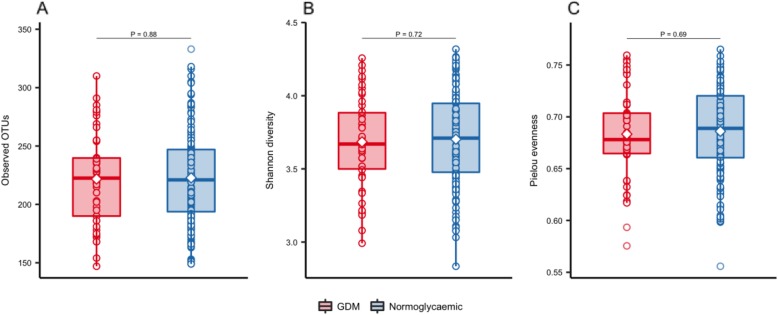
An aberrant composition of the salivary microbiota has been found in individuals with type 2 diabetes, and in pregnant women salivary microbiota composition has been associated with preeclampsia and pre-term birth. Pregnant women, who develop gestational diabetes (GDM), have a high risk of developing type 2 diabetes after pregnancy. In the present study we assessed whether GDM is linked to variation in the oral microbial community by examining the diversity and composition of the salivary microbiota.
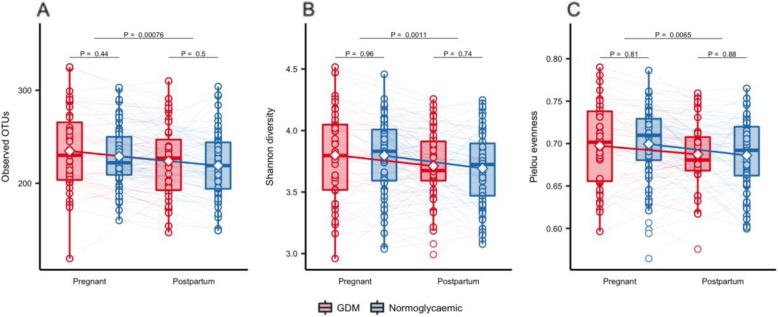
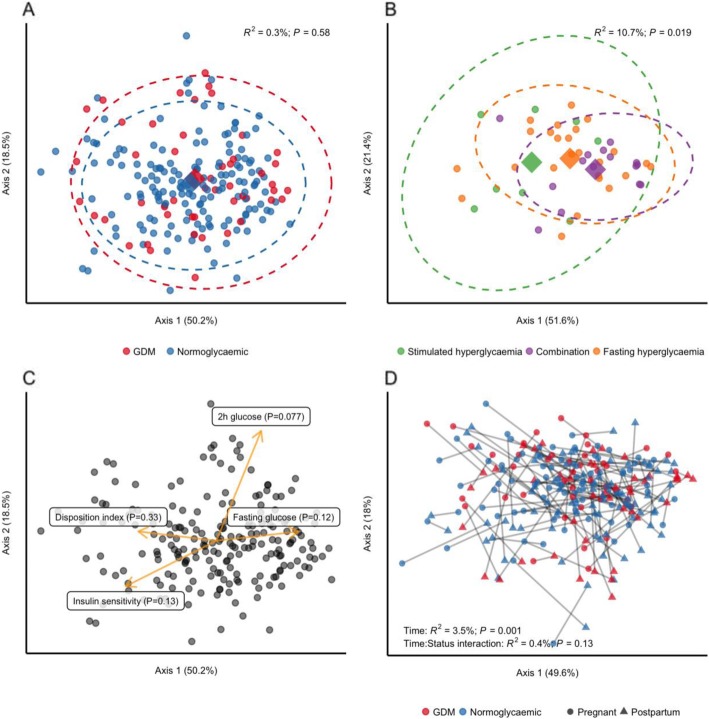
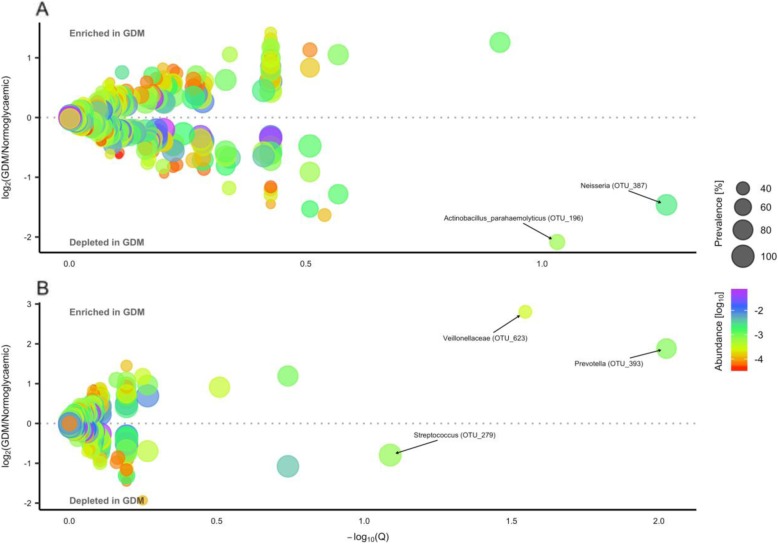
In this observational study the salivary microbiota of pregnant women with GDM (n = 50) and normal glucose regulation (n = 160) in third trimester and 9 months postpartum was assessed by 16S rRNA gene amplicon sequencing of the V1-V3 region. GDM was diagnosed in accordance with the International Association of the Diabetes and Pregnancy Study Groups (IADPSG) criteria. Cross-sectional difference in alpha diversity was assessed using Student's t-test and longitudinal changes were assessed by mixed linear regression. Cross-sectional and longitudinal difference in beta diversity was assessed by permutational multivariate analyses of variance. Differentially abundant genera and OTUs were identified by negative binomial regression.
In the third trimester, two species-level operational taxonomic units (OTUs), while eight OTUs postpartum were differentially abundant in women with GDM compared with normoglycaemic women. OTU richness, Shannon diversity and Pielou evenness decreased from late pregnancy to 9 months after delivery regardless of glycaemic status.
GDM is associated with a minor aberration of the salivary microbiota during late pregnancy and postpartum. For unknown reasons richness of the salivary microbiota decreased from late pregnancy to postpartum, which might be explained by the physiological changes of the immune system during human pregnancy.
在 2 型糖尿病患者和孕妇中发现唾液微生物群落组成异常,而孕妇的唾液微生物群落组成与先兆子痫和早产有关。患有妊娠期糖尿病(GDM)的孕妇在产后患 2 型糖尿病的风险很高。在本研究中,我们通过检查唾液微生物群落的多样性和组成,评估 GDM 是否与口腔微生物群落的变化有关。
在这项观察性研究中,通过对 V1-V3 区的 16S rRNA 基因扩增子测序,评估了患有 GDM(n=50)和正常血糖调节(n=160)的孕妇在孕晚期和产后 9 个月的唾液微生物群。GDM 按照国际糖尿病与妊娠研究协会(IADPSG)标准诊断。使用学生 t 检验评估 alpha 多样性的横断面差异,使用混合线性回归评估纵向变化。通过置换多元方差分析评估 beta 多样性的横断面和纵向差异。通过负二项式回归鉴定差异丰富的属和 OTU。
在孕晚期,有两个种水平的操作分类单元(OTU),而产后 8 个 OTU 在 GDM 女性中与正常血糖女性相比差异丰富。无论血糖状况如何,OTU 丰富度、香农多样性和皮埃罗均匀度从妊娠晚期到产后 9 个月都有所下降。
GDM 与妊娠晚期和产后唾液微生物群落的轻微异常有关。由于未知原因,唾液微生物群落的丰富度从妊娠晚期到产后下降,这可能是由于人类妊娠期间免疫系统的生理变化所致。