Pereira Ulises, Brunel Nicolas
Department of Statistics, The University of Chicago, Chicago, IL, United States.
Department of Neurobiology, The University of Chicago, Chicago, IL, United States.
Front Comput Neurosci. 2020 Jan 17;13:97. doi: 10.3389/fncom.2019.00097. eCollection 2019.
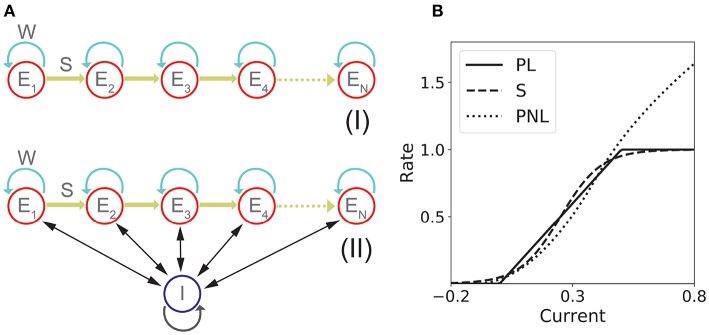
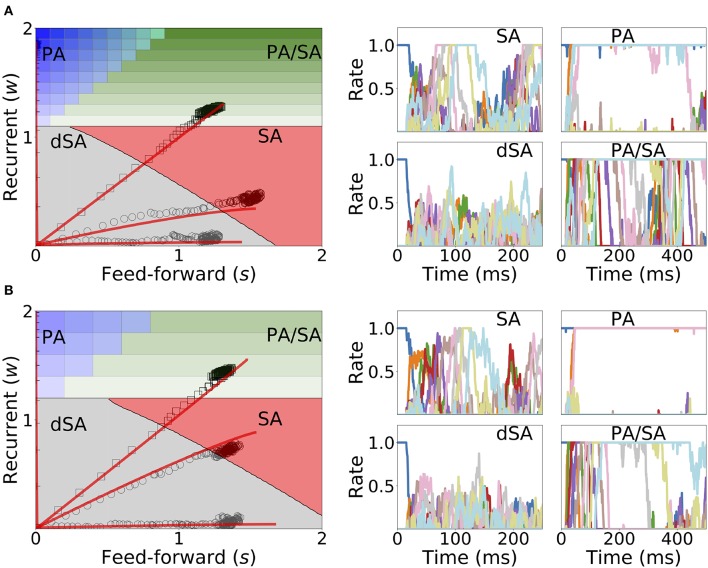
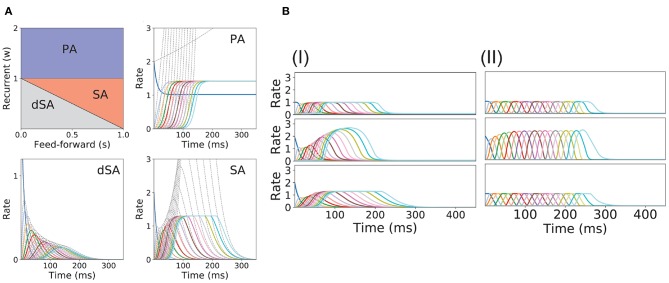
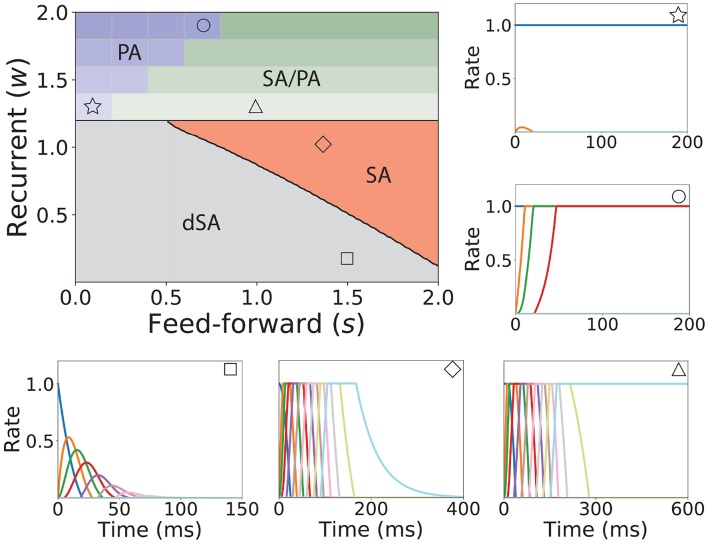
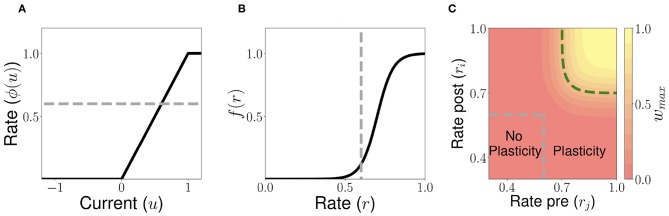
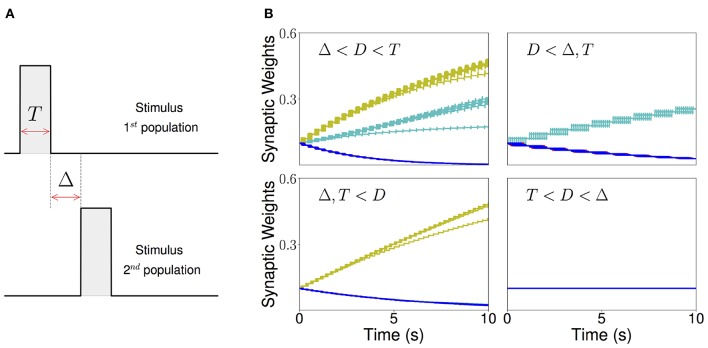
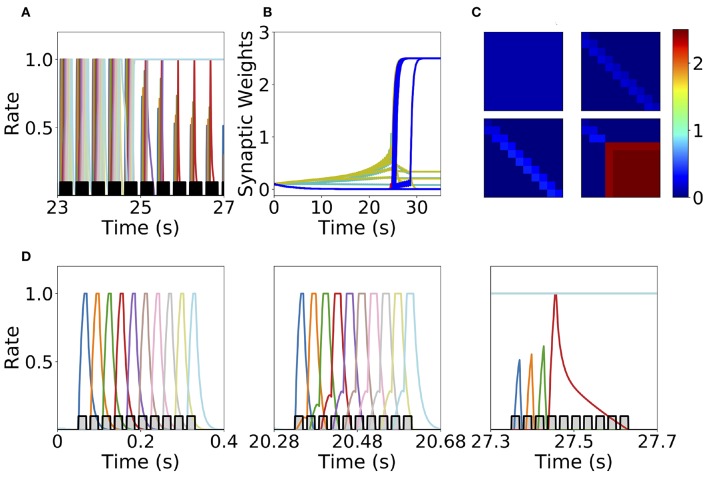
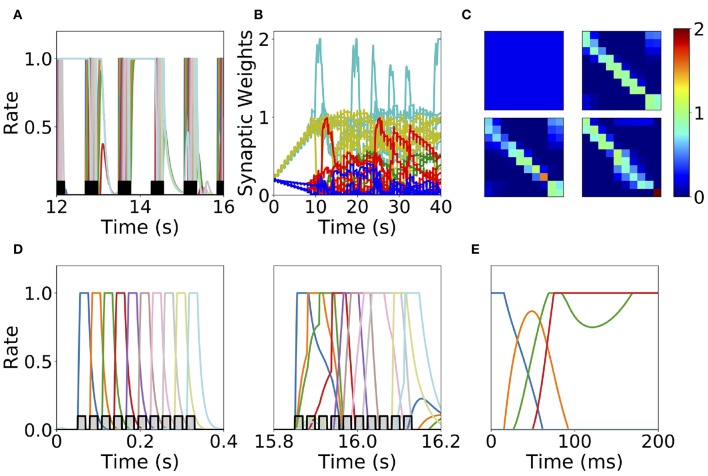
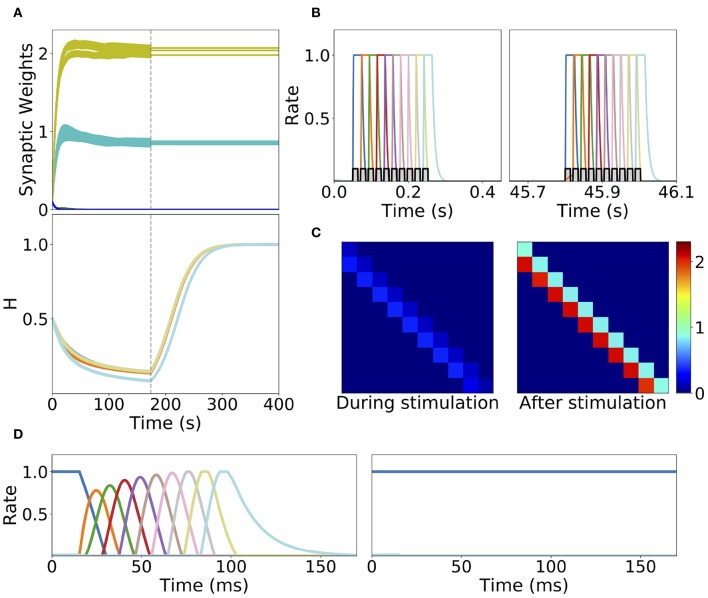
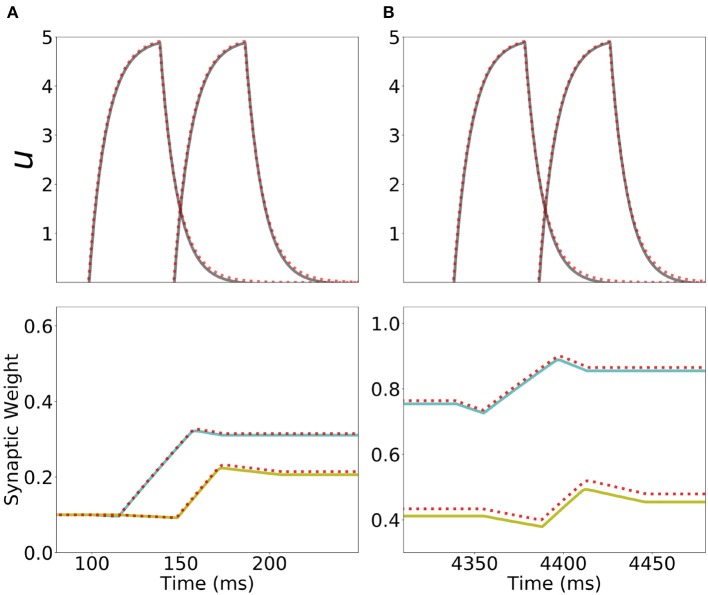
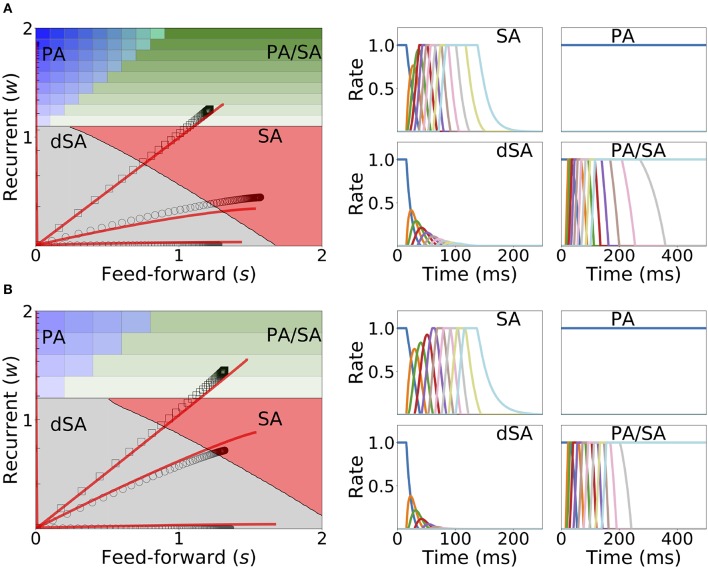
Two strikingly distinct types of activity have been observed in various brain structures during delay periods of delayed response tasks: Persistent activity (PA), in which a sub-population of neurons maintains an elevated firing rate throughout an entire delay period; and Sequential activity (SA), in which sub-populations of neurons are activated sequentially in time. It has been hypothesized that both types of dynamics can be "learned" by the relevant networks from the statistics of their inputs, thanks to mechanisms of synaptic plasticity. However, the necessary conditions for a synaptic plasticity rule and input statistics to learn these two types of dynamics in a stable fashion are still unclear. In particular, it is unclear whether a single learning rule is able to learn both types of activity patterns, depending on the statistics of the inputs driving the network. Here, we first characterize the complete bifurcation diagram of a firing rate model of multiple excitatory populations with an inhibitory mechanism, as a function of the parameters characterizing its connectivity. We then investigate how an unsupervised temporally asymmetric Hebbian plasticity rule shapes the dynamics of the network. Consistent with previous studies, we find that for stable learning of PA and SA, an additional stabilization mechanism is necessary. We show that a generalized version of the standard multiplicative homeostatic plasticity (Renart et al., 2003; Toyoizumi et al., 2014) stabilizes learning by effectively excitatory connections during stimulation and those connections during retrieval. Using the bifurcation diagram derived for fixed connectivity, we study analytically the temporal evolution and the steady state of the learned recurrent architecture as a function of parameters characterizing the external inputs. Slow changing stimuli lead to PA, while fast changing stimuli lead to SA. Our network model shows how a network with plastic synapses can stably and flexibly learn PA and SA in an unsupervised manner.
在延迟反应任务的延迟期内,已在各种脑结构中观察到两种截然不同的活动类型:持续活动(PA),即神经元亚群在整个延迟期内维持升高的放电率;以及序列活动(SA),即神经元亚群在时间上依次被激活。据推测,由于突触可塑性机制,这两种动力学类型都可以被相关网络从其输入的统计信息中“学习”。然而,突触可塑性规则和输入统计信息以稳定方式学习这两种动力学类型的必要条件仍不清楚。特别是,尚不清楚单一学习规则是否能够根据驱动网络的输入统计信息来学习这两种活动模式。在此,我们首先将具有抑制机制的多个兴奋性群体的放电率模型的完整分岔图表征为其连接性特征参数的函数。然后,我们研究无监督的时间不对称赫布可塑性规则如何塑造网络的动力学。与先前的研究一致,我们发现为了稳定学习PA和SA,需要一种额外的稳定机制。我们表明,标准乘法稳态可塑性(Renart等人,2003年;Toyoizumi等人,2014年)的广义版本通过在刺激期间有效增强兴奋性连接以及在检索期间削弱那些连接来稳定学习。利用针对固定连接性导出的分岔图,我们分析研究了作为外部输入特征参数函数的学习到的循环架构的时间演化和稳态。缓慢变化的刺激导致PA,而快速变化的刺激导致SA。我们的网络模型展示了具有可塑性突触的网络如何以无监督方式稳定且灵活地学习PA和SA。