Department of Physiology and Pharmacology, Cumming School of Medicine, Snyder Institute for Chronic Diseases, University of Calgary, Calgary, AB, Canada.
Department of Microbiology, Immunology and Infectious Diseases, Cumming School of Medicine, Snyder Institute for Chronic Diseases, University of Calgary, Calgary, AB, Canada.
Front Immunol. 2020 Jan 15;10:3107. doi: 10.3389/fimmu.2019.03107. eCollection 2019.
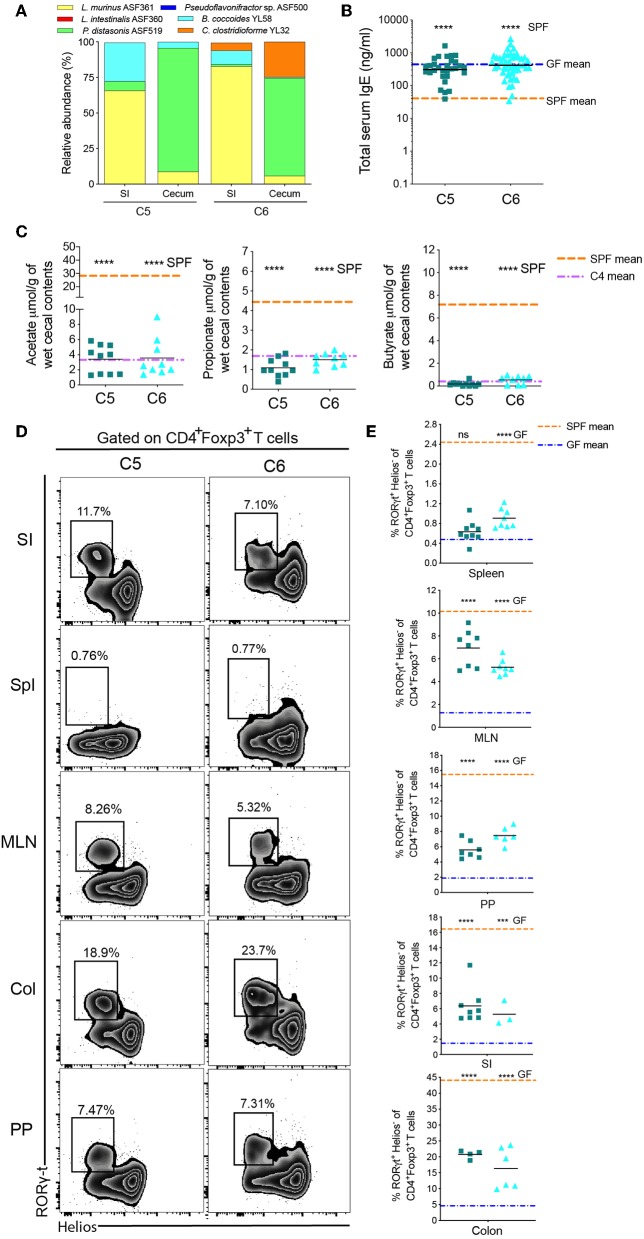
Early life exposure to microbes plays an important role in immune system development. Germ-free mice, or mice colonized with a low-diversity microbiota, exhibit high serum IgE levels. An increase in microbial richness, providing it occurs in a critical developmental window early in life, leads to inhibition of this hygiene-induced IgE. However, whether this inhibition is dependent solely on certain microbial species, or is an additive effect of microbial richness, remains to be determined. Here we report that mice colonized with a combination of bacterial species with specific characteristics is required to inhibit IgE levels. These defined characteristics include the presence in early life, acetate production and immunogenicity reflected by induction of IgA. Suppression of IgE did not correlate with production of the short chain fatty acids propionate and butyrate, or induction of peripherally induced Tregs in mucosal tissues. Thus, inhibition of IgE induction can be mediated by specific microbes and their associated metabolic pathways and immunogenic properties.
早期生活中接触微生物对免疫系统的发育起着重要作用。无菌小鼠或定植了低多样性微生物群的小鼠表现出高血清 IgE 水平。微生物丰富度的增加,如果发生在生命早期的关键发育窗口期,会抑制这种卫生诱导的 IgE。然而,这种抑制是否仅依赖于某些特定的微生物种类,还是微生物丰富度的附加效应,仍有待确定。在这里,我们报告说,需要定植具有特定特征的细菌组合来抑制 IgE 水平。这些定义的特征包括在生命早期存在、产生乙酸盐以及通过诱导 IgA 产生的免疫原性。IgE 的抑制与短链脂肪酸丙酸和丁酸的产生或粘膜组织中诱导的外周诱导性 Tregs 无关。因此,IgE 诱导的抑制可以通过特定的微生物及其相关的代谢途径和免疫原性来介导。