Khan Naiman A, Cannavale Corinne, Iwinski Samantha, Liu Ruyu, McLoughlin Gabriella M, Steinberg Linda G, Walk Anne M
Department of Kinesiology and Community Health, University of Illinois, Champaign, IL, United States.
Neuroscience Program, University of Illinois, Champaign, IL, United States.
Front Pediatr. 2020 Jan 14;7:548. doi: 10.3389/fped.2019.00548. eCollection 2019.
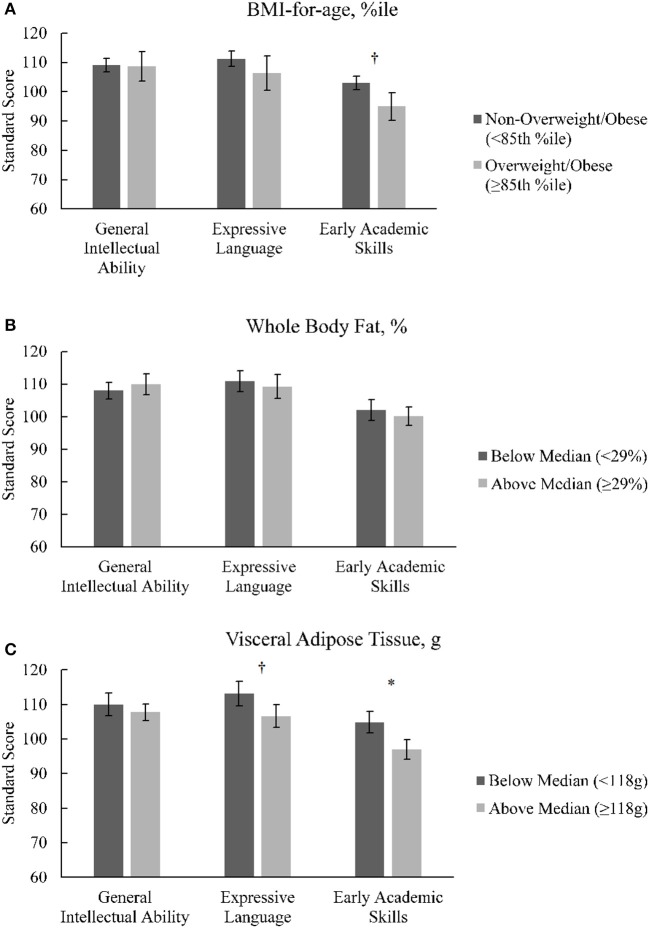
Visceral adipose tissue (VAT) and diet quality influence cognitive health in preadolescents; however, these relationships remain understudied among preschool-age children. Investigate the relationship between VAT, diet quality, academic skills, and cognitive abilities among preschool-age children. Children between 4 and 5 years ( = 57) were enrolled in a cross-sectional study. Woodcock Johnson Early Cognitive and Academic Development Test (ECAD™) was utilized to assess General Intellectual Ability, Early Academic Skills, and Expressive Language. DXA was used to assess VAT. Diet quality was measured using the Healthy Eating Index-2015 (HEI-2015) based on 7-day food records. Greater VAT was associated with poorer Early Academic Skills ( = -0.28, = 0.03) whereas a diet pattern that included Fatty Acids, Whole Grains, Saturated Fats, Seafood and Plant Proteins, Total Vegetables, and Dairy was positively associated with General Intellectual Ability ( = 0.26, = 0.04). Higher VAT is negatively related to Early Academic Skills whereas diet quality was positively and selectively related to intellectual abilities among preschool-age children. These findings indicate that the negative impact of abdominal adiposity on academic skills is evident as early as preschool-age while providing preliminary support for the potentially beneficial role of diet quality on cognitive abilities in early childhood.
内脏脂肪组织(VAT)和饮食质量会影响青春期前儿童的认知健康;然而,在学龄前儿童中,这些关系仍未得到充分研究。研究学龄前儿童的内脏脂肪组织、饮食质量、学术技能和认知能力之间的关系。4至5岁的儿童(n = 57)参与了一项横断面研究。使用伍德科克·约翰逊早期认知与学术发展测试(ECAD™)来评估一般智力能力、早期学术技能和表达性语言。采用双能X线吸收法(DXA)评估内脏脂肪组织。根据7天的食物记录,使用2015年健康饮食指数(HEI - 2015)来衡量饮食质量。较高的内脏脂肪组织与较差的早期学术技能相关(r = -0.28,p = 0.03),而包含脂肪酸、全谷物、饱和脂肪、海鲜和植物蛋白、总蔬菜以及乳制品的饮食模式与一般智力能力呈正相关(r = 0.26,p = 0.04)。较高的内脏脂肪组织与早期学术技能呈负相关,而饮食质量与学龄前儿童的智力能力呈正相关且具有选择性关系。这些发现表明,腹部肥胖对学术技能的负面影响早在学龄前就很明显,同时为饮食质量对幼儿认知能力的潜在有益作用提供了初步支持。