Pham Tra My, Carpenter James R, Morris Tim P, Sharma Manuj, Petersen Irene
MRC Clinical Trials Unit at UCL, London WC1V 6LJ, UK.
Department of Primary Care and Population Health, University College London, London NW3 2PF, UK.
Clin Epidemiol. 2019 Dec 31;11:1081-1088. doi: 10.2147/CLEP.S227621. eCollection 2019.
AIMS/HYPOTHESIS: Type 2 diabetes mellitus is associated with high levels of disease burden, including increased mortality risk and significant long-term morbidity. The prevalence of diabetes differs substantially among ethnic groups. We examined the prevalence of type 2 diabetes diagnoses in the UK primary care setting.
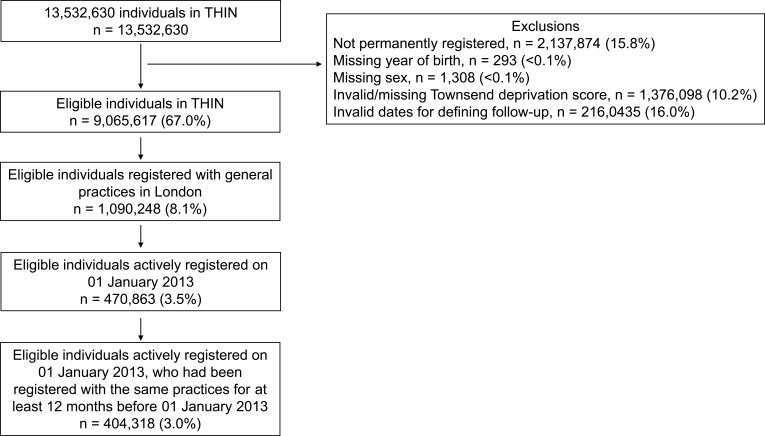
We analysed data from 404,318 individuals in The Health Improvement Network database, aged 0-99 years and permanently registered with general practices in London. The association between ethnicity and the prevalence of type 2 diabetes diagnoses in 2013 was estimated using a logistic regression model, adjusting for effect of age group, sex, and social deprivation. A multiple imputation approach utilising population-level information about ethnicity from the UK census was used for imputing missing data.
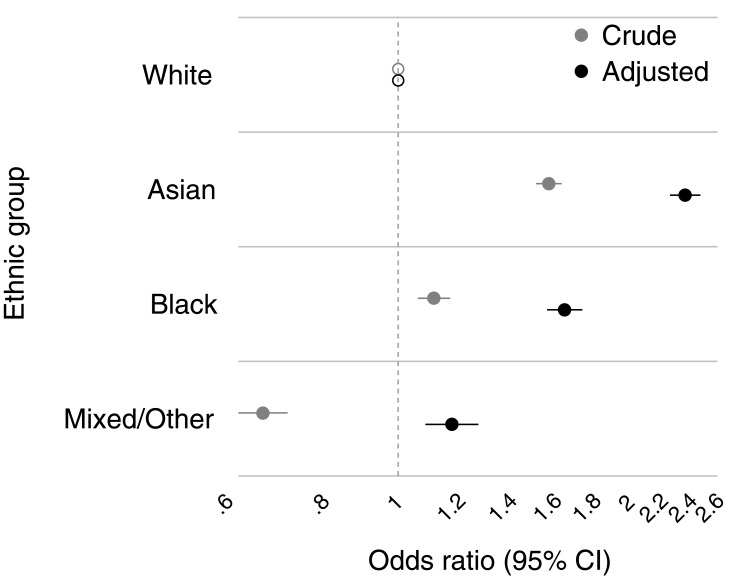
Compared with those of White ethnicity (5.04%, 95% CI 4.95 to 5.13), the crude percentage prevalence of type 2 diabetes was higher in the Asian (7.69%, 95% CI 7.46 to 7.92) and Black (5.58%, 95% CI 5.35 to 5.81) ethnic groups, while lower in the Mixed/Other group (3.42%, 95% CI 3.19 to 3.66). After adjusting for differences in age group, sex, and social deprivation, all minority ethnic groups were more likely to have a diagnosis of type 2 diabetes compared with the White group (OR Asian versus White 2.36, 95% CI 2.26 to 2.47; OR Black versus White 1.65, 95% CI 1.56 to 1.73; OR Mixed/Other versus White 1.17, 95% CI 1.08 to 1.27).
The prevalence of type 2 diabetes was higher in the Asian and Black ethnic groups, compared with the White group. Accurate estimates of ethnic prevalence of type 2 diabetes based on large datasets are important for facilitating appropriate allocation of public health resources, and for allowing population-level research to be undertaken examining disease trajectories among minority ethnic groups, that might help reduce inequalities.
目的/假设:2型糖尿病与高疾病负担相关,包括死亡风险增加和严重的长期发病情况。糖尿病患病率在不同种族群体中差异很大。我们研究了英国初级保健机构中2型糖尿病诊断的患病率。
我们分析了健康改善网络数据库中404318名年龄在0至99岁且在伦敦全科诊所长期注册的个体的数据。使用逻辑回归模型估计2013年种族与2型糖尿病诊断患病率之间的关联,并对年龄组、性别和社会剥夺的影响进行调整。采用利用英国人口普查中关于种族的人口水平信息的多重插补方法来插补缺失数据。
与白人种族(5.04%,95%置信区间4.95至5.13)相比,亚洲种族(7.69%,95%置信区间7.46至7.92)和黑人种族(5.58%,95%置信区间5.35至5.81)中2型糖尿病的粗患病率更高,而在混合/其他种族组中较低(3.42%,95%置信区间3.19至3.66)。在调整年龄组、性别和社会剥夺差异后,与白人组相比,所有少数族裔群体更有可能被诊断为2型糖尿病(亚洲人与白人相比的比值比为2.36,95%置信区间2.26至2.47;黑人与白人相比的比值比为1.65,95%置信区间1.56至1.73;混合/其他与白人相比的比值比为1.17,95%置信区间1.08至1.27)。
与白人组相比,亚洲和黑人种族中2型糖尿病的患病率更高。基于大型数据集准确估计2型糖尿病的种族患病率对于促进公共卫生资源的合理分配以及开展人口水平研究以检查少数族裔群体中的疾病轨迹很重要,这可能有助于减少不平等现象。