Department of Soil Science, University of Cape Coast, Cape Coast, Ghana.
Department of Molecular Biology and Biotechnology, University of Cape Coast, Cape Coast, Ghana.
PLoS One. 2020 Feb 6;15(2):e0228777. doi: 10.1371/journal.pone.0228777. eCollection 2020.
There is paucity of information on antibiotics utilization amongst farmers, factors associated with administration of antibiotics and farmers' knowledge of the effects of antibiotics on the soil ecosystem in Ghana.
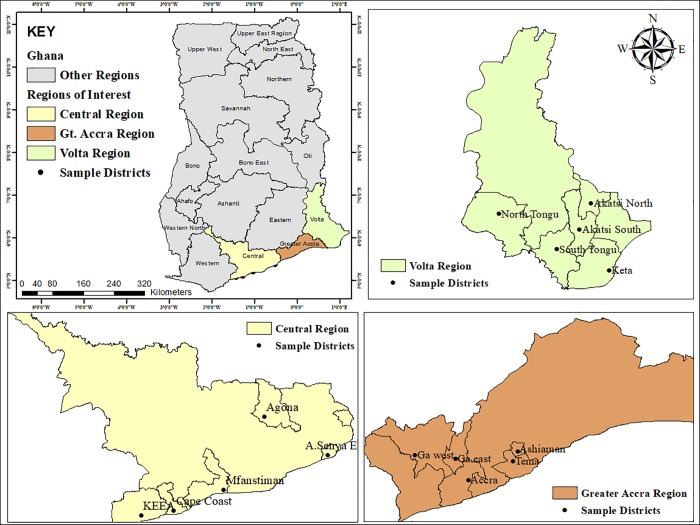
A cross sectional quantitative survey across three coastal regions of Ghana was undertaken amongst poultry and livestock farmers. Six hundred respondents were selected from five districts each across the three regions. Pretested and structured questionnaire were used to collect data through face to face interview. Data were summarized using descriptive statistics and regression analysis. Factors associated with antibiotic administration were determined using binary multiple logistic regression at p ≤ 0.05.
Out of the 600 farmers, 95% administered antibiotics and 84% bought antibiotics over-the-counter without prescription. Approximately 9% of antibiotic administration was carried out by veterinary officers, and the remaining, 91% based on farmer's experience. Approximately 93% had access to antibiotics without any difficulty. Withdrawal period was always observed by only 16% of farmers. Majority (74%) of farmers never had education on antibiotics and none of the farmers screened manure for the antibiotic residuals. Years of farming, income status, level of education of farmers, type of animal kept, access to extension services, registration with farmers' association, employing veterinary services, location of farm, system of production, education on antibiotics and access to antibiotics positively and significantly predicted the administration of antibiotics by farmers. Majority of farmers had inadequate knowledge of the effects of antibiotics on soil ecosystem with mean score ranging between 2.87±0.60 and 2.98 ± 0.7 on a scale of 5.0.
The study exposed the poor practices regarding antibiotic use and also inadequate knowledge on its effect on the soil ecosystem amongst farmers in Ghana. This calls for development of strategies to increase awareness on antibiotics because its misuse can negatively impact human, animals, environment and impact food security.
在加纳,关于农民使用抗生素的信息很少,也没有关于与抗生素使用相关的因素以及农民对抗生素对土壤生态系统影响的了解。
在加纳三个沿海地区进行了一项横断面定量调查,对象是家禽和牲畜农民。从三个地区的五个区中各选取了 600 名受访者。使用预测试和结构化问卷通过面对面访谈收集数据。使用描述性统计和回归分析汇总数据。使用二元多项逻辑回归确定与抗生素使用相关的因素,p 值≤0.05。
在 600 名农民中,95%的人使用过抗生素,84%的人在没有处方的情况下从药店购买过抗生素。大约 9%的抗生素使用是由兽医人员进行的,其余的 91%则基于农民的经验。大约 93%的农民可以轻松获得抗生素。只有 16%的农民始终遵守停药期。大多数(74%)农民从未接受过关于抗生素的教育,也没有农民对粪便进行抗生素残留筛查。农民的养殖年限、收入状况、教育程度、饲养动物的种类、是否能够获得推广服务、是否加入农民协会、是否聘请兽医服务、农场位置、生产方式、抗生素教育和抗生素的可获得性都对农民使用抗生素的行为有积极且显著的影响。大多数农民对抗生素对土壤生态系统的影响知之甚少,平均得分为 2.87±0.60 到 2.98±0.7,满分 5.0 分。
该研究揭示了加纳农民在抗生素使用方面存在的不良做法,以及他们对抗生素对土壤生态系统影响的认识不足。这就需要制定战略来提高对抗生素的认识,因为抗生素的滥用可能会对人类、动物、环境和食品安全产生负面影响。