Sichuan Circular Economy Research Center, Southwest University of Science and Technology, Mianyang, China.
School of Public Administration, University of Electronic Science and Technology of China, Chengdu, China.
PLoS One. 2020 Feb 7;15(2):e0228223. doi: 10.1371/journal.pone.0228223. eCollection 2020.
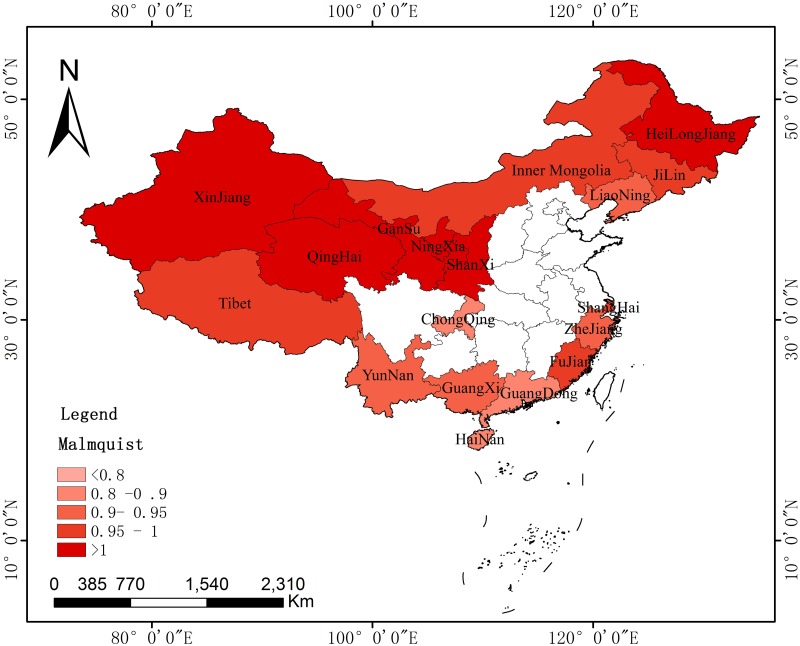
To better understand the agricultural resources and environmental problems of the provinces along The Belt and Road in China, it is critical to investigate their agricultural carbon emission efficiency and evolutionary trends. Based on the panel data of 18 key provinces and cities between 2006 and 2015, this paper evaluated the agricultural carbon emission efficiency with the data envelopment analysis-Malmquist model and further explored their dynamic evolutionary trends. There were several main findings. First, the efficiency levels of agricultural carbon emissions showed significant regional differentiation among the areas, with that along the 21st-Century Maritime Silk Road being much higher than that along the Silk Road Economic Belt. Second, technical efficiency was the key factor that restricted the improvement of the comprehensive efficiency of agricultural carbon. Third, most provinces invested in too many redundant and unreasonably allocated resources, showing a trend of diminishing returns to scale. Last, According to dynamic evolution analysis, the total productivity still demonstrated a diminishing trend. This paper provides some suggestions for effectively improve the efficiency of agricultural carbon emissions in China, such as optimize the agricultural industrial structure, increasing the investment of carbon emission reduction technology, and implementing a carbon emission quota clearing system. This paper contributes to the improvement of the environment in China.
为了更好地了解“一带一路”沿线省份的农业资源与环境问题,研究其农业碳排放效率及其动态演变趋势至关重要。本文基于 2006-2015 年中国 18 个重点省份的面板数据,运用数据包络分析-马尔科夫模型对农业碳排放效率进行了评价,并进一步探讨了其动态演变趋势。主要结论如下:第一,农业碳排放效率的水平在区域间存在显著差异,其中 21 世纪海上丝绸之路沿线省份的效率明显高于丝绸之路经济带沿线省份;第二,技术效率是制约农业碳综合效率提升的关键因素;第三,大多数省份投入了过多的冗余和不合理配置的资源,表现出规模报酬递减的趋势;第四,从动态演进分析来看,全要素生产率仍呈现出下降趋势。本文为中国有效提高农业碳排放效率提供了一些建议,如优化农业产业结构、增加减排技术投入、实施碳排放配额清算制度等。本文为中国的环境改善做出了贡献。