Bürkner Paul-Christian
Department of Computer Science, Aalto University, Konemiehentie 2, 02150 Espoo, Finland.
J Intell. 2020 Feb 4;8(1):5. doi: 10.3390/jintelligence8010005.
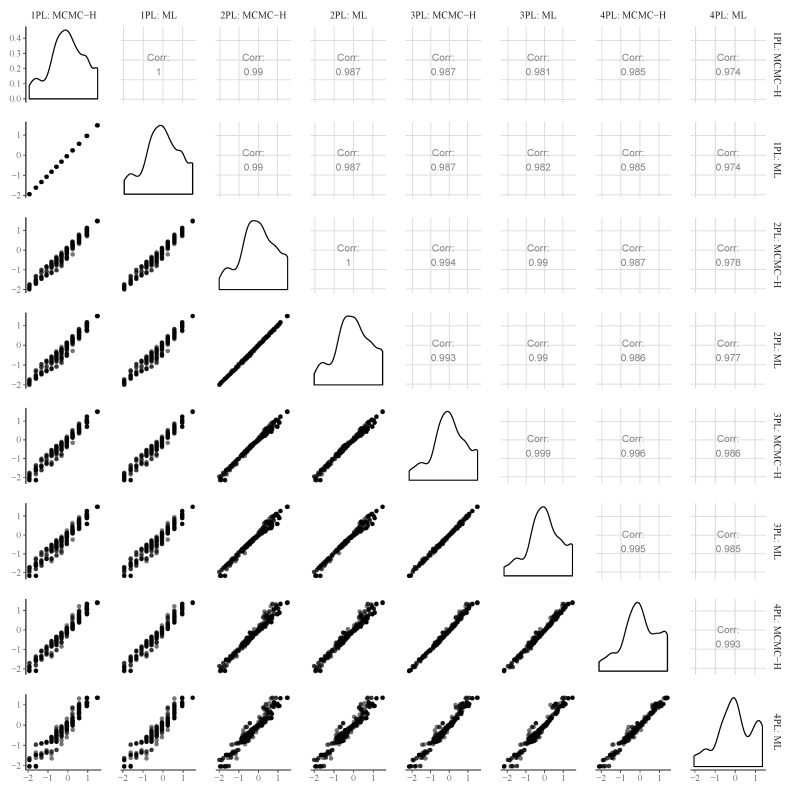
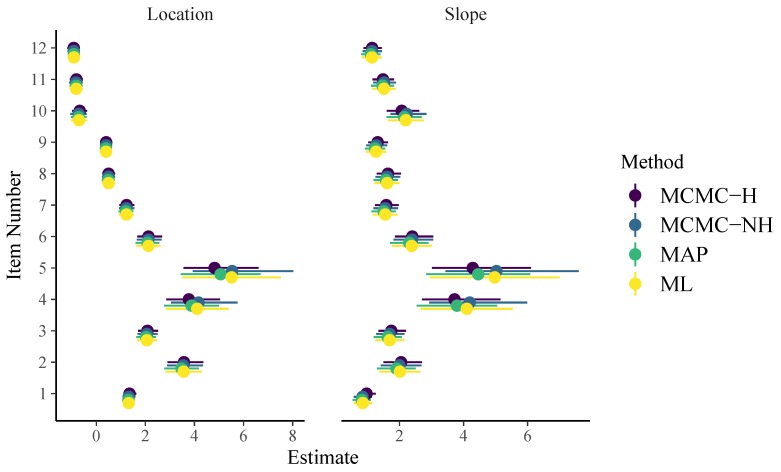
Raven's Standard Progressive Matrices (SPM) test and related matrix-based tests are widely applied measures of cognitive ability. Using Bayesian Item Response Theory (IRT) models, I reanalyzed data of an SPM short form proposed by Myszkowski and Storme (2018) and, at the same time, illustrate the application of these models. Results indicate that a three-parameter logistic (3PL) model is sufficient to describe participants dichotomous responses (correct vs. incorrect) while persons' ability parameters are quite robust across IRT models of varying complexity. These conclusions are in line with the original results of Myszkowski and Storme (2018). Using Bayesian as opposed to frequentist IRT models offered advantages in the estimation of more complex (i.e., 3-4PL) IRT models and provided more sensible and robust uncertainty estimates.
瑞文标准渐进矩阵(SPM)测试及相关的基于矩阵的测试是广泛应用的认知能力测量方法。使用贝叶斯项目反应理论(IRT)模型,我重新分析了 Myszkowski 和 Storme(2018 年)提出的 SPM 简版数据,同时说明了这些模型的应用。结果表明,三参数逻辑斯蒂(3PL)模型足以描述参与者的二分反应(正确与错误),而个体的能力参数在不同复杂程度的 IRT 模型中相当稳健。这些结论与 Myszkowski 和 Storme(2018 年)的原始结果一致。与频率主义 IRT 模型相比,使用贝叶斯 IRT 模型在估计更复杂(即 3 - 4PL)的 IRT 模型时具有优势,并提供了更合理、更稳健的不确定性估计。