Zhang Xiang-Long, Zheng Yu, Xia Meng-Lei, Wu Ya-Nan, Liu Xiao-Jing, Xie San-Kuan, Wu Yan-Fang, Wang Min
State Key Laboratory of Food Nutrition and Safety, Key Laboratory of Industrial Fermentation Microbiology, Ministry of Education, College of Biotechnology, Tianjin University of Science & Technology, Tianjin 300457, China.
Foods. 2020 Feb 10;9(2):166. doi: 10.3390/foods9020166.
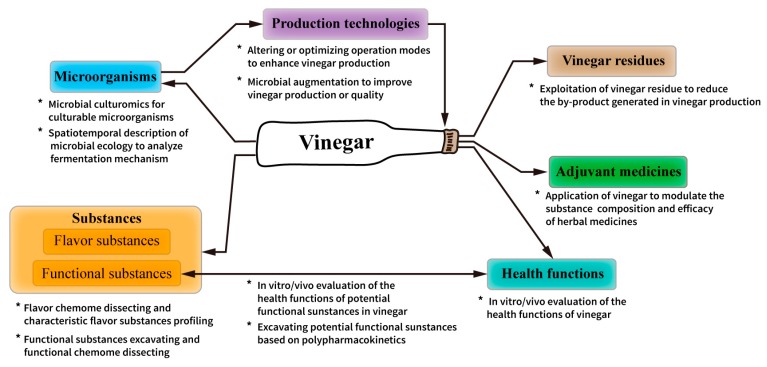
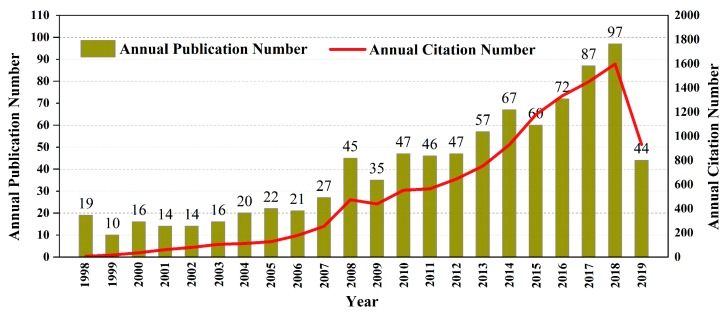
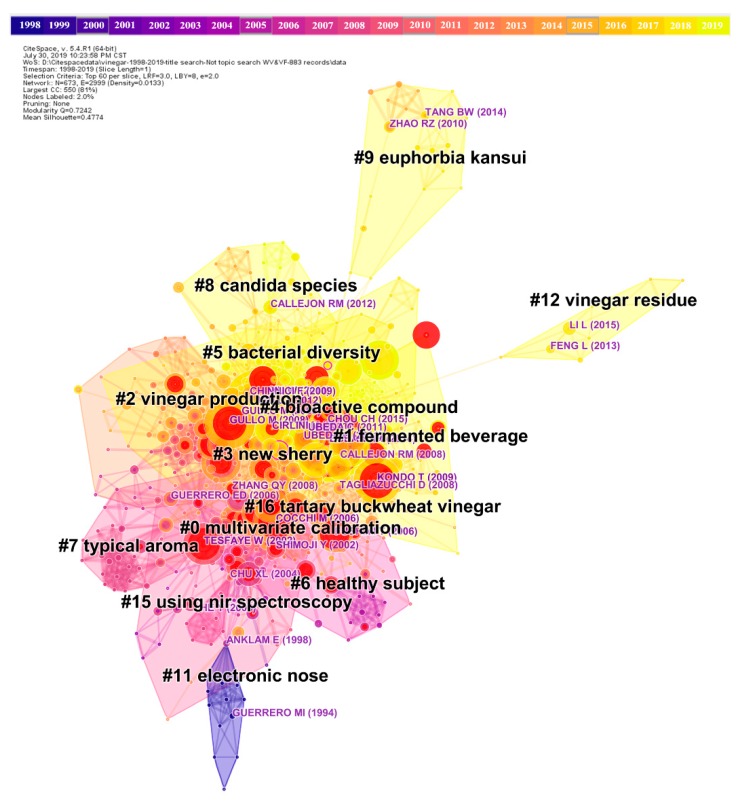
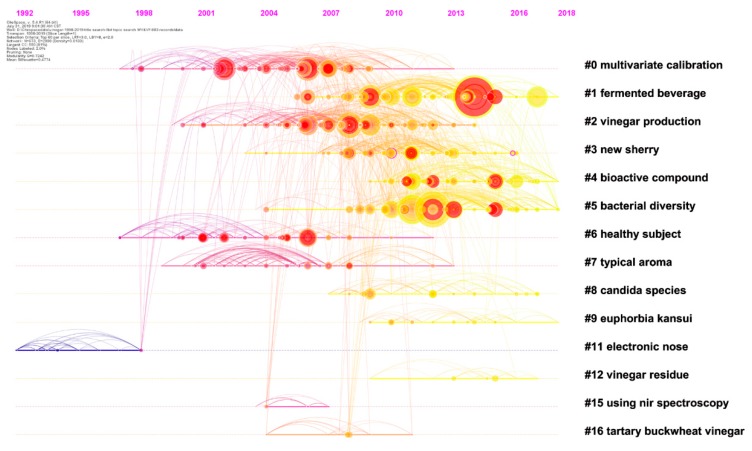
Vinegar is one of the most widely used acidic condiments. In recent decades, rapid advances have been made in the area of vinegar research, and the intellectual structure pertaining to this domain has significantly evolved. Thus, it is important that scientists keep abreast of associated developments to ensure an appropriate understanding of this field. To facilitate this current study, a bibliometric analysis method was adopted to visualize the knowledge map of vinegar research based on literature data retrieved from the Web of Science Core Collection (WoSCC) database. In total, 883 original research and review articles from between 1998 and 2019 with 19,663 references were analyzed by CiteSpace. Both a macroscopical sketch and microscopical characterization of the whole knowledge domain were realized. According to the research contents, the main themes that underlie vinegar research can be divided into six categories, that is, microorganisms, substances, health functions, production technologies, adjuvant medicines, and vinegar residues. In addition to the latter analysis, emerging trends and future research foci were predicted. Finally, the evolutionary stage of vinegar research was discerned according to Shneider's four-stage theory. This review will help scientists to discern the dynamic evolution of vinegar research, as well as highlight areas for future research.
醋是使用最为广泛的酸性调味品之一。近几十年来,醋的研究领域取得了快速进展,该领域的知识结构也发生了显著演变。因此,科学家紧跟相关进展对于确保对该领域有恰当的理解很重要。为推动当前的研究,采用文献计量分析方法,基于从科学引文索引核心合集(WoSCC)数据库检索到的文献数据,将醋的研究知识图谱可视化。CiteSpace对1998年至2019年间的883篇原创研究和综述文章以及19663条参考文献进行了分析。实现了对整个知识领域的宏观勾勒和微观表征。根据研究内容,醋研究的主要主题可分为六类,即微生物、物质、健康功能、生产技术、辅助药物和醋渣。除了上述分析,还预测了新兴趋势和未来研究重点。最后,根据施奈德的四阶段理论识别出醋研究的演化阶段。本综述将帮助科学家了解醋研究的动态演变,并突出未来的研究领域。