Applied Physics and Materials Engineering Department, Escuela Técnica Superior de Ingenieros Industriales, Universidad Politécnica de Madrid, C/ José Gutierrez Abascal, 2, 28006, Madrid, Spain.
Optics, Photonics and Biophotonics Group, Centre for Biomedical Technology, Campus de Montegancedo Universidad Politécnica de Madrid, 28223 Pozuelo de Alarcón, Madrid, Spain.
Anal Bioanal Chem. 2020 May;412(14):3285-3297. doi: 10.1007/s00216-020-02411-3. Epub 2020 Feb 14.
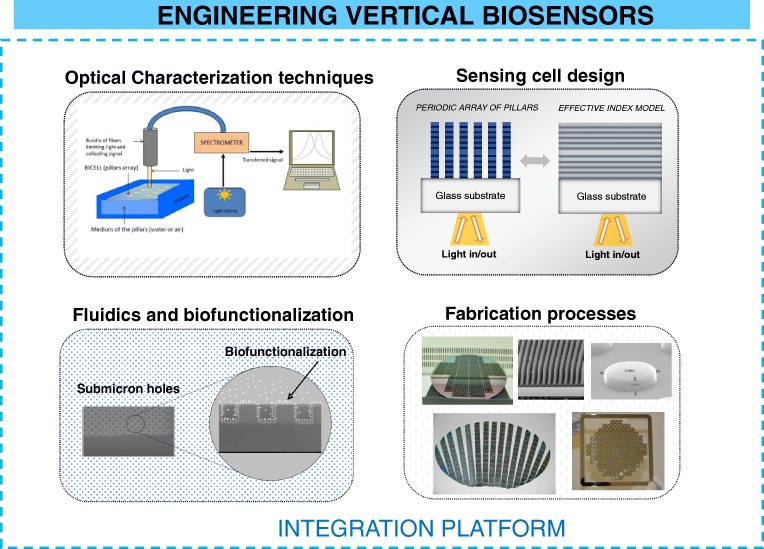
In this work, we review the technology of vertically interrogated optical biosensors from the point of view of engineering. Vertical sensors present several advantages in the fabrication processes and in the light coupling systems, compared with other interferometric sensors. Four different interrelated aspects of the design are identified and described: sensing cell design, optical techniques used in the interrogation, fabrication processes, fluidics, and biofunctionalization of the sensing surface. The designer of a vertical sensor should decide carefully which solution to adopt on each aspect prior to finally integrating all the components in a single platform. Complexity, cost, and reliability of this platform will be determined by the decisions taken on each of the design process. We focus on the research and experience acquired by our group during last years in the field of optical biosensors.
在这项工作中,我们从工程学的角度回顾了垂直检测光学生物传感器技术。与其他干涉传感器相比,垂直传感器在制造工艺和光耦合系统方面具有若干优势。我们确定并描述了设计的四个不同但相互关联的方面:传感单元设计、用于检测的光学技术、制造工艺、流动学以及传感表面的生物功能化。在最终将所有组件集成到单个平台之前,垂直传感器的设计者应仔细决定在每个方面采用哪种解决方案。该平台的复杂性、成本和可靠性将取决于设计过程中每个决策的结果。我们重点介绍了我们小组在过去几年中在光学生物传感器领域的研究和经验。