Liao Simeng, Tang Shengguo, Chang Meinan, Qi Ming, Li Jianjun, Tan Bie, Gao Qian, Zhang Shuo, Li Xiaozhen, Yin Yulong, Sun Peng, Tang Yulong
Laboratory of Animal Nutritional Physiology and Metabolic Process, Key Laboratory of Agro-ecological Processes in Subtropical Region, National Engineering Laboratory for Pollution Control and Waste Utilization in Livestock and Poultry Production, Institute of Subtropical Agriculture, Chinese Academy of Sciences, Changsha 410125, China.
State Key Laboratory of Animal Nutrition, Institute of Animal Sciences, Chinese Academy of Agricultural Sciences, Beijing 100093, China.
Animals (Basel). 2020 Feb 12;10(2):290. doi: 10.3390/ani10020290.
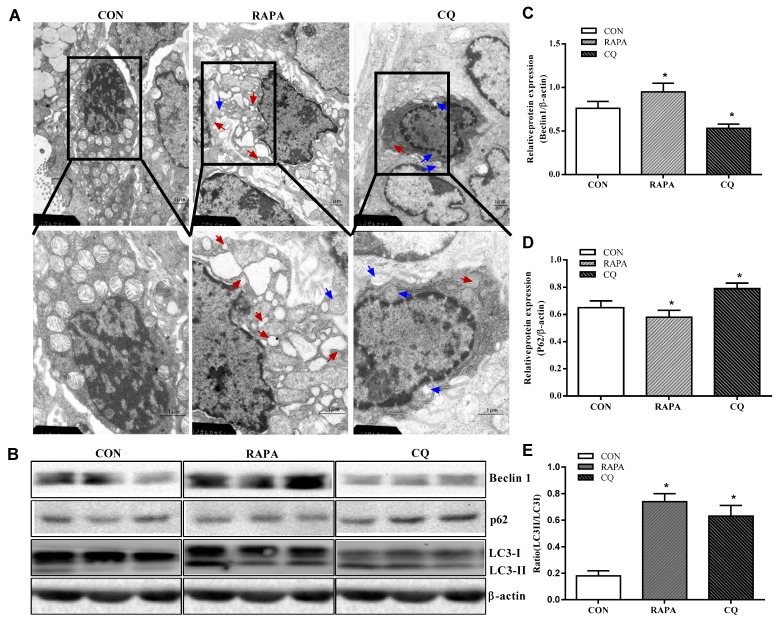
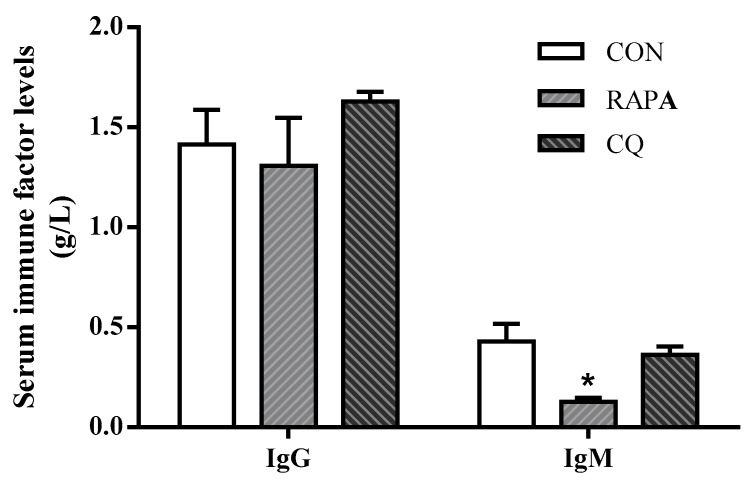
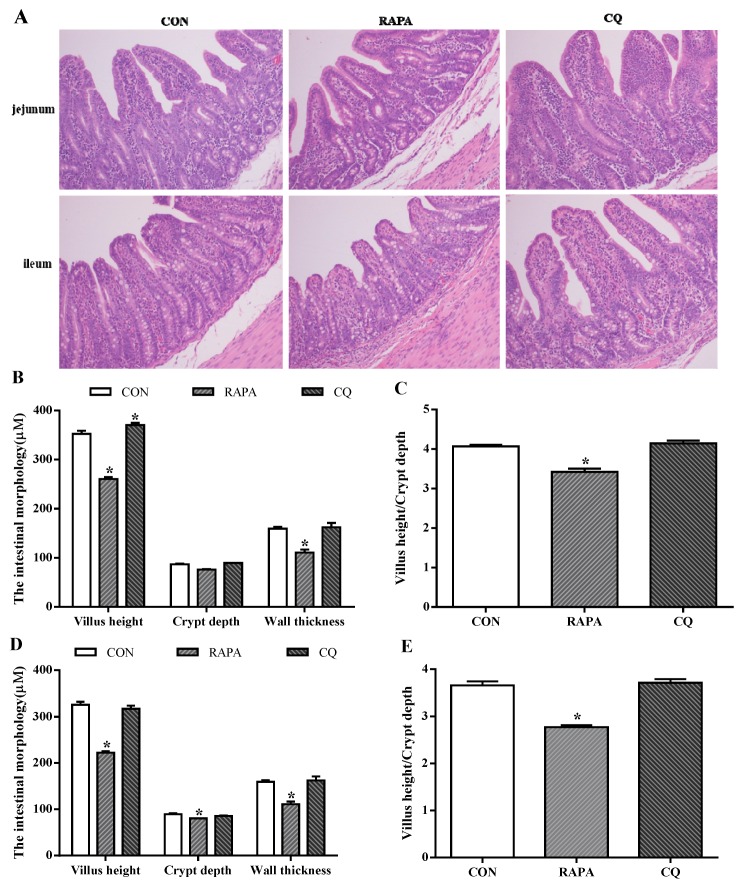
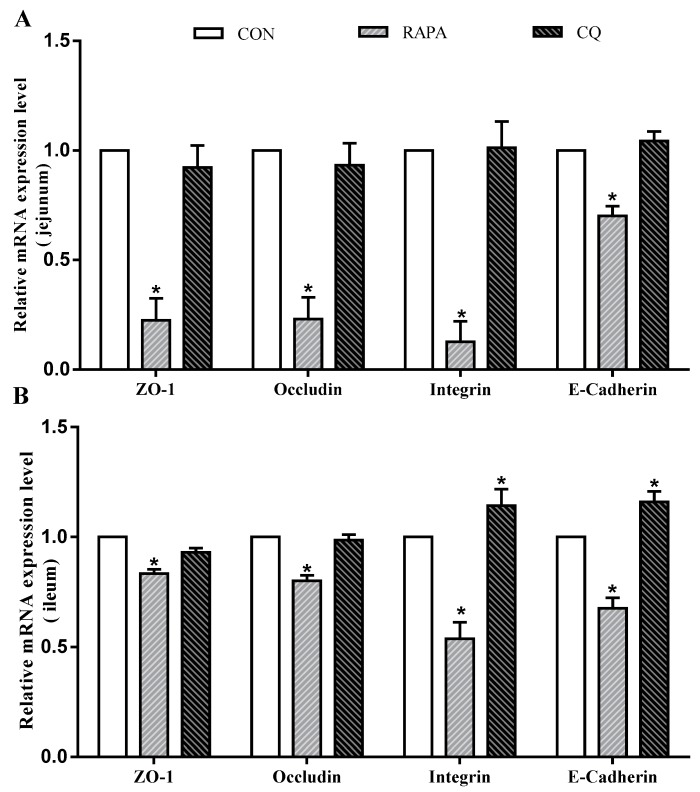
Early weaning stress impairs the development of gastrointestinal barrier function, causing immune system dysfunctions, reduction in feed intake, and growth retardation. Autophagy was hypothesized to be a key underlying cellular process in these dysfunctions. We conjectured that rapamycin (RAPA) and chloroquine (CQ), as two autophagy-modifying agents, regulate the autophagy process and may produce deleterious or beneficial effects on intestinal health and growth. To explore the effect of autophagy on early weaning stress in piglets, 18 early-weaned piglets were assigned to three treatments (each treatment of six piglets) and treated with an equal volume of RAPA, CQ, or saline. The degree of autophagy and serum concentrations of immunoglobulins and cytokines, as well as intestinal morphology and tight junction protein expression, were evaluated. Compared with the control treatment, RAPA-treated piglets exhibited activated autophagy and had decreased final body weight (BW) and average daily gain (ADG) ( < 0.05), impaired intestinal morphology and tight junction function, and higher inflammatory responses. The CQ-treated piglets showed higher final BW, ADG, jejuna and ileal villus height, and lower autophagy and inflammation, compared with control piglets ( < 0.05). Throughout the experiment, CQ treatment was beneficial to alleviate early weaning stress and intestinal and immune system dysfunction.
早期断奶应激会损害胃肠道屏障功能的发育,导致免疫系统功能紊乱、采食量减少和生长发育迟缓。自噬被认为是这些功能紊乱背后的关键细胞过程。我们推测,雷帕霉素(RAPA)和氯喹(CQ)作为两种自噬调节剂,可调节自噬过程,可能对肠道健康和生长产生有害或有益的影响。为了探究自噬对仔猪早期断奶应激的影响,将18头早期断奶仔猪分为三组处理(每组6头仔猪),分别用等量的RAPA、CQ或生理盐水进行处理。评估了自噬程度、免疫球蛋白和细胞因子的血清浓度,以及肠道形态和紧密连接蛋白的表达。与对照处理相比,经RAPA处理的仔猪自噬激活,终末体重(BW)和平均日增重(ADG)降低(<0.05),肠道形态和紧密连接功能受损,炎症反应增强。与对照仔猪相比,经CQ处理的仔猪终末BW、ADG、空肠和回肠绒毛高度更高,自噬和炎症更低(<0.05)。在整个实验过程中,CQ处理有利于缓解早期断奶应激以及肠道和免疫系统功能紊乱。