Institute for Translational Medicine, Department of Periodontology, The Affiliated Hospital of Qingdao University, Qingdao University, Qingdao 266021, China.
University of Groningen, University Medical Center Groningen, Department of Biomedical Engineering-FB40, W.J. Kolff Institute for Biomedical Engineering and Materials Science-FB41, A. Deusinglaan 1, 9713 AV Groningen, Netherlands.
Sci Adv. 2020 Jan 29;6(5):eaay2756. doi: 10.1126/sciadv.aay2756. eCollection 2020 Jan.
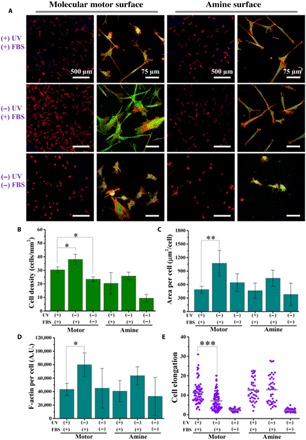
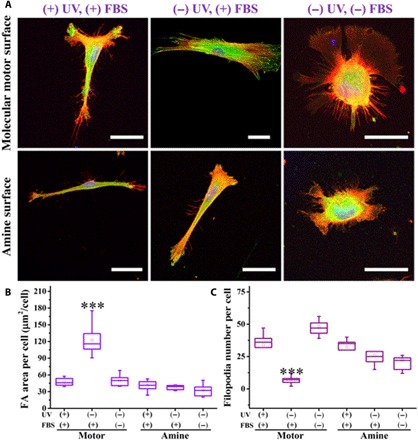
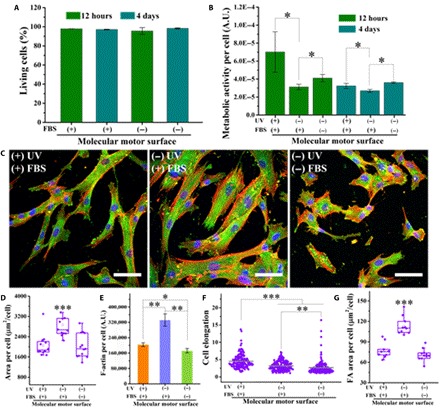
Artificial rotary molecular motors convert energy into controlled motion and drive a system out of equilibrium with molecular precision. The molecular motion is harnessed to mediate the adsorbed protein layer and then ultimately to direct the fate of human bone marrow-derived mesenchymal stem cells (hBM-MSCs). When influenced by the rotary motion of light-driven molecular motors grafted on surfaces, the adsorbed protein layer primes hBM-MSCs to differentiate into osteoblasts, while without rotation, multipotency is better maintained. We have shown that the signaling effects of the molecular motion are mediated by the adsorbed cell-instructing protein layer, influencing the focal adhesion-cytoskeleton actin transduction pathway and regulating the protein and gene expression of hBM-MSCs. This unique molecular-based platform paves the way for implementation of dynamic interfaces for stem cell control and provides an opportunity for novel dynamic biomaterial engineering for clinical applications.
人工旋转分子马达将能量转化为可控运动,并以分子精度驱动系统远离平衡状态。分子运动被用来调节吸附的蛋白质层,从而最终指导人骨髓间充质干细胞(hBM-MSCs)的命运。当受到表面接枝的光驱动分子马达的旋转运动影响时,吸附的蛋白质层使 hBM-MSCs 向成骨细胞分化,而没有旋转时,多能性则更好地保持。我们已经表明,分子运动的信号作用是通过吸附的细胞指令蛋白层介导的,影响着粘着斑-细胞骨架肌动蛋白转导途径,并调节 hBM-MSCs 的蛋白质和基因表达。这个独特的基于分子的平台为实现干细胞控制的动态界面铺平了道路,并为临床应用的新型动态生物材料工程提供了机会。