Department of Ophthalmology, University of Cologne, Faculty of Medicine and University Hospital Cologne, Cologne, Germany
M3 Reading Center, Eye Center, St. Franziskus-Hospital Muenster, Muenster, Germany.
Br J Ophthalmol. 2020 Nov;104(11):1573-1578. doi: 10.1136/bjophthalmol-2019-315717. Epub 2020 Feb 17.
BACKGROUND/AIMS: The prospective, non-interventional ORCA module of the OCEAN study (Observation of Treatment Patterns with Lucentis in Approved Indications) evaluated the qualiy of spectral domain-optical coherence tomography (SD-OCT) image interpretation and treatment decisions by clinicians in Germany and the impact on visual outcomes over 24 months in patients with neovascular age-related macular degeneration (nAMD).
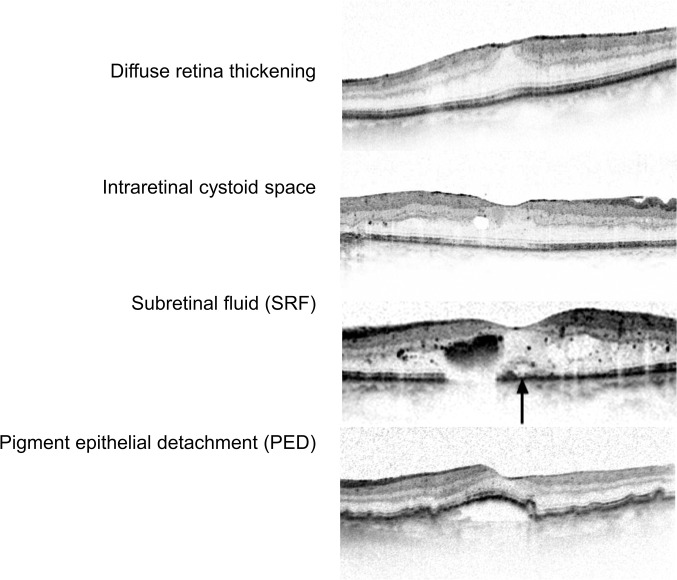
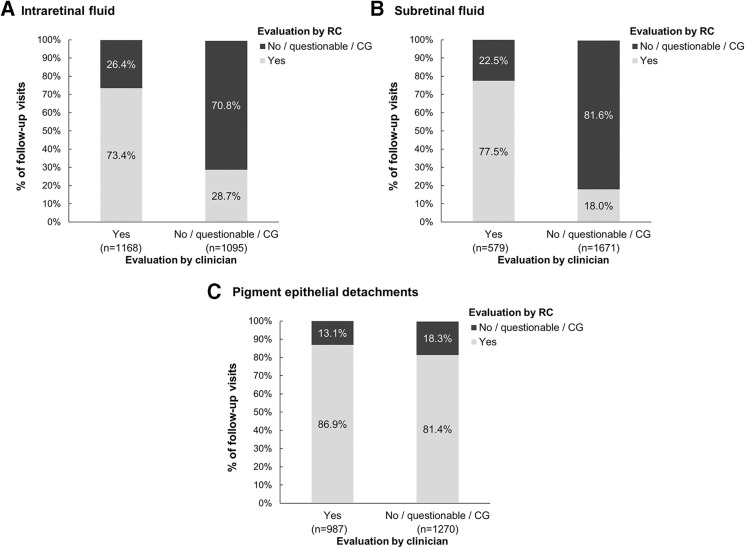
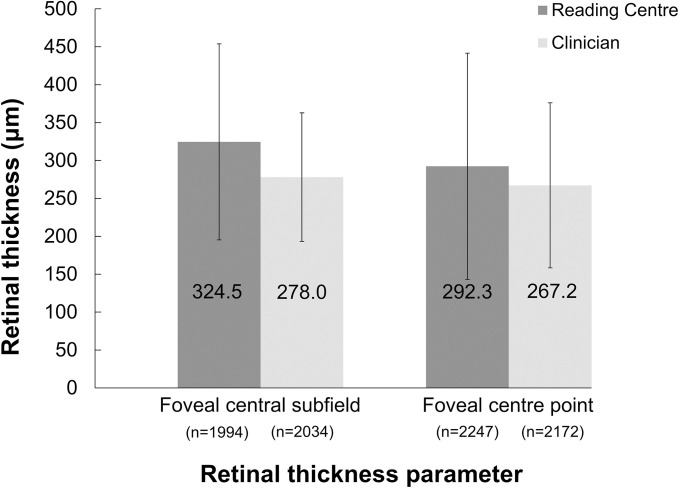
2286 SD-OCT scans of 205 eyes were independently evaluated by clinicians and reading centres (RCs) regarding signs of choroidal neovascularisation (CNV) activity, including presence of intraretinal fluid, subretinal fluid, and/or increase in pigment epithelial detachments. Agreement between clinicians and RCs was calculated. Treatment decisions by clinicians and the impact on treatment outcomes were evaluated.
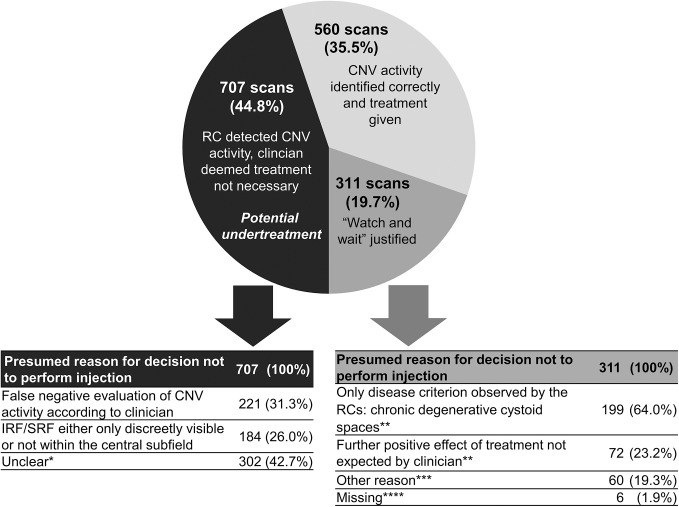
CNV activity was detected by RCs on 1578 scans (69.0%) and by clinicians on 1392 scans (60.9%), with agreement in 74.9% of cases. Of the 1578 scans with RC detected CNV activity, anti-vascular endothelial growth factor injections were performed by clinicians in only 35.5% (560/1578). In 19.7% of cases (311/1578), lack of treatment was justified by patients request, termination criteria or chronic cystoid spaces without other signs for CNV activity. In 44.8% of cases (707/1578) with RC detected CNV activity, clinicians claimed no treatment was necessary despite having correctly detected CNV activity in about 2/3 of these cases. In 34% of cases with presumed undertreatment, visual acuity declined in the following visit.
Although broad agreement on CNV activity parameters was observed between clinicians and RCs, correct identification of CNV activity did not always lead to the initiation of (re-)treatment. To preserve vision over time, correct interpretation of SD-OCT scans and careful retreatment decisions are required.
NCT02194803.
背景/目的:ORCA 模块是 OCEAN 研究(Lucentis 在批准适应证中的治疗模式观察)的前瞻性、非干预性研究模块,评估了德国临床医生对谱域光学相干断层扫描(SD-OCT)图像的解读质量以及对 24 个月内新生血管性年龄相关性黄斑变性(nAMD)患者视力结果的影响。
对 205 只眼的 2286 份 SD-OCT 扫描图由临床医生和阅读中心(RC)进行独立评估,以评估脉络膜新生血管(CNV)活性的迹象,包括视网膜内液、视网膜下液和/或色素上皮脱离的增加。计算临床医生和 RC 之间的一致性。评估临床医生的治疗决策及其对治疗结果的影响。
RC 在 1578 次扫描中(69.0%)和临床医生在 1392 次扫描中(60.9%)检测到 CNV 活性,在 74.9%的情况下一致。在 1578 次 RC 检测到 CNV 活性的扫描中,只有 35.5%(560/1578)的临床医生进行了抗血管内皮生长因子注射。在 19.7%的情况下(311/1578),根据患者的要求、终止标准或没有其他 CNV 活动迹象的慢性囊样空间,不进行治疗是合理的。在 RC 检测到 CNV 活性的 1578 例病例中,44.8%(707/1578)的临床医生声称不需要治疗,尽管在这些病例中约有 2/3 正确地检测到了 CNV 活性。在认为治疗不足的 34%的病例中,视力在随后的就诊中下降。
尽管临床医生和 RC 之间对 CNV 活性参数有广泛的一致性,但正确识别 CNV 活性并不总是导致(重新)治疗的开始。为了随着时间的推移保持视力,需要正确解读 SD-OCT 扫描并谨慎做出再治疗决策。
NCT02194803。