Collaborative Innovation Center for Diagnosis and Treatment of Infectious Diseases, State Key Laboratory for Diagnosis and Treatment of Infectious Diseases, First Affiliated Hospital, School of Medicine, Zhejiang University, Hangzhou, Zhejiang, PR China.
Int J Biol Sci. 2020 Jan 22;16(5):893-903. doi: 10.7150/ijbs.39725. eCollection 2020.
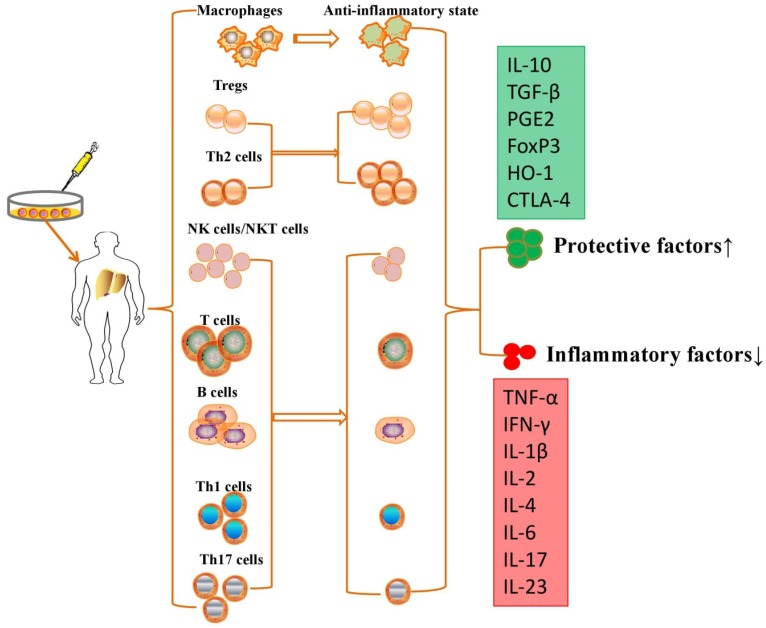
The liver is sensitive to pathogen-induced acute or chronic liver injury, and liver transplantation (LT) is the only effective strategy for end-stage liver diseases. However, the clinical application is limited by a shortage of liver organs, immunological rejection and high cost. Mesenchymal stromal cell (MSC)-based therapy has gradually become a hot topic for promoting liver regeneration and repairing liver injury in various liver diseases, since MSCs are reported to migrate toward injured tissues, undergo hepatogenic differentiation, inhibit inflammatory factor release and enhance the proliferation of liver cells . MSCs exert immunoregulatory effects through cell-cell contact and the secretion of anti-inflammatory factors to inhibit liver inflammation and promote liver regeneration. In addition, MSCs are reported to effectively inhibit the activation of cells of the innate immune system, including macrophages, natural killer (NK) cells, dendritic cells (DCs), monocytes and other immune cells, and inhibit the activation of cells of the adaptive immune system, including T lymphocytes, B lymphocytes and subsets of T cells or B cells. In the current review, we mainly focus on the potential effects and mechanisms of MSCs in inhibiting the activation of immune cells to attenuate liver injury in models or patients with acute liver failure (ALF), nonalcoholic fatty liver disease (NAFLD), and liver fibrosis and in patients or models after LT. We highlight that MSC transplantation may replace general therapies for eliminating acute or chronic liver injury in the near future.
肝脏对外源性病原体诱导的急性或慢性肝损伤敏感,肝移植(LT)是治疗终末期肝病的唯一有效策略。然而,由于肝源短缺、免疫排斥和高成本等因素,其临床应用受到限制。间充质基质细胞(MSC)具有向损伤组织迁移、向肝系细胞分化、抑制炎症因子释放和促进肝细胞增殖等功能,基于 MSC 的治疗策略逐渐成为促进各种肝脏疾病再生和修复肝损伤的热点,因此被报道可用于治疗急性肝衰竭(ALF)、非酒精性脂肪性肝病(NAFLD)、肝纤维化以及 LT 后患者或模型的肝脏损伤。MSC 通过细胞-细胞接触和分泌抗炎因子发挥免疫调节作用,抑制肝脏炎症和促进肝脏再生。此外,MSC 可有效抑制固有免疫细胞(包括巨噬细胞、自然杀伤(NK)细胞、树突状细胞(DC)、单核细胞和其他免疫细胞)和适应性免疫细胞(包括 T 淋巴细胞、B 淋巴细胞和 T 细胞或 B 细胞亚群)的激活。在本综述中,我们主要关注 MSC 抑制免疫细胞激活以减轻 ALF、NAFLD、肝纤维化以及 LT 后患者或模型肝脏损伤的潜在作用和机制。我们强调,MSC 移植可能在不久的将来替代一般疗法,用于消除急性或慢性肝损伤。