Abulmeaty Mahmoud Mustafa Ali, Almajwal Ali M, Alam Iftikhar, Razak Suhail, ElSadek Mohamed F, Aljuraiban Ghadeer S, Hussein Khulood S, Malash Asmaa M
Department of Community Health Sciences, College of Applied Medical Sciences, King Saud University, Riyadh, Saudi Arabia.
Medical Physiology Department, Faculty of Medicine, Zagazig University, Zagazig, Egypt.
Front Physiol. 2020 Jan 31;11:25. doi: 10.3389/fphys.2020.00025. eCollection 2020.
Previous studies have identified the role of irisin and vitamin D in energy homeostasis. However, the effect of irisin and vitamin D on energy regulation has not been thoroughly investigated. Therefore, in this study, the effects of a vitamin D-deficient diet and irisin on total energy expenditure (TEE), food intake, and blood metabolites were investigated in rats.
Sixteen healthy weaned male albino rats were randomly divided into two groups: a group fed a normal balanced growth diet (group A: = 8) and a group fed a normocalcemic diet that is vitamin D deficient with limited ultraviolet (UV) light exposure (group B, = 8). After 6 weeks, the volumes of respiratory gases were measured by open-circuit indirect calorimetry. Serum irisin, 25-OHVD, calcium, insulin, and glucose levels were measured using ELISA. The respiratory quotient (RQ), energy expenditure, and Homeostatic Model Assessment for Insulin Resistance (HOMA-IR) were calculated.
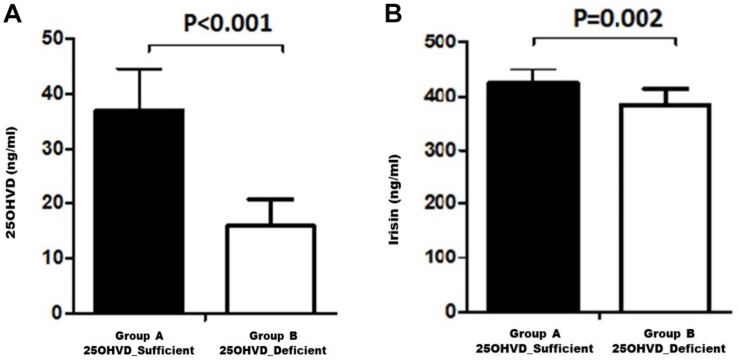
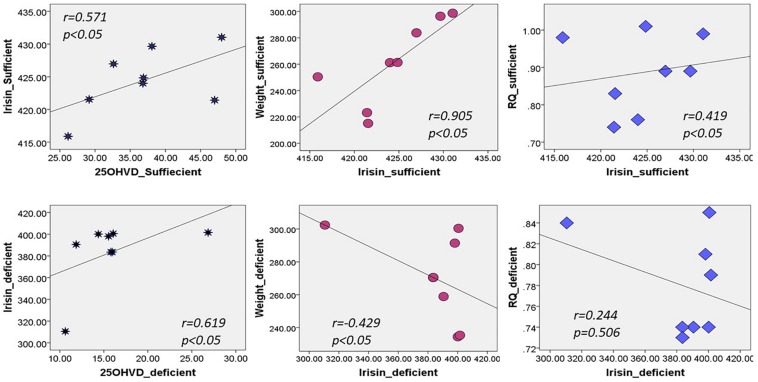
Rats with hypovitaminosis D were hypoirisinemic. Food intake, RQ (to the range of using endogenous fat), and glucose levels reduced significantly, while insulin levels increased. Body weight and TEE were non-significant changed. Additionally, irisin was strongly and positively correlated with body weight under normal conditions ( = 0.905, < 0.01), and a moderate negative correlation in group B ( = -0.429, < 0.05). TEE and irisin showed no significant correlation.
This study demonstrated that the early changes in energy homeostasis and irisin levels during states of hypovitaminosis D are affected by long-term consumption of a vitamin D-deficient diet with limited UV exposure.
以往研究已明确鸢尾素和维生素D在能量平衡中的作用。然而,鸢尾素和维生素D对能量调节的影响尚未得到充分研究。因此,本研究探讨了维生素D缺乏饮食和鸢尾素对大鼠总能量消耗(TEE)、食物摄入量和血液代谢物的影响。
将16只健康断奶雄性白化大鼠随机分为两组:一组喂食正常平衡生长饮食(A组:n = 8),另一组喂食维生素D缺乏且紫外线(UV)照射受限的正常血钙饮食(B组,n = 8)。6周后,采用开路间接量热法测量呼吸气体体积。使用酶联免疫吸附测定法(ELISA)测量血清鸢尾素、25-羟基维生素D(25-OHVD)、钙、胰岛素和葡萄糖水平。计算呼吸商(RQ)、能量消耗和胰岛素抵抗稳态模型评估(HOMA-IR)。
维生素D缺乏的大鼠鸢尾素水平较低。食物摄入量、RQ(至使用内源性脂肪的范围)和葡萄糖水平显著降低,而胰岛素水平升高。体重和TEE无显著变化。此外,在正常条件下,鸢尾素与体重呈强正相关(r = 0.905,P < 0.01),在B组呈中度负相关(r = -0.429,P < 0.05)。TEE与鸢尾素无显著相关性。
本研究表明,维生素D缺乏状态下能量平衡和鸢尾素水平的早期变化受长期食用维生素D缺乏且紫外线照射受限饮食的影响。