Graduate Program in Neuroscience, University of Washington, Seattle, WA 98195, USA; Department of Ophthalmology, University of Washington, Seattle WA 98109, USA.
Department of Ophthalmology, University of Washington, Seattle WA 98109, USA.
Curr Biol. 2020 Apr 6;30(7):1269-1274.e2. doi: 10.1016/j.cub.2020.01.040. Epub 2020 Feb 20.
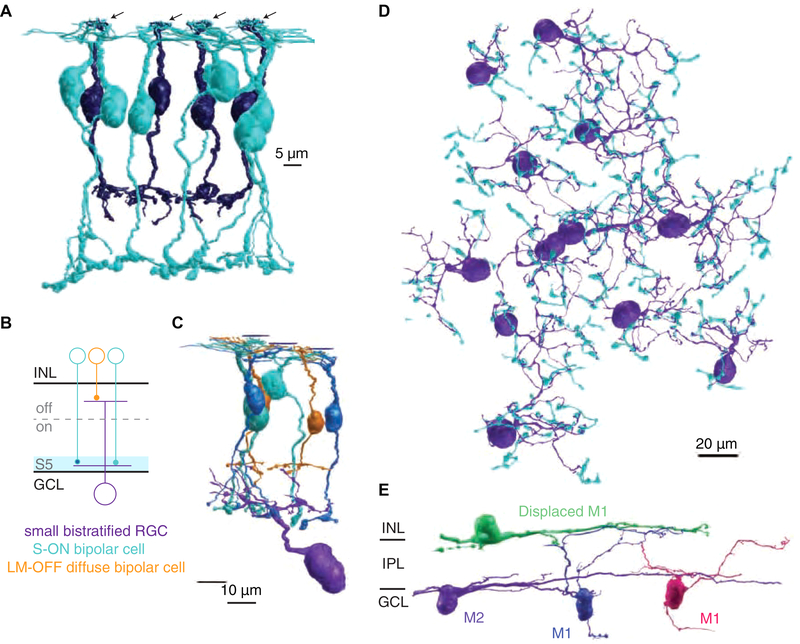
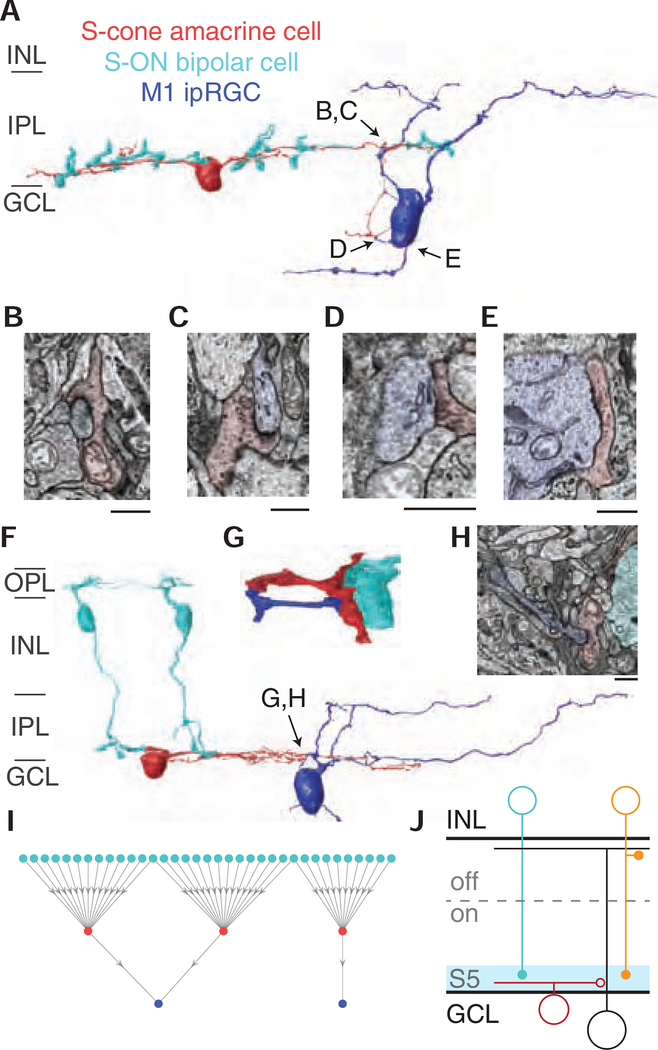
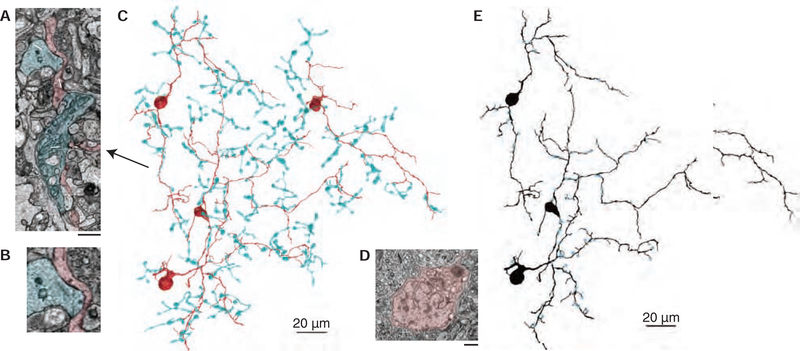
Melanopsin-expressing, intrinsically photosensitive retinal ganglion cells (ipRGCs) synchronize our biological clocks with the external light/dark cycle [1]. In addition to photoentrainment, they mediate the effects of light experience as a central modulator of mood, learning, and health [2]. This makes a complete account of the circuity responsible for ipRGCs' light responses essential to understanding their diverse roles in our well-being. Considerable progress has been made in understanding ipRGCs' melanopsin-mediated responses in rodents [3-5]. However, in primates, ipRGCs also have a rare blue-OFF response mediated by an unknown short-wavelength-sensitive (S)-cone circuit [6]. Identifying this S-cone circuit is particularly important because ipRGCs mediate many of the wide-ranging effects of short-wavelength light on human biology. These effects are often attributed to melanopsin, but there is evidence for an S-cone contribution as well [7, 8]. Here, we tested the hypothesis that the S-OFF response is mediated by the S-ON pathway through inhibitory input from an undiscovered S-cone amacrine cell. Using serial electron microscopy in the macaque retina, we reconstructed the neurons and synapses of the S-cone connectome, revealing a novel inhibitory interneuron, an amacrine cell, receiving excitatory glutamatergic input exclusively from S-ON bipolar cells. This S-cone amacrine cell makes highly selective inhibitory synapses onto ipRGCs, resulting in a blue-OFF response. Identification of the S-cone amacrine cell provides the missing component of an evolutionarily ancient circuit using spectral information for non-image forming visual functions.
表达黑视蛋白的视网膜神经节细胞(ipRGCs)将我们的生物钟与外部的明暗周期同步[1]。除了光适应作用外,它们还作为情绪、学习和健康的中央调节剂,介导光经验的影响[2]。这使得对负责 ipRGCs 光反应的回路有一个完整的了解,对于理解它们在我们健康中的多种作用至关重要。在理解啮齿动物中 ipRGCs 的黑视蛋白介导的反应方面已经取得了相当大的进展[3-5]。然而,在灵长类动物中,ipRGCs 还具有一种由未知短波长敏感(S)-cone 回路介导的罕见的蓝光-OFF 反应[6]。确定这个 S-cone 回路尤其重要,因为 ipRGCs 介导了短波长光对人类生物学的许多广泛影响。这些影响通常归因于黑视蛋白,但也有证据表明 S-cone 也有贡献[7,8]。在这里,我们测试了这样一个假设,即 S-OFF 反应是由 S-ON 通路通过来自未发现的 S-cone 无长突细胞的抑制性输入来介导的。我们在猕猴视网膜中使用连续电子显微镜,重建了 S-cone 连接组的神经元和突触,揭示了一种新型的抑制性中间神经元,即无长突细胞,它仅从 S-ON 双极细胞接收兴奋性谷氨酸能输入。这种 S-cone 无长突细胞对 ipRGCs 形成高度选择性的抑制性突触,导致蓝光-OFF 反应。S-cone 无长突细胞的鉴定为使用非成像视觉功能的光谱信息提供了一个古老的进化电路的缺失组成部分。