Werner Maike, Kurniawan Nicholas A, Bouten Carlijn V C
Soft Tissue Engineering and Mechanobiology, Department of Biomedical Engineering, Eindhoven University of Technology, 5612 AP Eindhoven, The Netherlands.
Institute for Complex Molecular Systems (ICMS), Eindhoven University of Technology, 5612 AZ Eindhoven, The Netherlands.
Materials (Basel). 2020 Feb 21;13(4):963. doi: 10.3390/ma13040963.
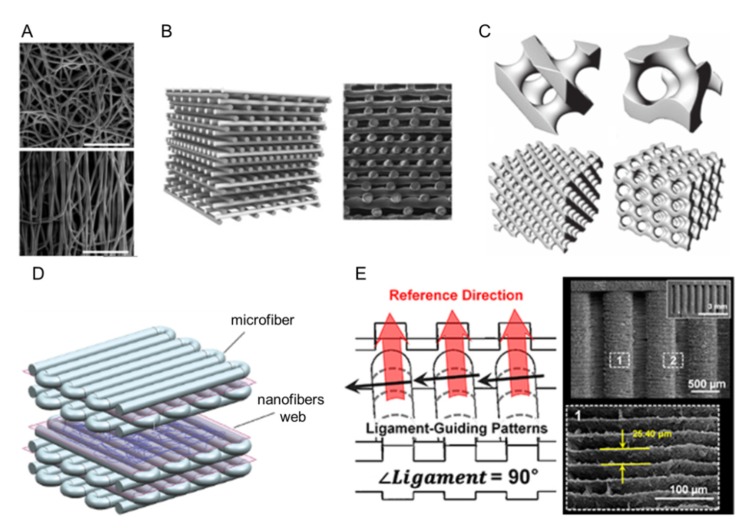
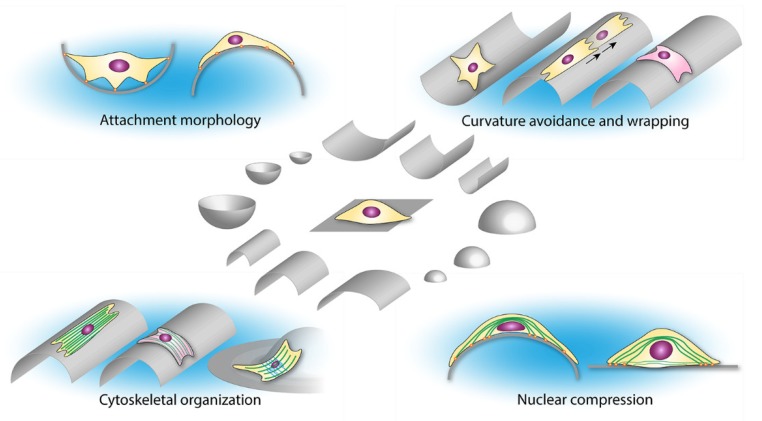
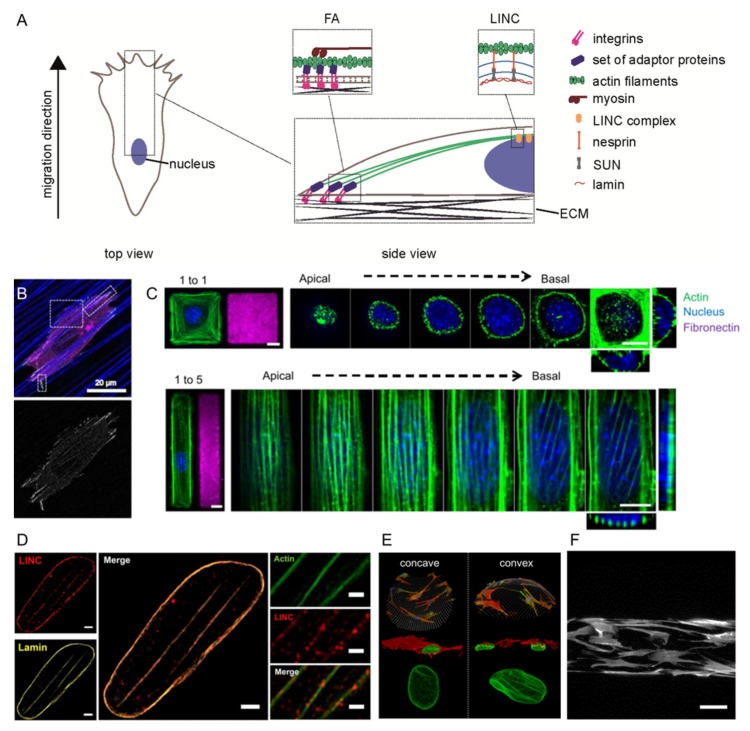
Geometrical cues provided by the intrinsic architecture of tissues and implanted biomaterials have a high relevance in controlling cellular behavior. Knowledge of how cells sense and subsequently respond to complex geometrical cues of various sizes and origins is needed to understand the role of the architecture of the extracellular environment as a cell-instructive parameter. This is of particular interest in the field of tissue engineering, where the success of scaffold-guided tissue regeneration largely depends on the formation of new tissue in a native-like organization in order to ensure proper tissue function. A well-considered internal scaffold design (i.e., the inner architecture of the porous structure) can largely contribute to the desired cell and tissue organization. Advances in scaffold production techniques for tissue engineering purposes in the last years have provided the possibility to accurately create scaffolds with defined macroscale external and microscale internal architectures. Using the knowledge of how cells sense geometrical cues of different size ranges can drive the rational design of scaffolds that control cellular and tissue architecture. This concise review addresses the recently gained knowledge of the sensory mechanisms of cells towards geometrical cues of different sizes (from the nanometer to millimeter scale) and points out how this insight can contribute to informed architectural scaffold designs.
组织的固有结构和植入生物材料所提供的几何线索在控制细胞行为方面具有高度相关性。为了理解细胞外环境结构作为一种细胞指导参数的作用,需要了解细胞如何感知并随后响应各种大小和来源的复杂几何线索。这在组织工程领域尤为重要,在该领域中,支架引导的组织再生的成功很大程度上取决于以类似天然组织的方式形成新组织,以确保组织功能正常。精心设计的内部支架结构(即多孔结构的内部架构)在很大程度上有助于实现理想的细胞和组织排列。近年来,用于组织工程目的的支架生产技术的进步使得精确制造具有明确宏观外部和微观内部结构的支架成为可能。利用细胞如何感知不同尺寸范围几何线索的知识,可以推动控制细胞和组织结构的支架的合理设计。这篇简要综述阐述了最近关于细胞对不同大小(从纳米到毫米尺度)几何线索的感知机制所获得的知识,并指出这种见解如何有助于进行明智的支架结构设计。