Yokote Akihito, Umeno Junji, Kawasaki Keisuke, Fujioka Shin, Fuyuno Yuta, Matsuno Yuichi, Yoshida Yuichiro, Imazu Noriyuki, Miyazono Satoshi, Moriyama Tomohiko, Kitazono Takanari, Torisu Takehiro
Department of Medicine and Clinical Science Graduate School of Medical Science Kyushu University Fukuoka Japan.
Department of Endoscopic Diagnostics and Therapeutics Kyushu University Hospital Fukuoka Japan.
DEN Open. 2023 Jun 22;4(1):e258. doi: 10.1002/deo2.258. eCollection 2024 Apr.
Artificial intelligence (AI) may be practical for image classification of small bowel capsule endoscopy (CE). However, creating a functional AI model is challenging. We attempted to create a dataset and an object detection CE AI model to explore modeling problems to assist in reading small bowel CE.
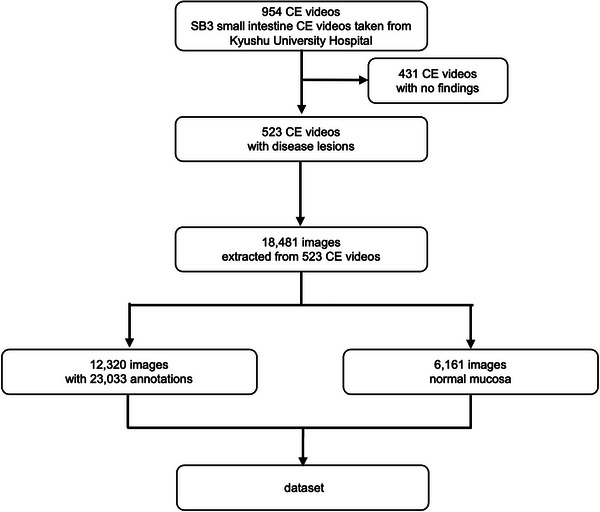
We extracted 18,481 images from 523 small bowel CE procedures performed at Kyushu University Hospital from September 2014 to June 2021. We annotated 12,320 images with 23,033 disease lesions, combined them with 6161 normal images as the dataset, and examined the characteristics. Based on the dataset, we created an object detection AI model using YOLO v5 and we tested validation.
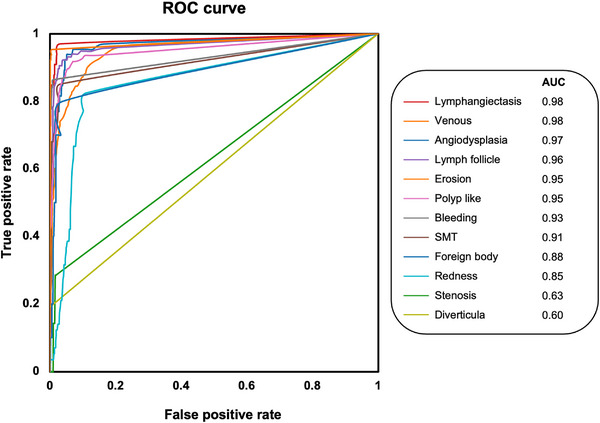
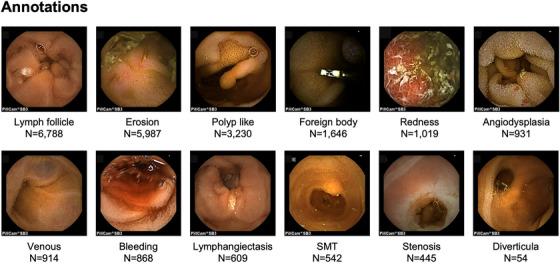
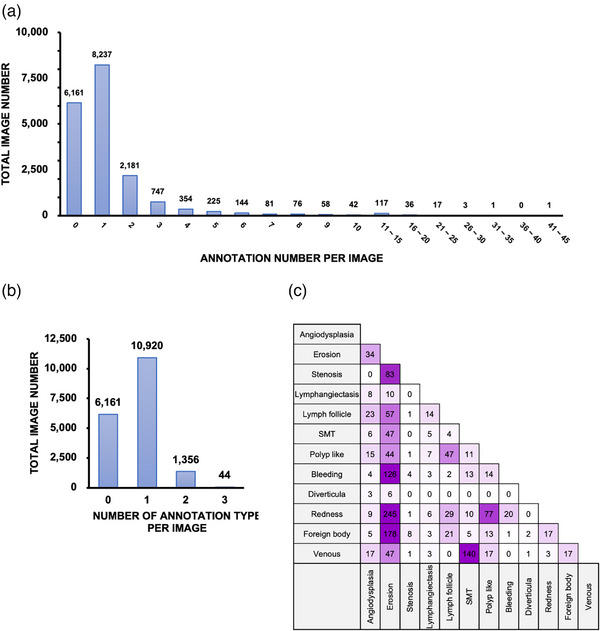
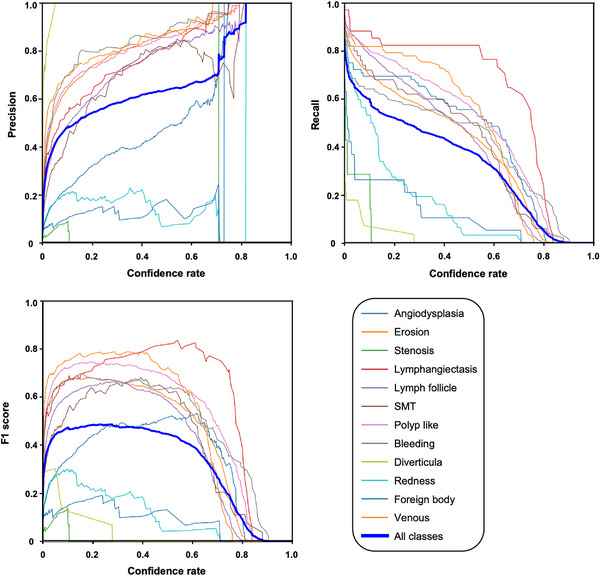
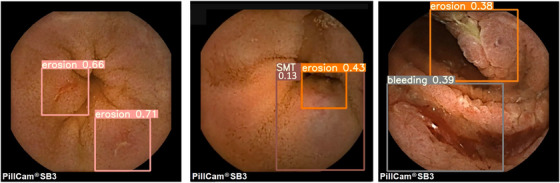
We annotated the dataset with 12 types of annotations, and multiple annotation types were observed in the same image. We test validated our AI model with 1396 images, and sensitivity for all 12 types of annotations was about 91%, with 1375 true positives, 659 false positives, and 120 false negatives detected. The highest sensitivity for individual annotations was 97%, and the highest area under the receiver operating characteristic curve was 0.98, but the quality of detection varied depending on the specific annotation.
Object detection AI model in small bowel CE using YOLO v5 may provide effective and easy-to-understand reading assistance. In this SEE-AI project, we open our dataset, the weights of the AI model, and a demonstration to experience our AI. We look forward to further improving the AI model in the future.
人工智能(AI)可能适用于小肠胶囊内镜(CE)的图像分类。然而,创建一个功能齐全的AI模型具有挑战性。我们试图创建一个数据集和一个目标检测CE AI模型,以探索建模问题,辅助小肠CE的解读。
我们从2014年9月至2021年6月在九州大学医院进行的523例小肠CE检查中提取了18481张图像。我们用23033个疾病病变对12320张图像进行注释,并将它们与6161张正常图像合并作为数据集,并检查其特征。基于该数据集,我们使用YOLO v5创建了一个目标检测AI模型,并进行了验证测试。
我们用12种注释类型对数据集进行注释,并且在同一图像中观察到多种注释类型。我们用1396张图像对我们的AI模型进行了测试验证,所有12种注释类型的敏感度约为91%,检测到1375个真阳性、659个假阳性和120个假阴性。单个注释的最高敏感度为97%,受试者工作特征曲线下的最大面积为0.98,但检测质量因具体注释而异。
使用YOLO v5的小肠CE目标检测AI模型可能提供有效且易于理解的解读辅助。在这个SEE-AI项目中,我们开放了我们的数据集、AI模型的权重以及一个体验我们的AI的演示。我们期待未来进一步改进AI模型。