Leonarski Filip, Mozzanica Aldo, Brückner Martin, Lopez-Cuenca Carlos, Redford Sophie, Sala Leonardo, Babic Andrej, Billich Heinrich, Bunk Oliver, Schmitt Bernd, Wang Meitian
Paul Scherrer Institut, Forschungsstrasse 111, 5232 Villigen PSI, Switzerland.
Struct Dyn. 2020 Feb 26;7(1):014305. doi: 10.1063/1.5143480. eCollection 2020 Jan.
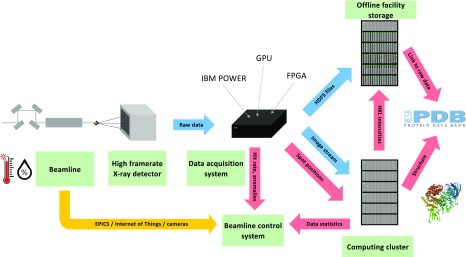
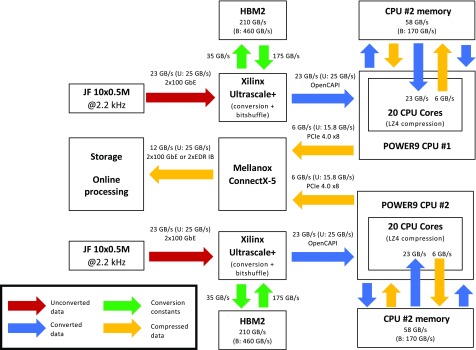
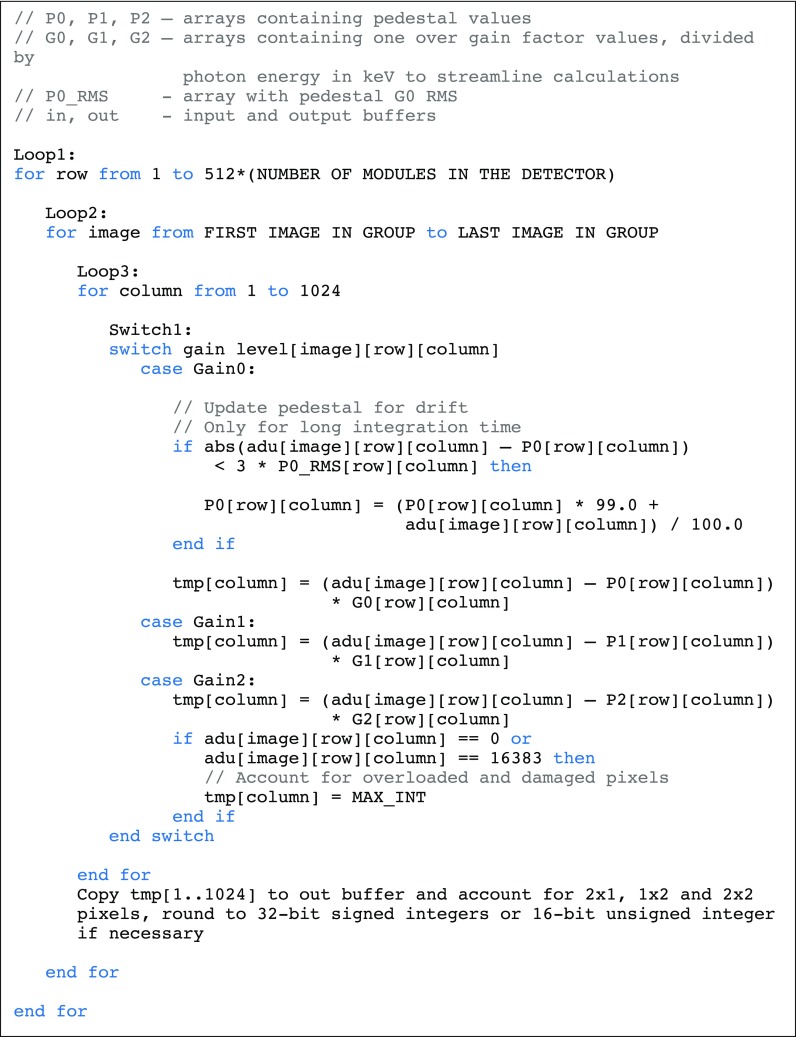
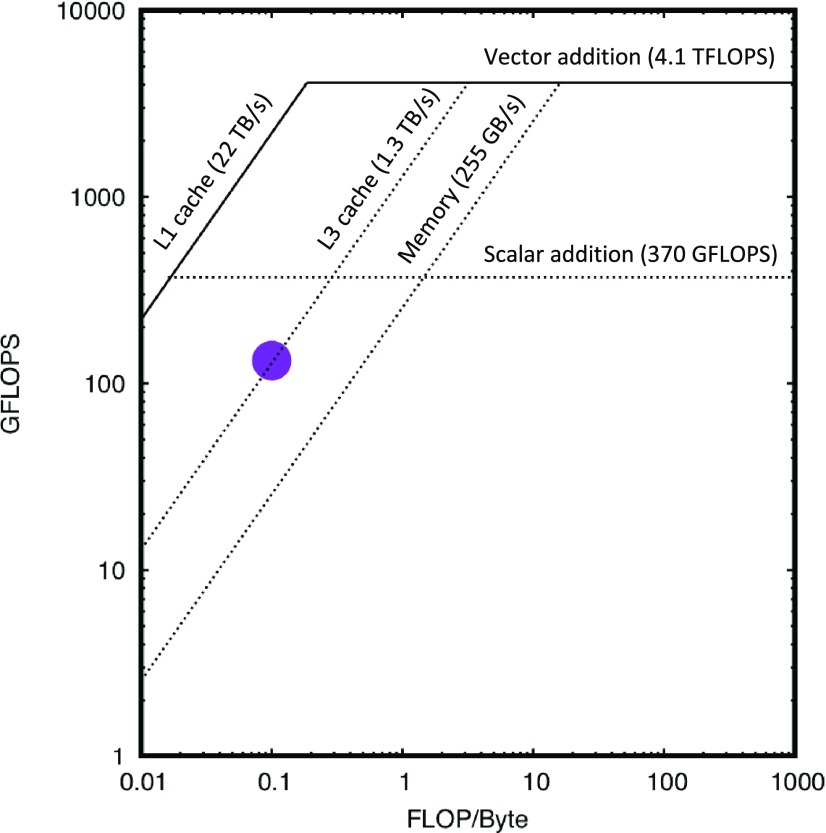
In this paper, we present a data workflow developed to operate the adJUstiNg Gain detector FoR the Aramis User station (JUNGFRAU) adaptive gain charge integrating pixel-array detectors at macromolecular crystallography beamlines. We summarize current achievements for operating at 9 GB/s data-rate a JUNGFRAU with 4 Mpixel at 1.1 kHz frame-rate and preparations to operate at 46 GB/s data-rate a JUNGFRAU with 10 Mpixel at 2.2 kHz in the future. In this context, we highlight the challenges for computer architecture and how these challenges can be addressed with innovative hardware including IBM POWER9 servers and field-programmable gate arrays. We discuss also data science challenges, showing the effect of rounding and lossy compression schemes on the MX JUNGFRAU detector images.
在本文中,我们展示了一种为在大分子晶体学光束线操作用于阿瑞米斯用户站(琼格弗劳)自适应增益电荷积分像素阵列探测器的增益调整探测器而开发的数据工作流程。我们总结了当前以9GB/s数据速率运行具有400万像素、帧率为1.1kHz的琼格弗劳探测器的成果,以及未来以46GB/s数据速率运行具有1000万像素、帧率为2.2kHz的琼格弗劳探测器的准备工作。在此背景下,我们强调了计算机架构面临的挑战,以及如何通过包括IBM POWER9服务器和现场可编程门阵列在内的创新硬件来应对这些挑战。我们还讨论了数据科学挑战,展示了舍入和有损压缩方案对大分子晶体学琼格弗劳探测器图像的影响。