From the Department of Neurosciences, Rehabilitation, Ophthalmology, Genetics, Maternal and Child Health (M.C., F.I., M.P., A.L., C.L., G.N., G.B., E.S., S.P., M.I., N.K.d.R.) and Center of Excellence for Biomedical Research (A.U.), University of Genoa, Italy; BD Biosciences Italy (G.R.), Milan; Institut d'Investigacions Biomediques August Pi Sunyer (G.V., P.V.), Barcelona, Spain; Charité Universitaetsmedizin Berlin and Max Delbrueck Center for Molecular Medicine (P.B.-K., S.A., F.P.), Germany; Department of Research, Innovation and Education (T.B.), Neuroscience Research Unit, Oslo University Hospital; Department of Mechanical Electronics and Chemical Engineering (T.B.), Oslo Metropolitan University, Norway; University of Oslo (E.H., H.F.H.) and Oslo University Hospital (H.F.H.), Norway; Department of Mathematics and Padova Neuroscience Center (C.C.), University of Padua, Italy; Department of Mathematics (M.P.), University of Genoa, Italy; and IRCCS Ospedale Policlinico San Martino (A.L., M.P., M.I., A.U.), Genoa, Italy.
Neurol Neuroimmunol Neuroinflamm. 2020 Mar 5;7(3). doi: 10.1212/NXI.0000000000000693. Print 2020 May.
To establish cytometry profiles associated with disease stages and immunotherapy in MS.
Demographic/clinical data and peripheral blood samples were collected from 227 patients with MS and 82 sex- and age-matched healthy controls (HCs) enrolled in a cross-sectional study at 4 European MS centers (Spain, Italy, Germany, and Norway). Flow cytometry of isolated peripheral blood mononuclear cells was performed in each center using specifically prepared antibody-cocktail Lyotubes; data analysis was centralized at the Genoa center. Differences in immune cell subsets were assessed between groups of untreated patients with relapsing-remitting or progressive MS (RRMS or PMS) and HCs and between groups of patients with RRMS taking 6 commonly used disease-modifying drugs.
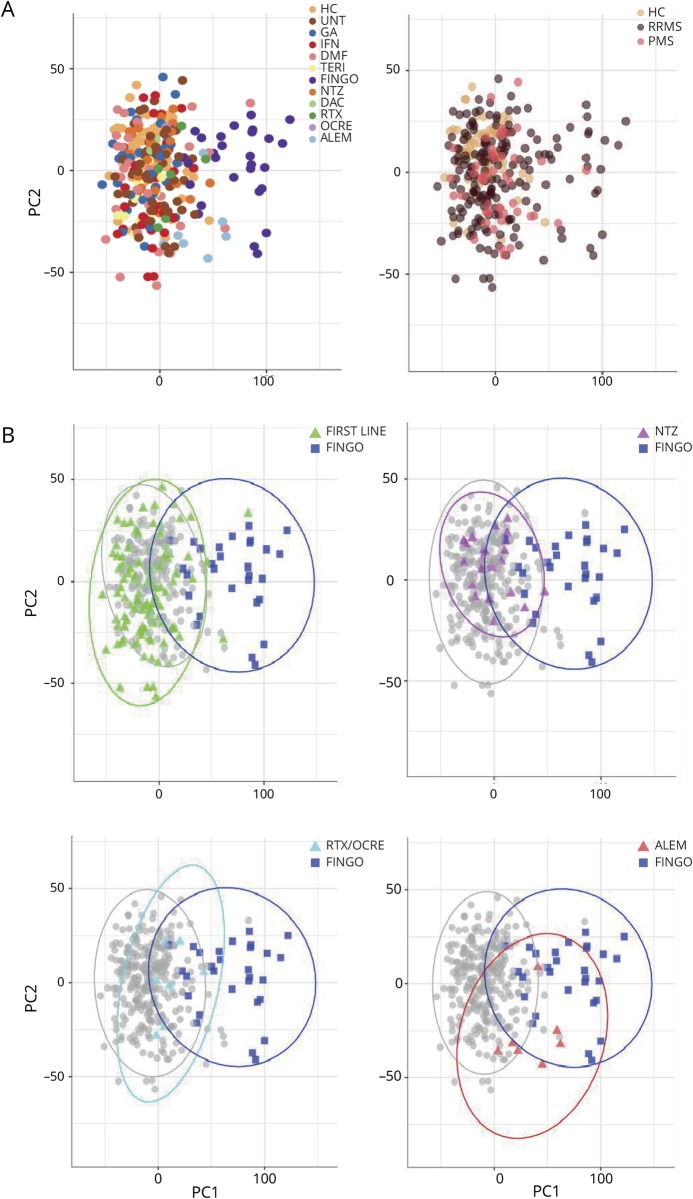
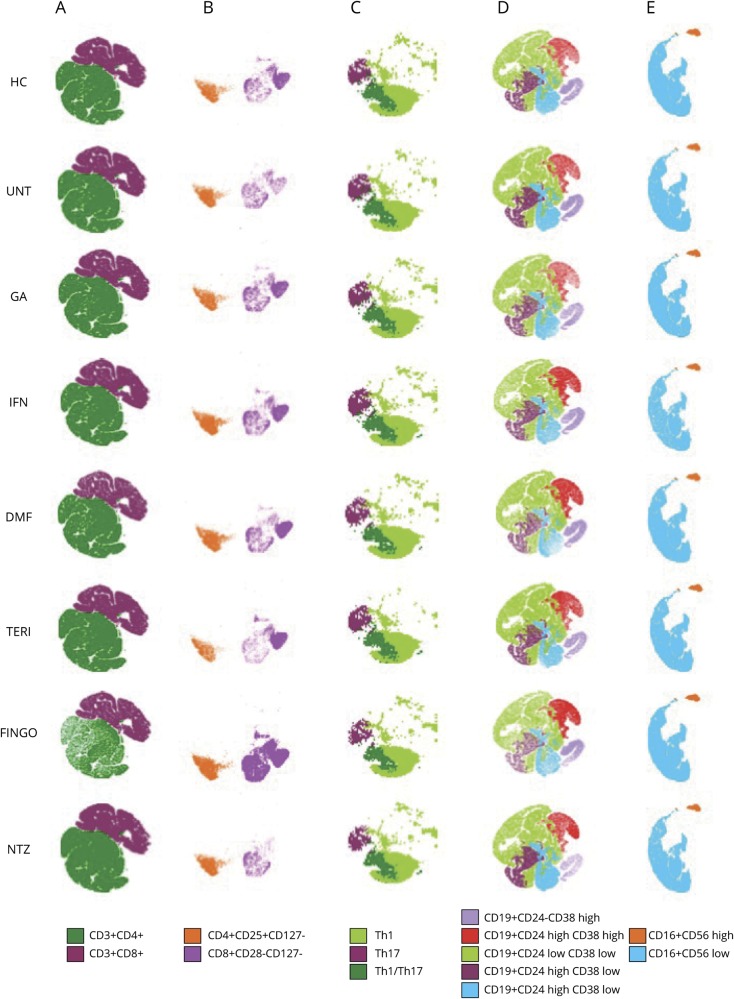
In untreated patients with MS, significantly higher frequencies of Th17 cells in the RRMS population compared with HC and lower frequencies of B-memory/B-regulatory cells as well as higher percentages of B-mature cells in patients with PMS compared with HCs emerged. Overall, the greatest deviation in immunophenotype in MS was observed by treatment rather than disease course, with the strongest impact found in fingolimod-treated patients. Fingolimod induced a decrease in total CD4 T cells and in B-mature and B-memory cells and increases in CD4 and CD8 T-regulatory and B-regulatory cells.
Our highly standardized, multisite cytomics data provide further understanding of treatment impact on MS immunophenotype and could pave the way toward monitoring immune cells to help clinical management of MS individuals.
建立与 MS 疾病阶段和免疫治疗相关的细胞术特征。
在西班牙、意大利、德国和挪威的 4 个欧洲 MS 中心进行的横断面研究中,共纳入 227 例 MS 患者和 82 名性别和年龄匹配的健康对照者(HCs),收集了他们的人口统计学/临床数据和外周血样本。在每个中心使用专门制备的抗体混合 Lyotubes 对分离的外周血单个核细胞进行流式细胞术;数据分析在热那亚中心集中进行。评估了未经治疗的 RRMS 或 PMS 患者组与 HCs 之间以及接受 6 种常用疾病修正药物治疗的 RRMS 患者组之间免疫细胞亚群的差异。
在未经治疗的 MS 患者中,与 HC 相比,RRMS 患者群体中 Th17 细胞的频率明显更高,而 PMS 患者群体中 B 记忆/B 调节细胞的频率较低,B 成熟细胞的百分比较高。总体而言,与疾病进程相比,治疗对 MS 免疫表型的影响更大,而在接受 fingolimod 治疗的患者中发现的影响最大。fingolimod 诱导总 CD4 T 细胞以及 B 成熟和 B 记忆细胞减少,CD4 和 CD8 T 调节细胞以及 B 调节细胞增加。
我们的高度标准化、多站点细胞术数据进一步了解了治疗对 MS 免疫表型的影响,并为监测免疫细胞以帮助 MS 个体的临床管理铺平了道路。