Department of Epidemiology, School of Public Health and Safety, Shahid Beheshti University of Medical Sciences, Tehran, Iran.
Cellular and Molecular Endocrine Research Center, Research Institute for Endocrine Sciences, Shahid Beheshti University of Medical Sciences, Tehran, Iran.
Epidemiol Health. 2020;42:e2020009. doi: 10.4178/epih.e2020009. Epub 2020 Mar 8.
Cigarette smoking is an established, strong, and modifiable risk factor for coronary heart disease (CHD). However, little research has investigated CHD risk in former smokers who continue to be exposed to others' cigarette smoke (former & secondhand smokers).
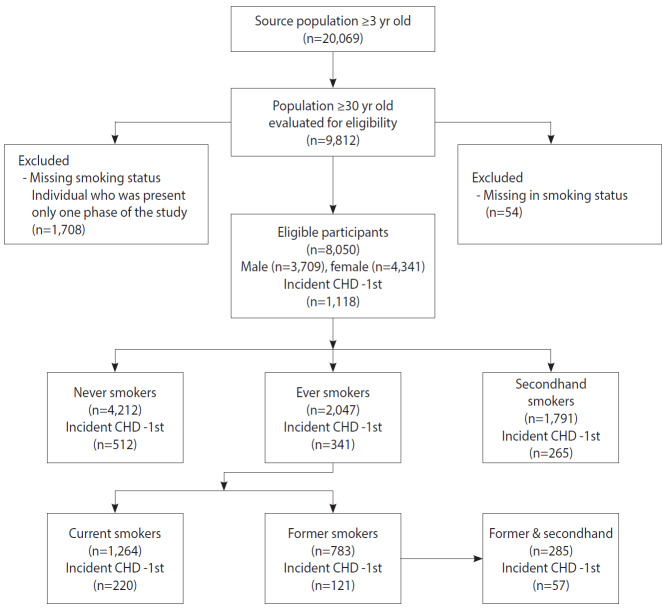
In the Tehran Lipid and Glucose Study, a prospective population-based cohort (n=20,069) was followed up for a median period of 14.6 years. A subset of 8,050 participants of 30 years of age and older was analyzed, with first CHD events as the study outcome. Participants were categorized as never, former, current, secondhand, and former & secondhand smokers. Data on smoking intensity (cigarette/d) were also collected. A Cox proportional hazards regression model was applied to estimate the risk of CHD, taking into account the main potential confounders.
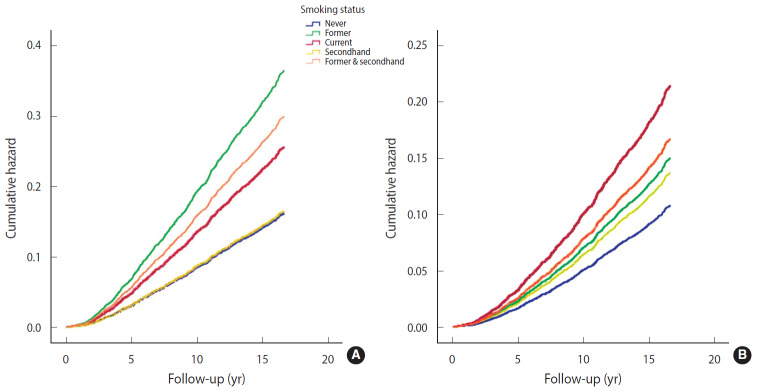
The mean age of participants was 46.10 ±11.38 years, and they experienced 1,118 first CHD events (with most CHD cases in former smokers) during the follow-up period. The risk of CHD was highest in current smokers, followed in order by former & secondhand, former, and secondhand smokers (hazard ratio [HR], 1.99; 95% confidence interval [CI], 1.65 to 2.39; HR, 1.55; 95% CI, 1.15 to 2.08; HR, 1.39; 95% CI, 1.12 to 1.72; HR, 1.27; 95% CI, 1.07 to 1.51, respectively), compared to never smokers. The risk of CHD increased with smoking intensity, which has been proposed as a preferable measure of smoking, indicating a dose-response pattern.
The elevated risk of CHD in former & secondhand smokers was a noteworthy finding, with possible implications for health policy; however, further research is needed.
吸烟是冠心病(CHD)的一个已确定的、强大的、可改变的危险因素。然而,很少有研究调查过继续暴露于他人香烟烟雾(前吸烟者和二手烟者)的前吸烟者的 CHD 风险。
在德黑兰血脂和血糖研究中,对一个前瞻性的基于人群的队列(n=20069)进行了中位数为 14.6 年的随访。对其中年龄在 30 岁以上的 8050 名参与者进行了分析,以首次 CHD 事件为研究结果。参与者被分为从不吸烟、前吸烟者、现吸烟者、二手烟者和前吸烟者和二手烟者。还收集了吸烟强度(支/天)的数据。应用 Cox 比例风险回归模型来估计 CHD 的风险,同时考虑到主要的潜在混杂因素。
参与者的平均年龄为 46.10±11.38 岁,在随访期间发生了 1118 例首次 CHD 事件(大多数 CHD 病例在前吸烟者中)。CHD 风险最高的是现吸烟者,其次是前吸烟者和二手烟者、前吸烟者和二手烟者(危险比 [HR],1.99;95%置信区间 [CI],1.65 至 2.39;HR,1.55;95%CI,1.15 至 2.08;HR,1.39;95%CI,1.12 至 1.72;HR,1.27;95%CI,1.07 至 1.51),与从不吸烟者相比。随着吸烟强度的增加,CHD 的风险增加,这一指标被认为是吸烟的一个更优的衡量标准,表明存在剂量-反应关系。
前吸烟者和二手烟者的 CHD 风险增加是一个值得注意的发现,这可能对卫生政策有影响;然而,还需要进一步的研究。