Stein Helge S, Gregoire John M
Joint Center for Artificial Photosynthesis , California Institute of Technology , Pasadena , CA 91125 , USA . Email:
Division of Engineering and Applied Science , California Institute of Technology , Pasadena , CA 91125 , USA.
Chem Sci. 2019 Sep 20;10(42):9640-9649. doi: 10.1039/c9sc03766g. eCollection 2019 Nov 14.
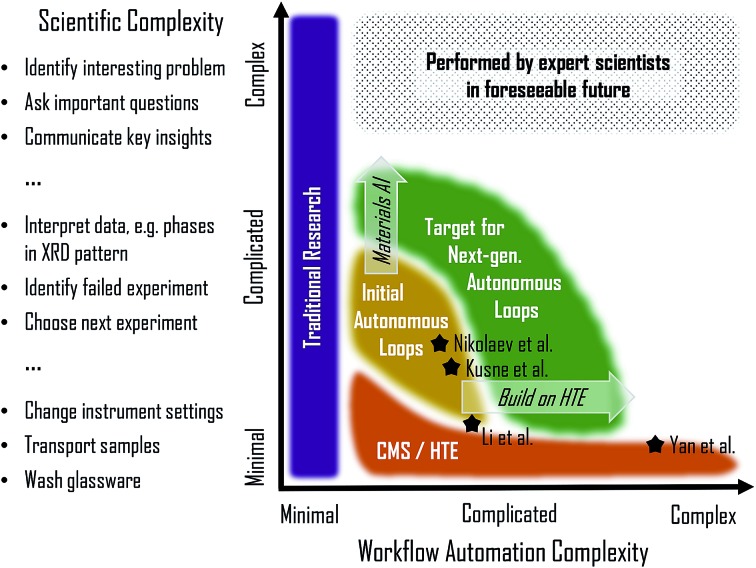
Accelerating materials research by integrating automation with artificial intelligence is increasingly recognized as a grand scientific challenge to discover and develop materials for emerging and future technologies. While the solid state materials science community has demonstrated a broad range of high throughput methods and effectively leveraged computational techniques to accelerate individual research tasks, revolutionary acceleration of materials discovery has yet to be fully realized. This perspective review presents a framework and ontology to outline a materials experiment lifecycle and visualize materials discovery workflows, providing a context for mapping the realized levels of automation and the next generation of autonomous loops in terms of scientific and automation complexity. Expanding autonomous loops to encompass larger portions of complex workflows will require integration of a range of experimental techniques as well as automation of expert decisions, including subtle reasoning about data quality, responses to unexpected data, and model design. Recent demonstrations of workflows that integrate multiple techniques and include autonomous loops, combined with emerging advancements in artificial intelligence and high throughput experimentation, signal the imminence of a revolution in materials discovery.
通过将自动化与人工智能相结合来加速材料研究,日益被视为一项重大科学挑战,即发现和开发用于新兴及未来技术的材料。虽然固态材料科学界已经展示了广泛的高通量方法,并有效地利用计算技术来加速各项研究任务,但材料发现的革命性加速尚未完全实现。这篇观点综述提出了一个框架和本体,以勾勒材料实验生命周期并可视化材料发现工作流程,为根据科学和自动化复杂性来描绘已实现的自动化水平及下一代自主循环提供背景。将自主循环扩展到涵盖更大部分的复杂工作流程,需要整合一系列实验技术以及专家决策的自动化,包括对数据质量的精细推理、对意外数据的应对以及模型设计。最近展示的整合多种技术并包含自主循环的工作流程,再加上人工智能和高通量实验方面的新进展,预示着材料发现领域即将发生一场革命。