Mehdizadeh Tooraj, Zamani Asghar, Abtahi Froushani Seyyed Meysam
Department of Food Hygiene and Quality Control, Faculty of Veterinary Medicine, Urmia University, Urmia, Iran.
Department of Nanotechnology, Faculty of Science, Urmia University, Urmia, Iran.
Heliyon. 2020 Mar 4;6(3):e03528. doi: 10.1016/j.heliyon.2020.e03528. eCollection 2020 Mar.
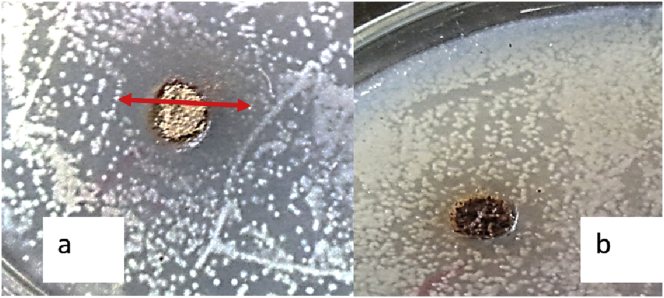
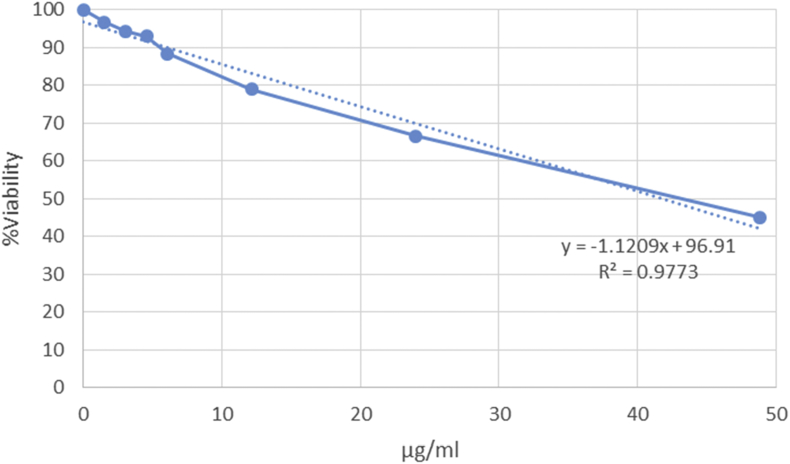
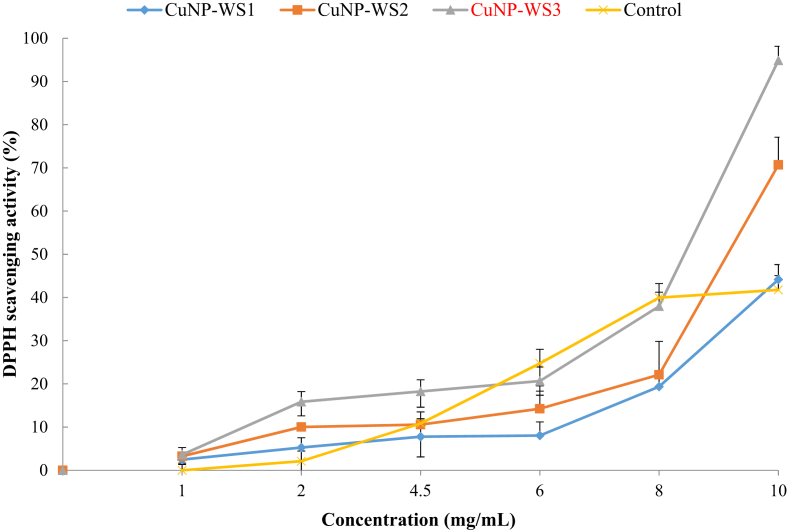
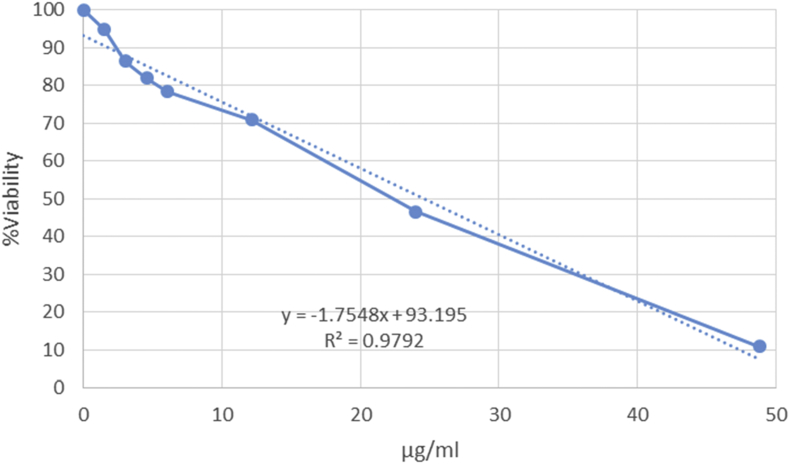
In this study, antibacterial, antioxidant, and anticancer effects of Cu nanoparticles (CuNPs) fixed on cellulosic walnut shell material were investigated. Firstly, three types of walnut shell-supported copper nanoparticles with various sizes (CuNP-WS1 15-22 nm, CuNP-WS2 60-80 nm and, CuNP-WS3 aggregated of metallic nanoparticles) were synthesized. Antibacterial properties of CuNPs were studied on three strains of bacteria; , and . DPPH (1, 1-Diphenyl-2-picrylhydrazyl) method was used to examining antioxidant properties. Cytotoxic effects of the synthesized nanoparticles on the cancer cell line were studied. Antimicrobial properties of CuNPs showed that these nanomaterials affect both Gram-positive and Gram-negative bacteria. The antioxidant properties of CuNPs increased significantly by increasing the concentration to 10%. CuNPs appeared to have a dose-dependent cytotoxic effect on K562 cells. However, the IC50 of the synthesized nanoparticles against the K562 (25.24 ± 5 μg/mL) cancer cells was lower significantly ( < 0.01) of the IC50 of these compounds against PBMCs (42.54 ± 6.2 μg/mL).
在本研究中,对固定在纤维素核桃壳材料上的铜纳米颗粒(CuNPs)的抗菌、抗氧化和抗癌作用进行了研究。首先,合成了三种不同尺寸的核桃壳负载铜纳米颗粒(CuNP-WS1 15 - 22纳米,CuNP-WS2 60 - 80纳米以及CuNP-WS3由金属纳米颗粒聚集而成)。研究了CuNPs对三种细菌菌株的抗菌性能; 、 和 。采用DPPH(1,1 - 二苯基 - 2 - 苦基肼)法检测抗氧化性能。研究了合成纳米颗粒对癌细胞系的细胞毒性作用。CuNPs的抗菌性能表明,这些纳米材料对革兰氏阳性菌和革兰氏阴性菌均有影响。将CuNPs浓度提高到10%时,其抗氧化性能显著增强。CuNPs对K562细胞似乎具有剂量依赖性细胞毒性作用。然而,合成纳米颗粒对K562(25.24±5μg/mL)癌细胞的IC50显著低于(<0.01)这些化合物对PBMCs(42.54±6.2μg/mL)的IC50。