Esteves Carina, Santos Gonçalo M C, Alves Cláudia, Palma Susana I C J, Porteira Ana R, Filho João, Costa Henrique M A, Alves Vitor D, Morais Faustino Bruno M, Ferreira Isabel, Gamboa Hugo, Roque Ana C A
UCIBIO, Departamento de Química, Faculdade de Ciências e Tecnologia, Universidade Nova de Lisboa, Caparica, Portugal.
LIBPhys-UNL, Departamento de Física, Faculdade de Ciências e Tecnologia, Universidade Nova de Lisboa, Caparica, Portugal.
Mater Today Bio. 2019 Mar 22;1:100002. doi: 10.1016/j.mtbio.2019.100002. eCollection 2019 Jan.
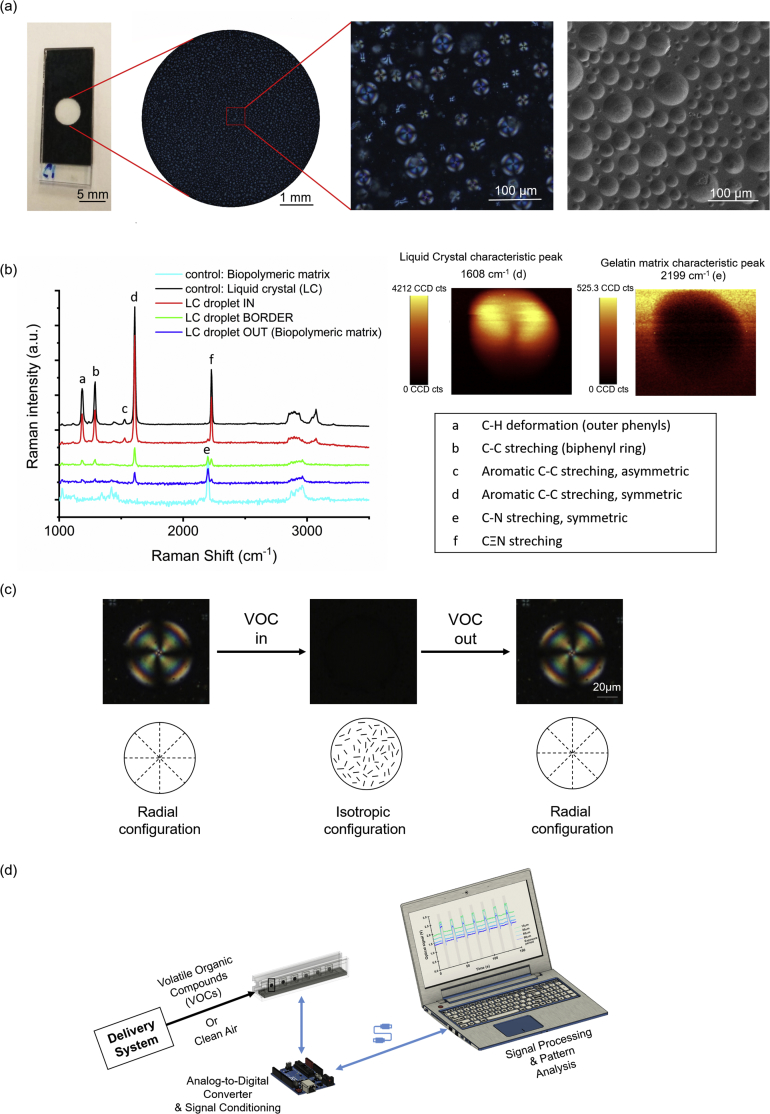
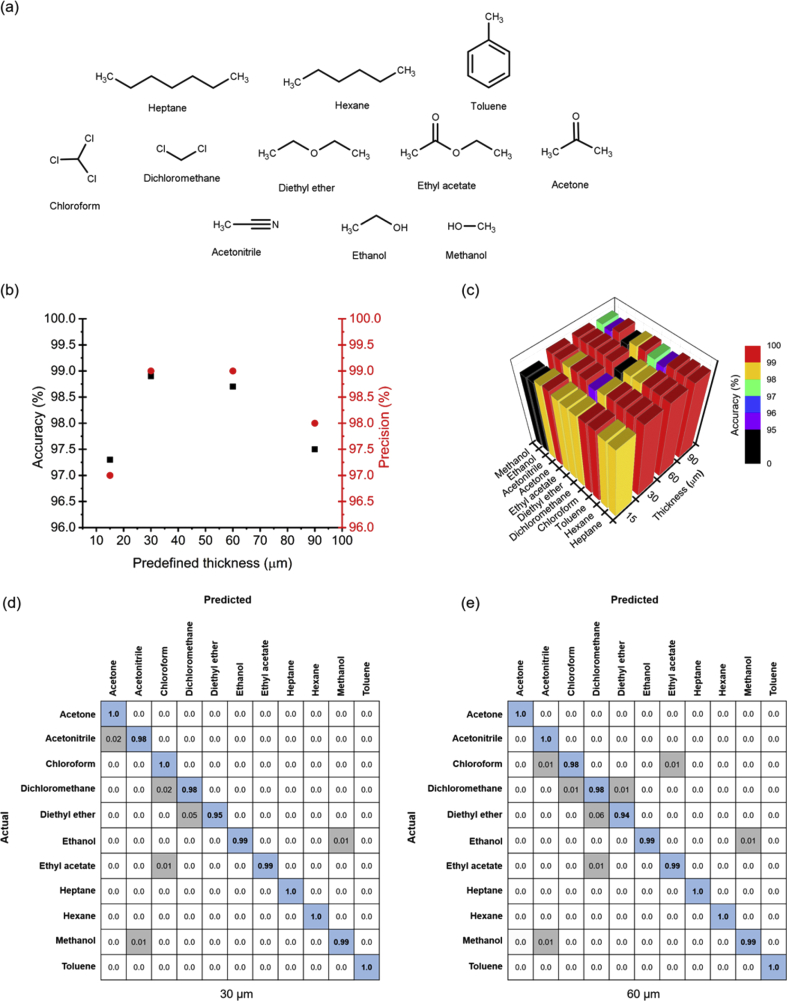
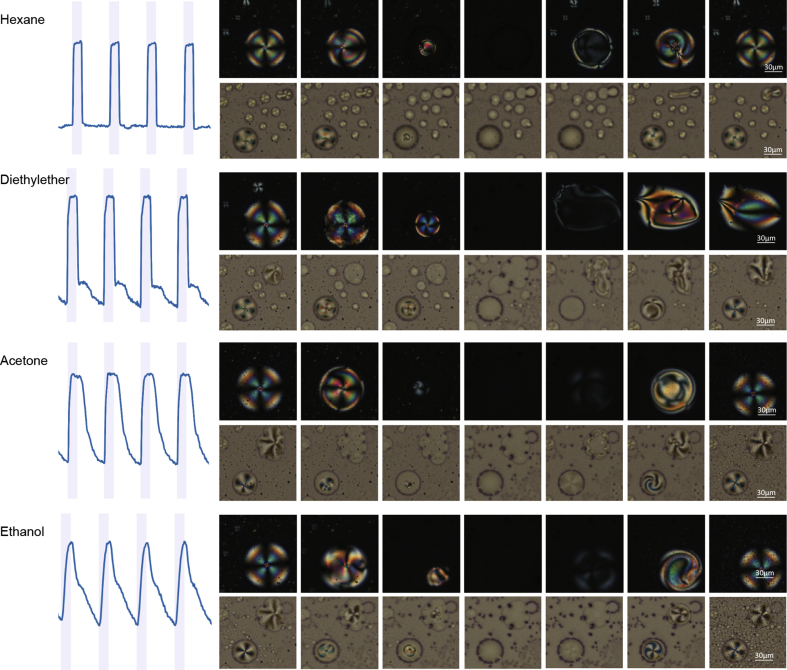
Artificial olfaction is a fast-growing field aiming to mimic natural olfactory systems. Olfactory systems rely on a first step of molecular recognition in which volatile organic compounds (VOCs) bind to an array of specialized olfactory proteins. This results in electrical signals transduced to the brain where pattern recognition is performed. An efficient approach in artificial olfaction combines gas-sensitive materials with dedicated signal processing and classification tools. In this work, films of gelatin hybrid gels with a single composition that change their optical properties upon binding to VOCs were studied as gas-sensing materials in a custom-built electronic nose. The effect of films thickness was studied by acquiring signals from gelatin hybrid gel films with thicknesses between 15 and 90 μm when exposed to 11 distinct VOCs. Several features were extracted from the signals obtained and then used to implement a dedicated automatic classifier based on support vector machines for data processing. As an optical signature could be associated to each VOC, the developed algorithms classified 11 distinct VOCs with high accuracy and precision (higher than 98%), in particular when using optical signals from a single film composition with 30 μm thickness. This shows an unprecedented example of soft matter in artificial olfaction, in which a single gelatin hybrid gel, and not an array of sensing materials, can provide enough information to accurately classify VOCs with small structural and functional differences.
人工嗅觉是一个快速发展的领域,旨在模仿自然嗅觉系统。嗅觉系统依赖于分子识别的第一步,其中挥发性有机化合物(VOCs)与一系列专门的嗅觉蛋白结合。这会产生电信号,传导至大脑进行模式识别。人工嗅觉中的一种有效方法是将气敏材料与专用的信号处理和分类工具相结合。在这项工作中,研究了具有单一成分的明胶混合凝胶薄膜,该薄膜在与VOCs结合时会改变其光学特性,并将其作为定制电子鼻中气体传感材料进行研究。通过获取厚度在15至90μm之间的明胶混合凝胶薄膜在暴露于11种不同VOCs时的信号,研究了薄膜厚度的影响。从获得的信号中提取了几个特征,然后用于基于支持向量机实现专用的自动分类器进行数据处理。由于可以将光学特征与每种VOC相关联,因此所开发的算法能够高精度和高精准度(高于98%)地对11种不同的VOCs进行分类,特别是在使用来自厚度为30μm的单一薄膜成分的光学信号时。这展示了人工嗅觉中软物质的一个前所未有的例子,其中单一的明胶混合凝胶而非一系列传感材料,能够提供足够的信息来准确分类结构和功能差异较小的VOCs。