Pietrzak Elzbieta, Dunislawska Aleksandra, Siwek Maria, Zampiga Marco, Sirri Federico, Meluzzi Adele, Tavaniello Siria, Maiorano Giuseppe, Slawinska Anna
Department of Animal Biotechnology and Genetics, UTP University of Science and Technology, Mazowiecka 28, 85-084 Bydgoszcz, Poland.
Department of Agricultural and Food Sciences, University of Bologna, Via del Florio 2, 40064 Ozzano dell'Emilia, Italy.
Animals (Basel). 2020 Mar 12;10(3):474. doi: 10.3390/ani10030474.
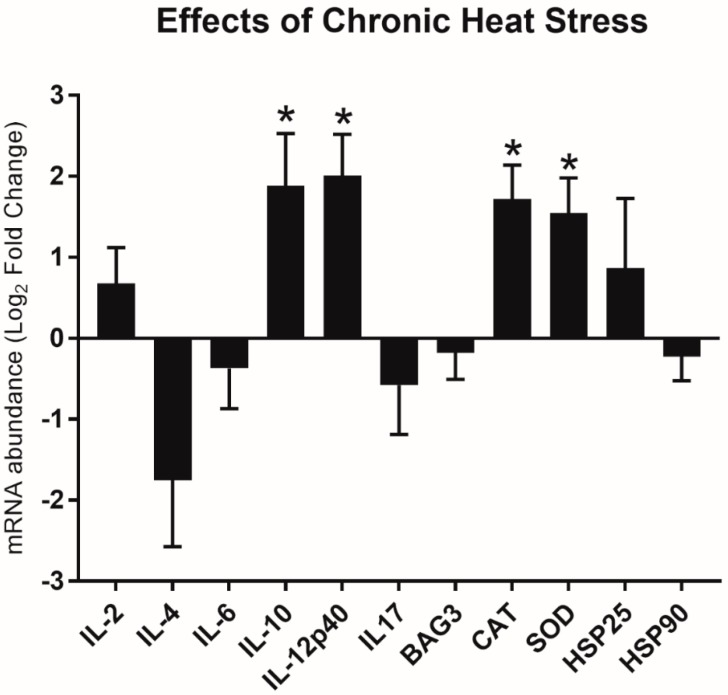
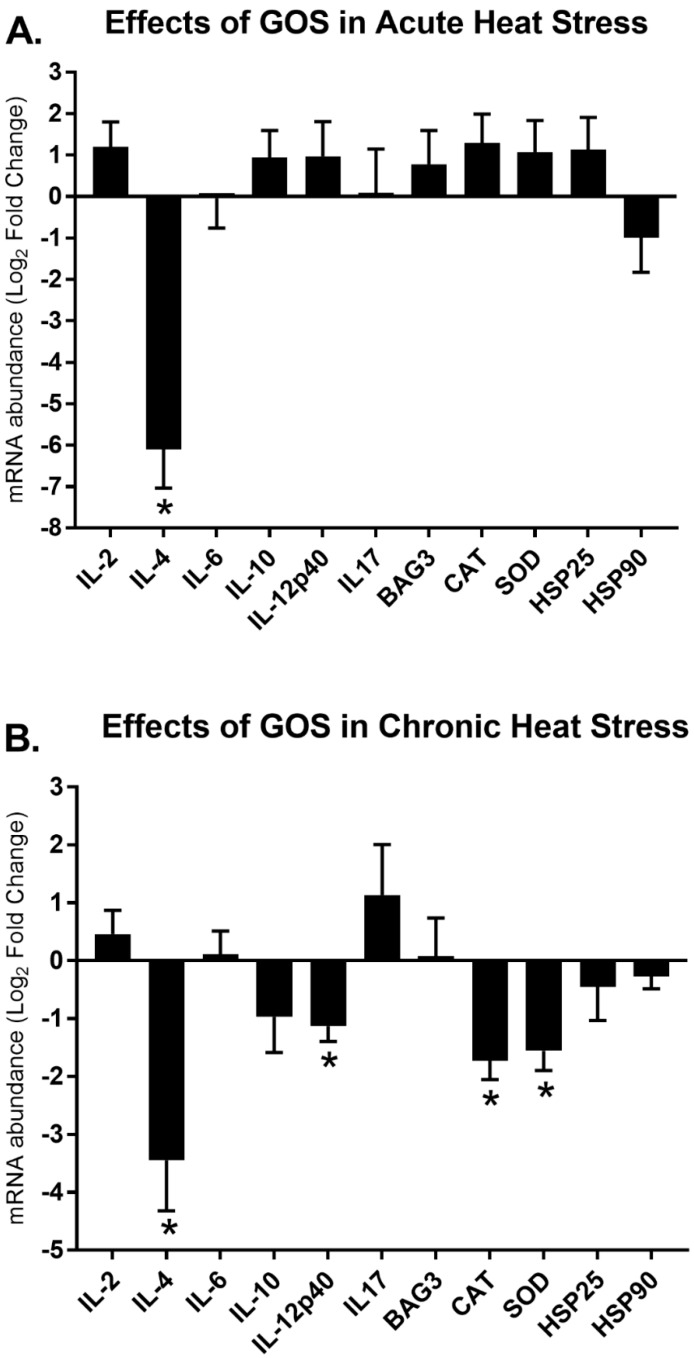
Galactooligosaccharides (GOS) that are delivered in ovo improve intestinal microbiota composition and mitigate the negative effects of heat stress in broiler chickens. Hubbard hybrids are slow-growing chickens with a high resistance to heat. In this paper, we determined the impact of GOS delivered in ovo on slow-growing chickens that are challenged with heat. The experiment was a 2 × 2 × 2 factorial design. On day 12 of incubation, GOS (3.5 mg/egg) was delivered into the egg (n = 300). Controls (C) were mock-injected with physiological saline (n = 300). After hatching, the GOS and C groups were split into thermal groups: thermoneutral (TN) and heat stress (HS). HS (30 °C) lasted for 14 days (days 36-50 post-hatching). The spleen (n = 8) was sampled after acute (8.5 h) and chronic (14 days) HS. The gene expression of immune-related ( and ) and stress-related genes ( and ) was detected with RT-qPCR. Chronic HS up-regulated the expression of the genes: , , ( < 0.05), and ( < 0.01). GOS delivered in ovo down-regulated (acute < 0.001; chronic < 0.01), , and (chronic < 0.05). The obtained results suggest that slow-growing hybrids are resistant to acute heat and tolerant to chronic heat, which can be supported with in ovo GOS administration.
卵内注射低聚半乳糖(GOS)可改善肉鸡肠道微生物群组成,并减轻热应激的负面影响。哈伯德杂交鸡生长缓慢,但耐热性高。在本文中,我们确定了卵内注射GOS对受热应激挑战的生长缓慢型鸡的影响。该实验采用2×2×2析因设计。在孵化第12天,将GOS(3.5毫克/枚蛋)注入蛋内(n = 300)。对照组(C)用生理盐水进行模拟注射(n = 300)。孵化后,GOS组和C组再分为热环境组:热中性(TN)和热应激(HS)。热应激(30℃)持续14天(孵化后第36 - 50天)。在急性(8.5小时)和慢性(14天)热应激后采集脾脏样本(n = )。用RT-qPCR检测免疫相关基因(和)和应激相关基因(和)的基因表达。慢性热应激上调了基因、、(< 0.05)和(< 0.01)的表达。卵内注射GOS下调了(急性< 0.001;慢性< 0.01)、、和(慢性< 0.05)的表达。所得结果表明,生长缓慢的杂交鸡对急性热有抗性,对慢性热有耐受性,卵内注射GOS可支持这一特性。