Department of Animal Biotechnology and Genetics, UTP University of Science and Technology, Bydgoszcz, Poland.
Department of Agricultural, Environmental and Food Sciences, University of Molise, Campobasso, Italy.
PLoS One. 2019 Feb 27;14(2):e0212318. doi: 10.1371/journal.pone.0212318. eCollection 2019.
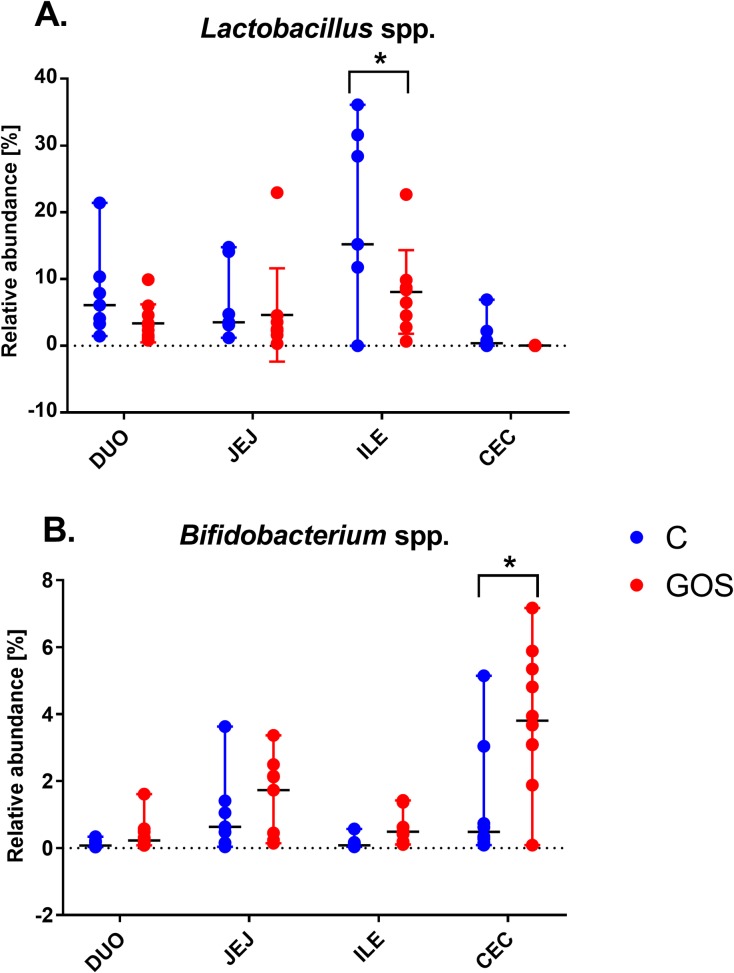
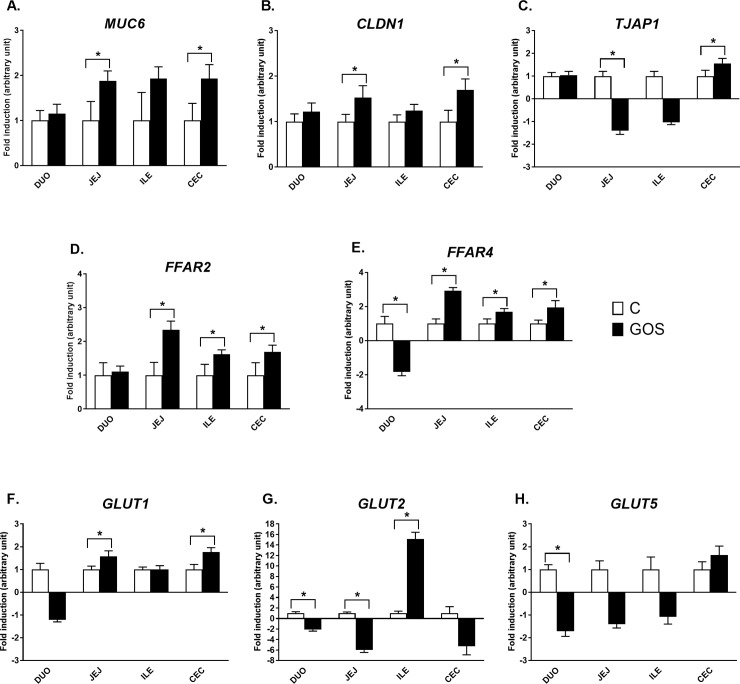
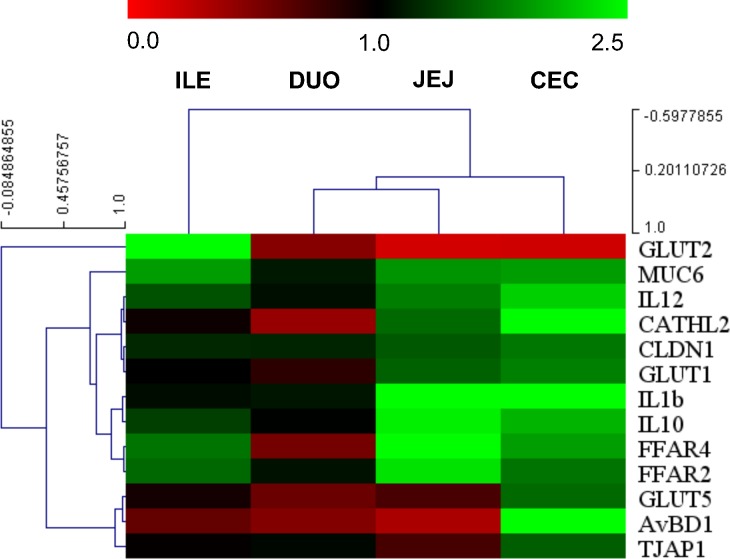
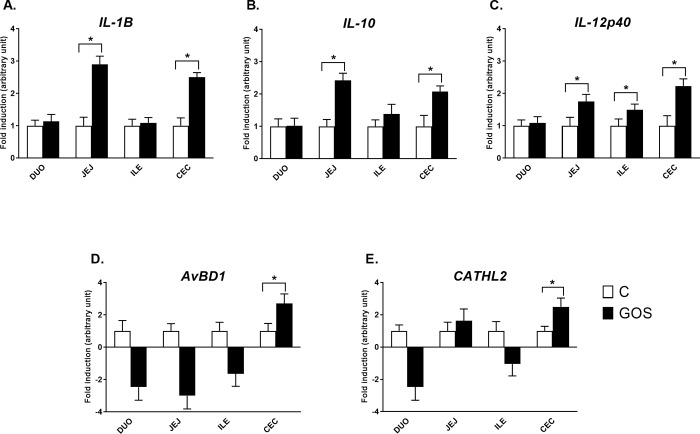
Intestinal mucosa is the interface between the microbial content of the gut and the host's milieu. The goal of this study was to modulate chicken intestinal microflora by in ovo stimulation with galactooligosaccharides (GOS) prebiotic and to demonstrate the molecular responses of the host. The animal trial was performed on meat-type chickens (Ross 308). GOS was delivered by in ovo injection performed into the air cell on day 12 of egg incubation. Analysis of microbial communities and mucosal gene expression was performed at slaughter (day 42 post-hatching). Chyme (for DNA isolation) and intestinal mucosa (for RNA isolation) from four distinct intestinal segments (duodenum, jejunum, ileum, and caecum) was sampled. The relative abundance of Bifidobacterium spp. and Lactobacillus spp. in DNA isolated from chyme samples was determined using qPCR. On the host side, the mRNA expression of 13 genes grouped into two panels was analysed with RT-qPCR. Panel (1) included genes related to intestinal innate immune responses (IL-1β, IL-10 and IL-12p40, AvBD1 and CATHL2). Panel (2) contained genes involved in intestinal barrier function (MUC6, CLDN1 and TJAP1) and nutrients sensing (FFAR2 and FFAR4, GLUT1, GLUT2 and GLUT5). GOS increased the relative abundance of Bifidobacterium in caecum (from 1.3% to 3.9%). Distinct effects of GOS on gene expression were manifested in jejunum and caecum. Cytokine genes (IL-1β, IL-10 and IL-12p40) were up-regulated in the jejunum and caecum of the GOS-treated group. Host defence peptides (AvBD1 and CATHL2) were up-regulated in the caecum of the GOS-treated group. Free fatty acid receptors (FFAR2 and FFAR4) were up-regulated in all three compartments of the intestine (except the duodenum). Glucose transporters were down-regulated in duodenum (GLUT2 and GLUT5) but up-regulated in the hindgut (GLUT1 and GLUT2). In conclusion, GOS delivered in ovo had a bifidogenic effect in adult chickens. It also modulated gene expression related to intestinal immune responses, gut barrier function, and nutrient sensing.
肠黏膜是肠道内微生物群与宿主环境的界面。本研究的目的是通过用半乳糖寡糖(GOS)益生元对鸡胚进行宫内刺激来调节鸡的肠道微生物群,并证明宿主的分子反应。动物试验在肉用型鸡(罗斯 308 号)上进行。GOS 通过在孵化第 12 天的气室中进行的宫内注射进行递送。在屠宰时(孵化后第 42 天)进行微生物群落和黏膜基因表达分析。从四个不同的肠道段(十二指肠、空肠、回肠和盲肠)采集食糜(用于 DNA 分离)和肠黏膜(用于 RNA 分离)。使用 qPCR 确定从食糜样品中分离的 DNA 中双歧杆菌属和乳杆菌属的相对丰度。在宿主方面,使用 RT-qPCR 分析了分为两组的 13 个基因的 mRNA 表达。第 1 组包括与肠道先天免疫反应相关的基因(IL-1β、IL-10 和 IL-12p40、AvBD1 和 CATHL2)。第 2 组包含与肠道屏障功能(MUC6、CLDN1 和 TJAP1)和营养感知(FFAR2 和 FFAR4、GLUT1、GLUT2 和 GLUT5)相关的基因。GOS 增加了盲肠中双歧杆菌的相对丰度(从 1.3%增加到 3.9%)。GOS 对基因表达的不同影响表现在空肠和盲肠中。细胞因子基因(IL-1β、IL-10 和 IL-12p40)在 GOS 处理组的空肠和盲肠中上调。宿主防御肽(AvBD1 和 CATHL2)在 GOS 处理组的盲肠中上调。游离脂肪酸受体(FFAR2 和 FFAR4)在肠的所有三个部位(十二指肠除外)上调。葡萄糖转运体在十二指肠下调(GLUT2 和 GLUT5),但在后肠上调(GLUT1 和 GLUT2)。总之,宫内给予 GOS 对成年鸡具有双歧杆菌作用。它还调节与肠道免疫反应、肠道屏障功能和营养感知相关的基因表达。