Sukumaran Sangeetha Kolathuparambil, Vadakkekuttical Rosamma Joseph, Kanakath Harikumar
Department of Periodontics, Government Dental College, Affiliated to Kerala University of Health Sciences, Calicut, Kerala, India.
J Indian Soc Periodontol. 2020 Mar-Apr;24(2):109-116. doi: 10.4103/jisp.jisp_173_19. Epub 2020 Mar 2.
Chemical plaque control acts as an adjunct to mechanical periodontal therapy. Chlorhexidine (CHX) is considered as the gold standard in chemical plaque control, but the main concern is about its fibroblast cytotoxicity. Curcumin, a lipophilic polyphenol, may offer as a promising antiplaque agent. This study was conducted to compare the effect of curcumin (0.003%, 0.03%, 0.06%, 0.1%, and 0.12%) and CHX (0.03%, 0.06%, 0.1%, 0.12%, and 0.2%) on gingival fibroblast cell viability and wound healing at different time periods (1, 2, 4, 6, 8, and 10 min).
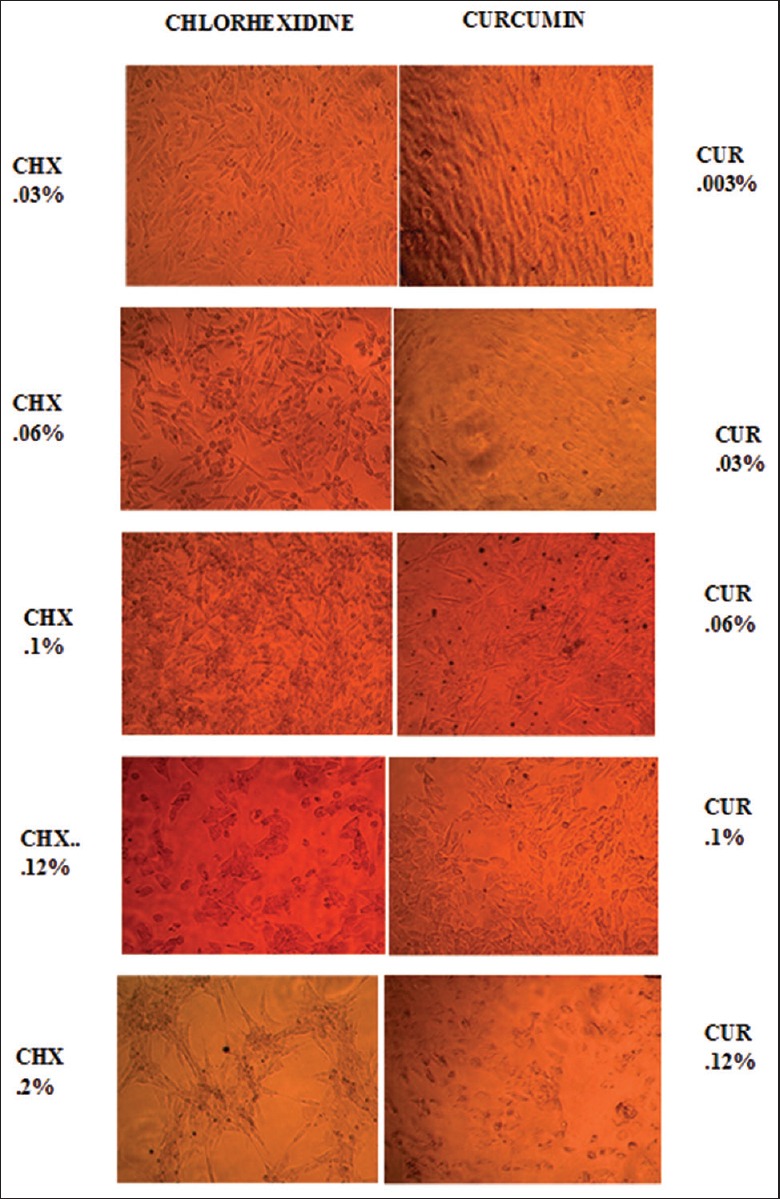
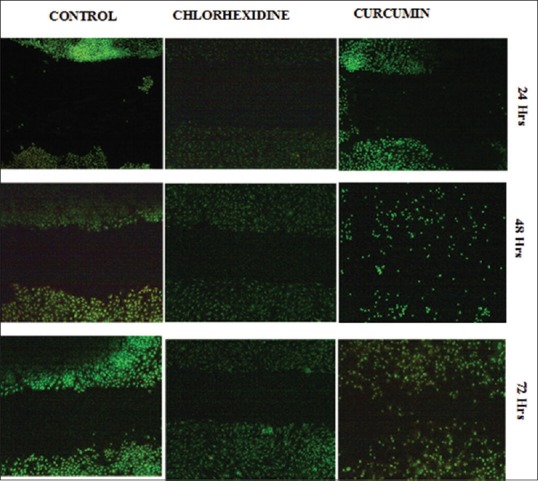
The minimum inhibitory concentration (MIC50) was determined before the evaluation of cytotoxicity and wound healing property. 3-(4,5-Dimethylthiazol-2-yl)-2,5-diphenyltetrazolium bromide assay and morphological examination by direct invert microscopy were carried out to determine cytotoxicity. Wound healing was evaluated by scratch wound assay.
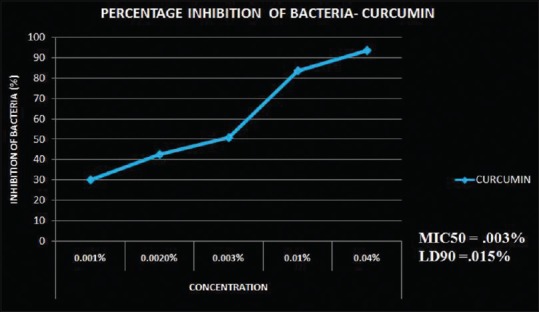
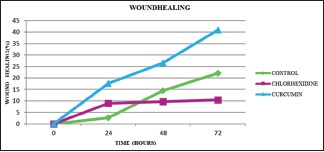
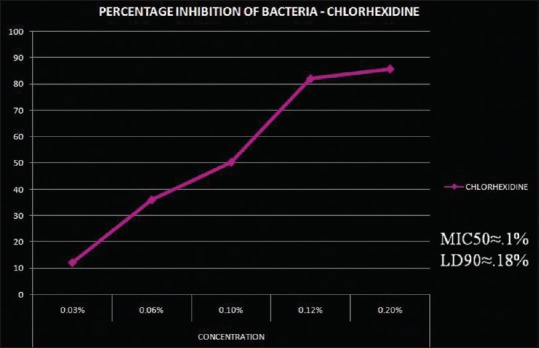
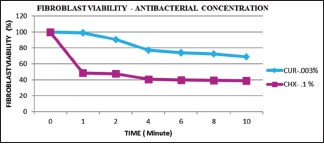
The MIC50 of CHX and curcumin was at 0.1% and 0.003%, respectively. The mean percentage of fibroblast viability at different concentrations of CHX and curcumin at each time period showed a significant difference. Curcumin exhibited less cytotoxicity as compared to CHX at all concentrations and at varying time periods. There was a significant difference between mean percentage of fibroblast viability at MIC50 of CHX (0.1%) and curcumin (0.003%) at different time periods. The difference between percentage wound healing at antibacterial concentrations of CHX and curcumin at varying time periods was significant.
The antibacterial concentration of curcumin (0.003%) exhibits less fibroblast cytotoxicity and excellent wound healing property as compared to CHX. Curcumin may offer as a promising chemical plaque control agent which is less cytotoxic, cost-effective, safe, easily available, and with a possibly beneficial effect on wound healing.
化学菌斑控制是机械性牙周治疗的辅助手段。氯己定(CHX)被视为化学菌斑控制的金标准,但其主要问题在于对成纤维细胞的细胞毒性。姜黄素是一种亲脂性多酚,可能是一种有前景的抗菌斑剂。本研究旨在比较姜黄素(0.003%、0.03%、0.06%、0.1%和0.12%)和CHX(0.03%、0.06%、0.1%、0.12%和0.2%)在不同时间段(1、2、4、6、8和10分钟)对牙龈成纤维细胞活力和伤口愈合的影响。
在评估细胞毒性和伤口愈合特性之前测定最低抑菌浓度(MIC50)。采用3-(4,5-二甲基噻唑-2-基)-2,5-二苯基四氮唑溴盐法和直接倒置显微镜形态学检查来确定细胞毒性。通过划痕试验评估伤口愈合情况。
CHX和姜黄素的MIC50分别为0.1%和0.003%。在每个时间段,不同浓度的CHX和姜黄素下成纤维细胞活力的平均百分比显示出显著差异。在所有浓度和不同时间段,姜黄素的细胞毒性均低于CHX。在不同时间段,CHX(0.1%)和姜黄素(0.003%)的MIC50下成纤维细胞活力的平均百分比之间存在显著差异。在不同时间段,CHX和姜黄素抗菌浓度下伤口愈合百分比之间的差异显著。
与CHX相比,姜黄素的抗菌浓度(0.003%)对成纤维细胞的细胞毒性较小,且具有优异的伤口愈合特性。姜黄素可能是一种有前景的化学菌斑控制剂,其细胞毒性较小、成本效益高、安全、易于获得,并且可能对伤口愈合有有益作用。