Department of Family and Community Health, University of Pennsylvania School of Nursing, Philadelphia, PA, United States.
University of Pennsylvania School of Nursing, Philadelphia, PA, United States.
JMIR Public Health Surveill. 2020 Mar 26;6(1):e16191. doi: 10.2196/16191.
Substance use by youth remains a significant public health concern. Social media provides the opportunity to discuss and display substance use-related beliefs and behaviors, suggesting that the act of posting drug-related content, or viewing posted content, may influence substance use in youth. This aligns with empirically supported theories, which posit that behavior is influenced by perceptions of normative behavior. Nevertheless, few studies have explored the content of posts by youth related to substance use.
This study aimed to identify the beliefs and behaviors of youth related to substance use by characterizing the content of youths' drug-related tweets. Using a sequential explanatory mixed methods approach, we sampled drug-relevant tweets and qualitatively examined their content.
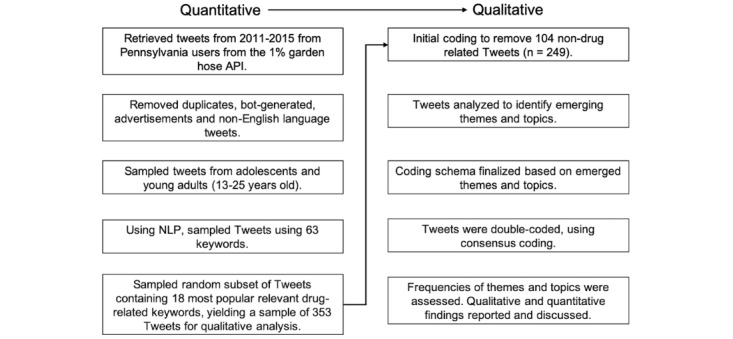
We used natural language processing to determine the frequency of drug-related words in public tweets (from 2011 to 2015) among youth Twitter users geolocated to Pennsylvania. We limited our sample by age (13-24 years), yielding approximately 23 million tweets from 20,112 users. We developed a list of drug-related keywords and phrases and selected a random sample of tweets with the most commonly used keywords to identify themes (n=249).
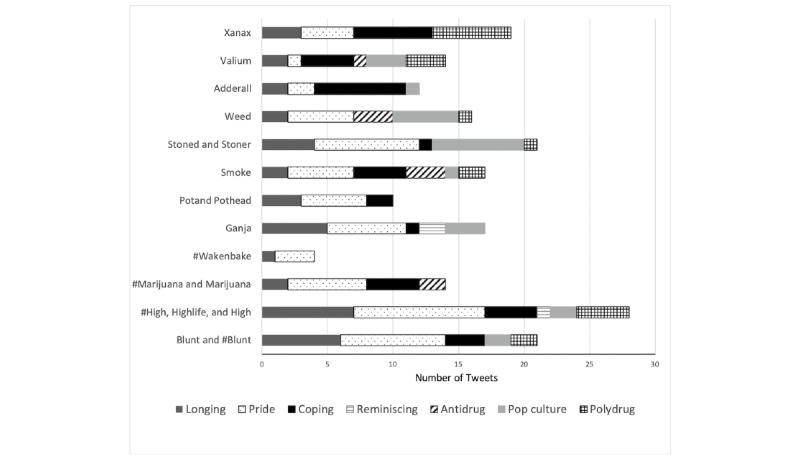
We identified two broad classes of emergent themes: functional themes and relational themes. Functional themes included posts that explicated a function of drugs in one's life, with subthemes indicative of pride, longing, coping, and reminiscing as they relate to drug use and effects. Relational themes emphasized a relational nature of substance use, capturing substance use as a part of social relationships, with subthemes indicative of drug-related identity and companionship. We also identified topical areas in tweets related to drug use, including reference to polysubstance use, pop culture, and antidrug content. Across the tweets, the themes of pride (63/249, 25.3%) and longing (39/249, 15.7%) were the most popular. Most tweets that expressed pride (46/63, 73%) were explicitly related to marijuana. Nearly half of the tweets on coping (17/36, 47%) were related to prescription drugs. Very few of the tweets contained antidrug content (9/249, 3.6%).
Data integration indicates that drugs are typically discussed in a positive manner, with content largely reflective of functional and relational patterns of use. The dissemination of this information, coupled with the relative absence of antidrug content, may influence youth such that they perceive drug use as normative and justified. Strategies to address the underlying causes of drug use (eg, coping with stressors) and engage antidrug messaging on social media may reduce normative perceptions and associated behaviors among youth. The findings of this study warrant research to further examine the effects of this content on beliefs and behaviors and to identify ways to leverage social media to decrease substance use in this population.
青少年的物质使用仍然是一个重大的公共卫生问题。社交媒体提供了讨论和展示与物质使用相关的信仰和行为的机会,这表明发布与毒品相关的内容或查看发布的内容的行为可能会影响青少年的物质使用。这与经验支持的理论一致,该理论认为行为受到对规范行为的看法的影响。然而,很少有研究探讨与青少年物质使用相关的帖子的内容。
本研究旨在通过描述青少年与物质使用相关的信念和行为来确定与物质使用相关的青少年的信念和行为,方法是对青少年的毒品相关推文内容进行定性分析。使用顺序解释性混合方法,我们确定了宾夕法尼亚州青少年 Twitter 用户发布的与毒品相关的推文的内容,并对其进行了分析。
我们使用自然语言处理来确定公共推文中与毒品相关的词的频率(2011 年至 2015 年),这些推文来自宾夕法尼亚州的青少年 Twitter 用户。我们通过年龄(13-24 岁)进行了限制,从 20112 名用户中生成了大约 2300 万条推文。我们制定了一份与毒品相关的关键词和短语清单,并从最常用关键词的推文随机选择样本,以确定主题(n=249)。
我们确定了两类突出的主题:功能主题和关系主题。功能主题包括在一个人的生活中阐述药物功能的帖子,子主题表明与药物使用和效果相关的自豪、渴望、应对和回忆。关系主题强调物质使用的关系性质,将物质使用作为社会关系的一部分,子主题表明与毒品相关的身份和陪伴。我们还确定了与毒品使用相关的推文的主题,包括多物质使用、流行文化和反毒品内容的参考。在这些推文中,自豪(63/249,25.3%)和渴望(39/249,15.7%)是最受欢迎的主题。表达自豪的推文(46/63,73%)大多是明确与大麻相关的。与应对相关的推文(17/36,47%)中,近一半与处方药有关。很少有推文包含反毒品内容(9/249,3.6%)。
数据整合表明,药物通常以积极的方式讨论,内容主要反映了使用的功能和关系模式。这种信息的传播,加上相对缺乏反毒品内容,可能会影响青少年,使他们认为药物使用是正常和合理的。在社交媒体上解决药物使用的根本原因(例如应对压力源)并开展反毒品宣传的策略,可能会减少青少年对药物使用的规范认知和相关行为。这项研究的结果需要进一步研究,以进一步研究这些内容对信仰和行为的影响,并确定利用社交媒体减少这一人群物质使用的方法。