School of Public Health & Tropical Medicine, Tulane University, New Orleans, LA, USA.
Georgia Policy Labs, Georgia State University, Atlanta, GA, USA.
Lancet Planet Health. 2020 Mar;4(3):e98-e106. doi: 10.1016/S2542-5196(20)30055-3.
The role of diet in health is well established and, in the past decade, more attention has been given to the role of food choices in the environment. The agricultural sector produces about a quarter of the world's greenhouse gas emissions (GHGE), and meat production, especially beef, is an important contributor to global GHGE. Our study aimed to address a fundamental gap in the diet-climate literature: identifying consumers who are receptive to making dietary changes, and the effect of their potential changes on GHGE, diet healthfulness, and diet costs.
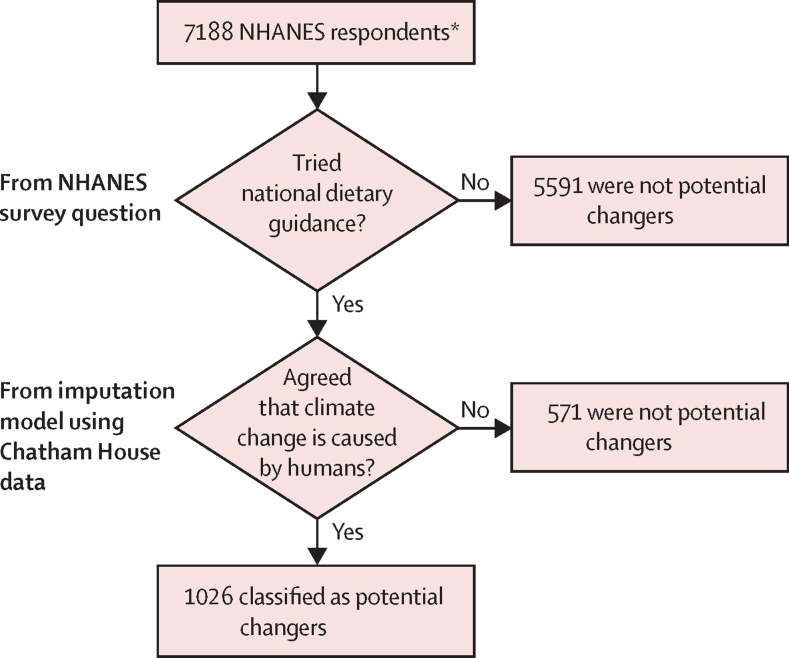
Dietary data on US individuals from a nationally representative survey were linked to food-related GHGE. We identified individuals receptive to changing their diets (potential changers) as those who reported trying US dietary guidance and were likely to agree that humans contribute to climate change. We assessed GHGE, diet healthfulness measured by the Healthy Eating Index (HEI), and diet costs before and after hypothetical changes replacing either beef or meats with poultry or plant-protein foods.
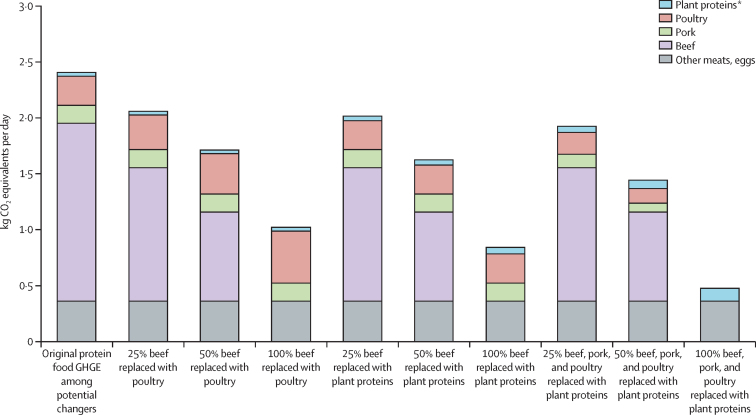
Our sample comprised 7188 individuals, of whom 16% were potential changers. These were disproportionately women, highly educated, or had higher income compared with individuals deemed not likely to change. Replacing 100% of beef intake in potential changers with poultry reduced mean dietary GHGE by 1·38 kg CO-equivalents per person per day (95% CI 1·19-1·58), a 35·7% decrease. This replacement also increased mean HEI by 1·7% and reduced mean diet costs by 1·7%. We observed the largest changes when replacing all beef, pork, or poultry intake with plant-protein foods (GHGE decreased by 49·6%, mean HEI increased by 8·7%, and dietary costs decreased by 10·5%). Hypothetical replacements in the potential changers alone resulted in whole population reductions in 1-day dietary GHGE of 1·2% to 6·7%, equivalent to 22-126 million fewer passenger vehicle km.
Individual-level diet studies that include a variation in response by consumers can improve our understanding of the effects of climate policies such as those that include sustainability information in national dietary guidance. In our study, we found that changes by a small percentage of motivated individuals can modestly reduce the national dietary GHGE. Moreover, these substitutions can modestly improve diet healthfulness and reduce diet costs for individuals who make these changes.
Wellcome Trust.
饮食对健康的作用已得到充分证实,在过去十年中,人们越来越关注食物选择对环境的影响。农业部门产生了全球温室气体排放量(GHGE)的约四分之一,而肉类生产,尤其是牛肉,是全球 GHGE 的重要贡献者。我们的研究旨在解决饮食与气候文献中的一个基本差距:确定愿意改变饮食的消费者,以及他们的潜在变化对 GHGE、饮食健康和饮食成本的影响。
我们将来自全国代表性调查的美国个人的饮食数据与与食品相关的 GHGE 相关联。我们将那些报告尝试过美国饮食指南且可能同意人类对气候变化有贡献的人确定为愿意改变饮食的人(潜在改变者)。我们评估了 GHGE、用健康饮食指数(HEI)衡量的饮食健康状况,以及在假设用禽肉或植物蛋白食品代替牛肉或肉类后,潜在改变者的饮食成本。
我们的样本包括 7188 人,其中 16%是潜在改变者。与那些不太可能改变的人相比,这些人更多是女性、受过高等教育或收入更高。在潜在改变者中,用禽肉替代 100%的牛肉摄入量,使人均饮食 GHGE 减少 1.38 千克二氧化碳当量/人/天(95%CI 1.19-1.58),减少 35.7%。这一替代还使平均 HEI 增加了 1.7%,饮食成本降低了 1.7%。当用植物蛋白食品替代所有牛肉、猪肉或禽肉时,我们观察到最大的变化(GHGE 减少 49.6%,平均 HEI 增加 8.7%,饮食成本降低 10.5%)。仅在潜在改变者中进行假设性替代,就会使 1 天饮食 GHGE 减少 1.2%至 6.7%,相当于减少 2200 万至 1.26 亿辆乘用车公里。
包括消费者反应变化的个体饮食研究可以提高我们对气候政策的影响的理解,例如在国家饮食指南中包含可持续性信息的政策。在我们的研究中,我们发现一小部分有动力的个体的变化可以适度减少全国饮食 GHGE。此外,这些替代方案可以适度改善愿意做出这些改变的个人的饮食健康,并降低他们的饮食成本。
惠康信托基金会。