Sarsaiya Surendra, Jain Archana, Fan Xiaokuan, Jia Qi, Xu Quan, Shu Fuxing, Zhou Qinian, Shi Jingshan, Chen Jishuang
Key Laboratory of Basic Pharmacology of Ministry of Education, Zunyi Medical University, Zunyi, China.
Joint International Research Laboratory of Ethnomedicine of Ministry of Education, Zunyi Medical University, Zunyi, China.
Front Microbiol. 2020 Mar 12;11:337. doi: 10.3389/fmicb.2020.00337. eCollection 2020.
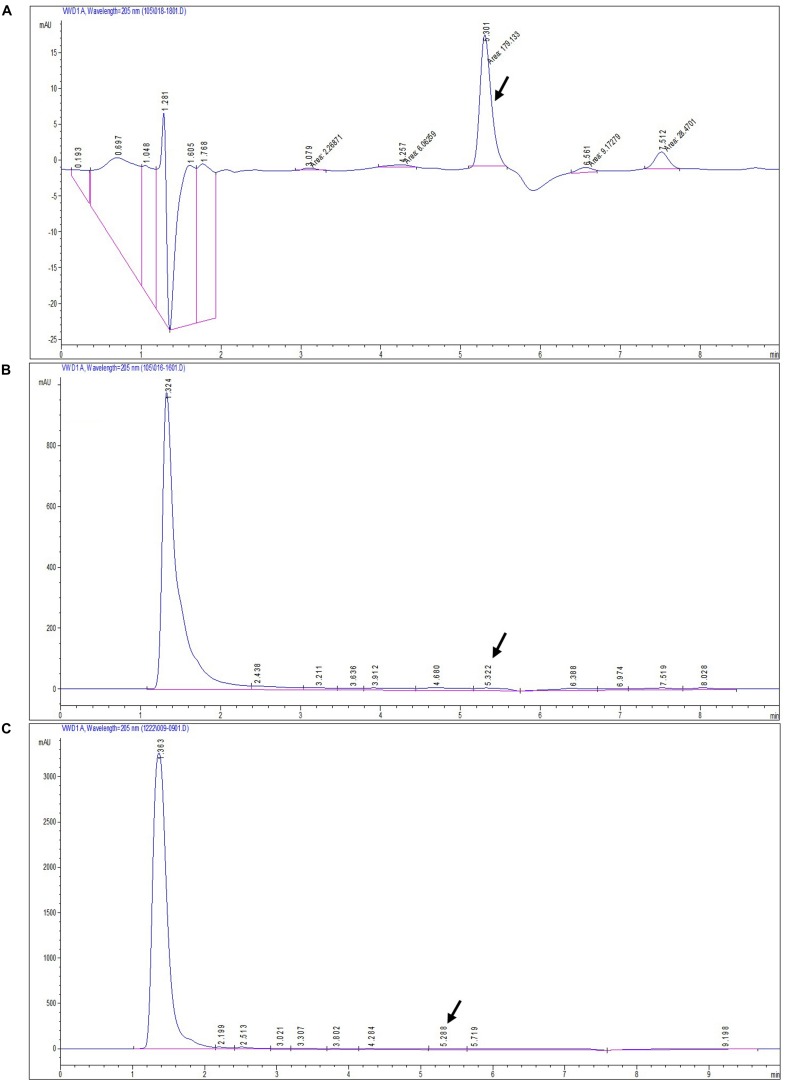
is the only plant that could produce the natural bioactive dendrobine. No other source of dendrobine has been found to date except from and via chemical synthesis. In this study, we aimed to examine the potential fungal endophyte isolated from stem segments using the molecular method and to detect dendrobine compound through high-performance liquid chromatography (HPLC), gas chromatography-mass spectrometry (GC-MS), and liquid chromatography with tandem mass spectrometry (LC-MS/MS) and their metabolite for their antibacterial activity. The potential dendrobine producer strain was recognized as based on molecular DNA sequencing and GenBank databases. The MD33 produced dendrobine and other compounds in a potato dextrose medium (PDM), as confirmed by HPLC retention time peak analysis. The HPLC results revealed that MD33 biomass showed a peak retention time of 5.28 ± 0.2 min, similar to wild stem dendrobine (5.32 ± 0.2 min) and standard chemical reference dendrobine (5.30 ± 0.2 min), indicating the presence of dendrobine in the fungal biomass. Results of GC-MS and LC-MS analysis revealed that MD33 produced the same molecular weight (263 in GC-MS and 264.195 in LC-MS) of dendrobine as compared with standard chemical reference dendrobine and dendrobine. Antibacterial activity data revealed that MD33 produced the strongest bactericidal activity against , , and species, and the diameter of the bacterial growth inhibition zone was 12 ± 0.2, 9 ± 0.2, and 8 ± 0.2 mm, respectively. To the best of our knowledge, this was the first study to investigate as a dendrobine producer, and the results revealed that was directly involved in the potential production of a similar bioactive compound to (dendrobine). In addition, the metabolite exhibited potent antibacterial activity and can be a potential strain for medical and industrial purposes.
是唯一能够产生天然生物活性石蒜碱的植物。迄今为止,除了从[具体来源]以及通过化学合成外,尚未发现其他石蒜碱来源。在本研究中,我们旨在使用分子方法检测从[植物名称]茎段分离出的潜在真菌内生菌,并通过高效液相色谱(HPLC)、气相色谱 - 质谱联用(GC - MS)和液相色谱 - 串联质谱(LC - MS/MS)检测石蒜碱化合物及其代谢产物的抗菌活性。基于分子DNA测序和GenBank数据库,潜在的石蒜碱产生菌株被鉴定为[菌株名称]。经HPLC保留时间峰分析证实,[菌株名称]MD33在马铃薯葡萄糖培养基(PDM)中产生了石蒜碱和其他化合物。HPLC结果显示,[菌株名称]MD33生物量的保留时间峰值为5.28±0.2分钟,与野生[植物名称]茎石蒜碱(5.32±0.2分钟)和标准化学参考石蒜碱(5.30±0.2分钟)相似,表明真菌生物量中存在石蒜碱。GC - MS和LC - MS分析结果表明,与标准化学参考石蒜碱和[植物名称]石蒜碱相比,[菌株名称]MD33产生的石蒜碱分子量相同(GC - MS中为263,LC - MS中为264.195)。抗菌活性数据显示,[菌株名称]MD33对[细菌名称1]、[细菌名称2]和[细菌名称3]物种产生最强的杀菌活性,细菌生长抑制圈直径分别为12±0.2、9±0.2和8±0.2毫米。据我们所知,这是首次研究[菌株名称]作为石蒜碱生产者,结果表明[菌株名称]直接参与了与[植物名称](石蒜碱)类似的生物活性化合物的潜在生产。此外,[菌株名称]代谢产物表现出强大的抗菌活性,可能是用于医疗和工业目的的潜在菌株。