Faculty of Sports Sciences, European University of Madrid, 28670 Villaviciosa de Odón, Spain.
Catapult Sports, Melbourne 3181, Australia.
Int J Environ Res Public Health. 2020 Mar 27;17(7):2256. doi: 10.3390/ijerph17072256.
The aim of this study is to describe the peak match demands and compare them with average demands in basketball players, from an external load point of view, using different time windows. Another objective is to determine whether there are differences between positions and to provide an approach for practical applications.
During this observational study, each player wore a micro technology device. We collected data from 12 male basketball players (mean ± SD: age 17.56 ± 0.67 years, height 196.17 ± 6.71 cm, body mass 90.83 ± 11.16 kg) during eight games. We analyzed intervals for different time windows using rolling averages (ROLL) to determine the peak match demands for Player Load. A separate one-way analysis of variance (ANOVA) was used to identify statistically significant differences between playing positions across different intense periods.
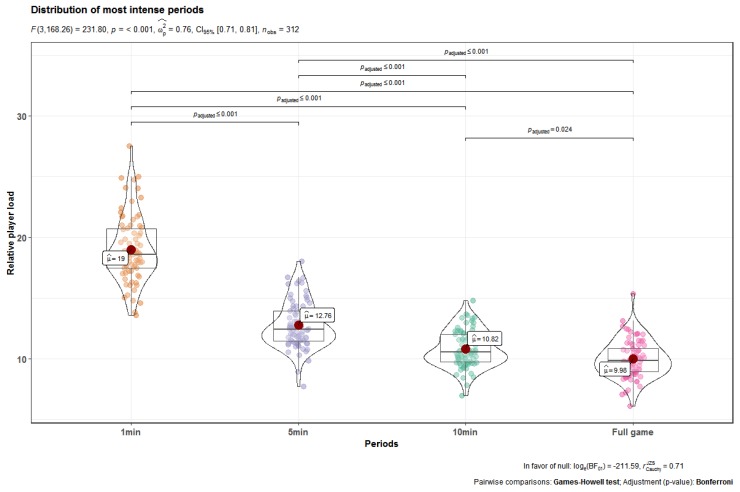
Separate one-way ANOVAs revealed statistically significant differences between 1 min, 5 min, 10 min, and full game periods for Player Load, F (3,168) = 231.80, η = 0.76, large, < 0.001. It is worth noting that guards produced a statistically significantly higher Player Load in 5 min ( < 0.01, η = -0.69, moderate), 10 min ( < 0.001, η = -0.90, moderate), and full game ( < 0.001, η = -0.96, moderate) periods than forwards.
The main finding is that there are significant differences between the most intense moments of a game and the average demands. This means that understanding game demands using averages drastically underestimates the peak demands of the game. This approach helps coaches and fitness coaches to prepare athletes for the most demanding periods of the game and present potential practical applications that could be implemented during training and rehabilitation sessions.
本研究旨在从外部负荷的角度描述篮球运动员的高峰比赛需求,并与平均需求进行比较,使用不同的时间窗口。另一个目的是确定位置之间是否存在差异,并提供一种实际应用的方法。
在这项观察性研究中,每个运动员都佩戴了微技术设备。我们从 12 名男性篮球运动员(平均 ± 标准差:年龄 17.56 ± 0.67 岁,身高 196.17 ± 6.71 厘米,体重 90.83 ± 11.16 公斤)在八场比赛中收集数据。我们使用滚动平均值(ROLL)分析不同时间窗口的间隔,以确定球员负荷的高峰比赛需求。使用单独的单向方差分析(ANOVA)来确定不同高强度时期的不同比赛位置之间的统计学显著差异。
单独的单向 ANOVA 显示,球员负荷在 1 分钟、5 分钟、10 分钟和整个比赛期间的差异具有统计学意义,F(3,168)=231.80,η=0.76,大,<0.001。值得注意的是,后卫在 5 分钟(<0.01,η=-0.69,中度)、10 分钟(<0.001,η=-0.90,中度)和整个比赛(<0.001,η=-0.96,中度)期间的球员负荷明显高于前锋。
主要发现是比赛中最激烈的时刻与平均需求之间存在显著差异。这意味着使用平均值来理解比赛需求会大大低估比赛的高峰需求。这种方法有助于教练和体能教练为运动员做好准备,以应对比赛中最具挑战性的时期,并提出可能在训练和康复期间实施的潜在实际应用。