Spanish Food Safety and Nutrition Agency, Alcala, 56, 28014Madrid, Spain.
Nutrition and Food Science department. Faculty of Pharmacy, Complutense University of Madrid, 28040 Madrid, Spain.
Nutrients. 2020 Apr 13;12(4):1078. doi: 10.3390/nu12041078.
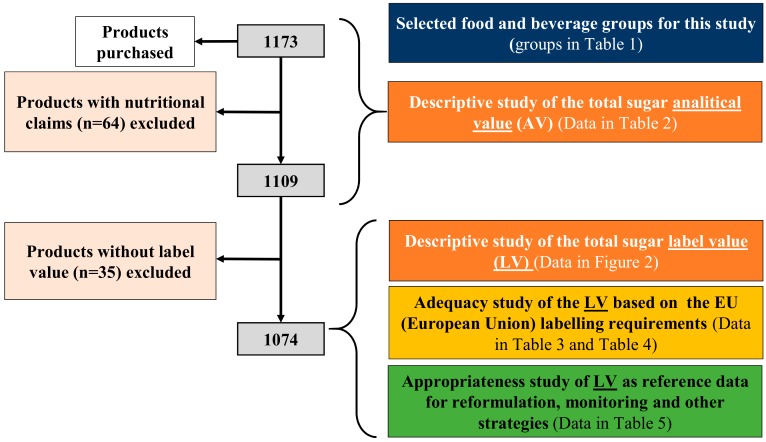
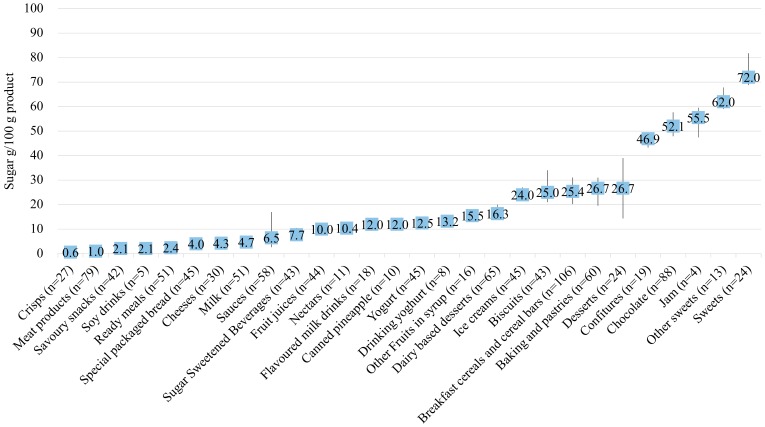
To reduce the sugar content of processed foods through reformulation, the first step is to determine the content of the largest sources of sugars in each country's diet. The aim of this work was to describe the sugar content in the most commonly consumed processed foods in Spain and to compare that sugar's labelling and laboratory analysis values (LVs and AVs, respectively) to confirm its adequacy. A sample of the 1173 most commonly consumed processed foods in Spain (28 groups; 77 subcategories) was collected. For each product, the total sugar content was compared according to its AV and LV. The median (25 -75 percentiles, interquartile range) sugar content by group was calculated for the total sample, and the groups were classified as "high sugar content" when this value was above 22.5 g/100g of product. The adequacy of the LV, according to the European Union (EU) tolerance requirements, was then evaluated, and each subcategory median was compared with the AV to determine its appropriateness via a median test for independent samples ( < 0.05). In total, 10 out of 28 groups presented high sugar content. Moreover, 98.4% of the products met the EU tolerance ranges. Finally, only one subcategory ("cured ham") presented significant differences between the AV and LV median values (0.4 g vs. 0.1 g sugar/100g, < 0.05). The groups of food products whose sugar content reduction could have the greatest impact on public health were identified. In addition, our study showed the high adequacy of LV with the EU labeling tolerance requirements, as well as the LV's appropriateness as a tool to implement actions aimed at reducing sugar consumption.
为了通过配方改革降低加工食品中的糖含量,第一步是确定每个国家饮食中糖的最大来源含量。本工作旨在描述西班牙最常消费的加工食品中的糖含量,并比较其标签和实验室分析值(分别为 LV 和 AV),以确认其是否合适。采集了西班牙最常消费的 1173 种加工食品(28 组;77 个亚类)的样本。对于每种产品,根据其 AV 和 LV 比较总糖含量。计算了总样本中每个组别的总糖含量中位数(25%-75%百分位数,四分位间距),并将该值高于 22.5 g/100g 产品的组归类为“高糖含量”。然后根据欧盟(EU)公差要求评估 LV 的适当性,并通过独立样本中位数检验比较每个亚类中位数与 AV,以确定其适当性(<0.05)。总共有 28 个组中的 10 个组呈现高糖含量。此外,98.4%的产品符合欧盟公差范围。最后,只有一个亚类(“腌制火腿”)的 AV 和 LV 中位数值存在显著差异(0.4 g 与 0.1 g 糖/100g,<0.05)。确定了可对公众健康产生最大影响的糖含量降低的食品产品组。此外,我们的研究表明 LV 与欧盟标签公差要求具有高度的适当性,以及 LV 作为实施旨在减少糖消耗的行动的工具的适当性。